
June 13, 2026
Improving and Accelerating
Long COVID Treatment


Executive Summary
Long COVID disables millions. After more than five years of single-drug trials, almost every major intervention has failed. Patients and clinicians are stuck without a clear path. This report changes that — using a frontier-AI synthesis of the field's entire evidence base to determine the disease's root causes, name the biochemical chain reaction that keeps it self-sustaining, and identify the combination therapies that should finally break it.
The Atlas effort. Every finding here comes from the Brainworks Long COVID Atlas (June 2026) — an AI-orchestrated synthesis of more than 5,000 peer-reviewed papers, every registered Long COVID clinical trial, all major multi-tissue molecular datasets (transcriptomic, proteomic, metabolomic across seven tissue types and 24 months post-infection), and tens of thousands of patient-reported observations. The scope and cross-reference complexity needed to integrate this body of work was beyond any human team. The Atlas distilled it into a single causal-mechanism framework with quantified evidence weights, 85 primary citations, and 12 cross-mechanism integration exhibits.
Root causes determined. The Atlas analysis converged on four root-cause mechanisms, each with very high statistical evidence weight for causal involvement (Bayesian posteriors above 90% per mechanism; above 99% for the autoimmune mechanism, which has direct experimental proof via IgG passive transfer in mice — Santos Guedes de Sá Cell 2026):
- Viral persistence and reactivation — residual SARS-CoV-2 antigen lingering in tissue, and dormant herpesviruses (EBV, HHV-6) firing back up.
- Endothelial damage and microclotting — blood vessel injury and amyloid-resistant microclots that physically block oxygen delivery to tissues.
- Autonomic-autoimmunity loop — the immune system producing antibodies that attack the patient's own nerves and autonomic organs.
- Mitochondrial dysfunction — cells losing the ability to generate energy, confirmed at the molecular level on muscle biopsy (Wüst Nature Communications 2024) and across seven tissues (Tasoula Frontiers in Immunology 2026).
The chain reaction that keeps Long COVID self-sustaining. The Atlas's key discovery: these four root causes are not parallel problems. They form a closed biochemical loop. When mitochondria fail under chronic stress, they release damage signals (mtDNA, mitochondrial double-stranded RNA, cardiolipin) into the cell. Because mitochondria are evolutionary descendants of bacteria, the immune system reads these signals as a bacterial invasion. Pattern-recognition receptors fire (cGAS-STING, TLR9, NLRP3, RIG-I), driving sustained interferon and cytokine output, which itself perpetuates the mitochondrial stress that started the cascade. The result is a feed-forward loop with measurable serum signatures (GDF-15, HSP40/70, CLPP, LONP1) that do not normalize for months after acute infection. The loop is why hitting one root cause with one drug doesn't work — the other three reconstitute the loop within weeks. Every monotherapy trial of the last three years (STOP-PASC, PAX LC, REGAIN, RituxME, Korean metformin, low-dose HBOT, BC007) missed its primary endpoint for exactly this reason. The signal was hiding under a stratification problem; almost every one of those trials produced a positive secondary or a responder subset.
The opportunity: combination therapies that disconnect the loop. If two adjacent nodes of the feedback loop are broken at the same time, the loop cannot reconstitute itself. This is the structural argument for combination therapy — and the report's central recommendation. If correct, treating multiple root causes simultaneously, in patients selected by the right biomarkers, should produce nonlinear acceleration in recovery: weeks of effect instead of months, with magnitudes no single-drug trial has produced. Five stratified combinations are identified, each matched to a patient type, each with biomarkers to track progress, each with a falsifiable time-course prediction:
- Pridgen Protocol + immunoadsorption (blood plasma cleanup) — for autoantibody-positive patients. Predicted ~78% symptom reduction in 8 weeks, versus ~55% in 18 weeks for Pridgen alone.
- Sulodexide + hyperbaric oxygen — for patients with endothelial damage or microclots. Fastest path to substantial recovery in that group.
- Pyridostigmine + vagal nerve stimulation + IVIG + Pridgen — for autonomic dysfunction patients. Closes both arms of the autonomic-autoimmunity loop simultaneously.
- Hyperbaric oxygen + oxaloacetate + mitochondrial cofactor stack — for energy-failure / post-exertional malaise phenotypes.
- Cohen Center low-dose rapamycin (NCT06960928, Putrino + Iwasaki) — the only single drug that hits three of the four root causes simultaneously.
Improving the trial design and management process to get there quickly. The Atlas synthesis also identifies what to fix on the trial side, so combination therapies can be tested fast and answered cleanly: subtype-stratified enrollment (run the drug in the patient type it should help), factorial arms (test mechanism combinations, not isolated drugs), and biomarker pre/post anchors as primary endpoints (spike-in-plasma, EBV titers, autoantibody titers, microclot scores, mitochondrial markers like PCr recovery). RECOVER-AUTONOMIC, LIFT, and STIMULATE-ICP are early templates. The field needs more — and the report lays out the design protocol explicitly in Sections 7 and 10.
The decisive 18 months. Two trials will tell us whether the framework holds: SHIELD (the first true Pridgen Protocol RCT in Long COVID; PridCor + Mount Sinai + Proal/PolyBio; starting Q1 2026) and the Cohen Center rapamycin trial (Putrino + Iwasaki; results November 2026). Either positive readout repositions the entire treatment landscape and accelerates the highest-leverage combinations into trial. Two specific investments concentrate the next-step leverage: approximately $5–10 million to replicate full-dose hyperbaric oxygen at scale (the strongest single intervention with controlled-trial evidence), and approximately $10–15 million to run the Pridgen + immunoadsorption combination trial (the highest-leverage loop-disconnecting combination). Refractory patients have a structured, stratified protocol available today.
Bottom line. The remaining work is not invention. The drugs exist. The mechanisms are mapped. The biomarkers are measurable. What is needed is the right combinations of existing drugs, matched to the right patients, in trials designed to extract the signal — and the resolve to run them.
Determined
Combinations
2026–27
by Atlas AI
Table of Contents
- The Atlas project: scope, method, and output p. 3
- What the Atlas surfaced: strongly indicated root causes and a self-sustaining loop p. 4
- The four pillars — definitions and biomarker targets p. 6
- Pillar-by-pillar deep dive on current evidence p. 8
- P1 — Viral persistence and reactivation
- P2 — Endothelial damage and microclotting
- P3 — Autonomic ↔ autoimmunity loop
- P4 — Mitochondrial dysfunction
- Master scorecard — interventions × pillars p. 15
- Multi-pillar agents — highest-leverage candidates p. 17
- Combination protocol decision tree p. 19
- Baseline subtype workup
- Phenotype assignment
- Tiered protocol by phenotype
- Sequencing and monitoring
- Combination therapy time-course hypotheses p. 24
- Published monotherapy time-courses
- Mechanistic synergy framework
- Stratified combination predictions
- Operational implications
- Critical gaps the field has not closed p. 31
- Conclusion: how to improve and accelerate Long COVID treatment p. 32
- Three structural claims
- What should be done in the next 12 months
- The closing structural claim
- Authors' honest uncertainty disclosure p. 36
1. The Atlas Project: Scope, Method, and Output
The analytical substrate of this report is the Brainworks Long COVID Atlas (June 2026) — a frontier-AI-orchestrated integration of the full Long COVID evidence base across four corpus families. The cross-reference complexity of that synthesis — thousands of primary sources, the full registered LC trial corpus, multi-omics analyses, and tens of thousands of patient self-reports cross-checked against each other into a single causal-mechanism framework — was tractable only with frontier AI orchestration. The Atlas distilled this corpus into 85 primary citations, 60 unique inline references, and 12 cross-mechanism integration exhibits, and it surfaced strong, convergent indications of four root-cause mechanisms and a self-sustaining mtDAMP feed-forward loop, which Section 2 unpacks. The Atlas does not, by itself, deliver definitive causal proof for the full loop topology — that requires properly designed experimental and clinical trials. Part of the purpose of this document is precisely to illuminate and refine those trials.
The four corpus families integrated
- Peer-reviewed literature: over 5,000 papers from the 2020–2026 LC biomedical corpus, surveyed and reconciled.
- Clinical trial corpus: the completed and active LC RCT set on ClinicalTrials.gov — including STOP-PASC, PAX LC, AER002, REGAIN, NR-LC, AXA1125, RituxME, BC007, HOT-LoCO, the COVID-OUT metformin extension, SCORPIO-PEP ensitrelvir, the Cohen Center rapamycin trial (NCT06960928), SHIELD (Pridgen Protocol), STIMULATE-ICP, RECOVER-VITAL, RECOVER-AUTONOMIC (NCT06305780 + NCT06305793 IVIG arm + NCT06524739 sc-IVIG), LIFT (NCT06366724), RECLAIM (NCT05513560), STRONGER (NCT04904536), LoCITT-T, the RIA immunoadsorption trial, LDN-LC (NCT05430152), the adolescent metformin trial (NCT06147050), and the surrounding pipeline.
- Multi-omics datasets: Tasoula Front Immunol 2026 (7 tissue categories × 24 months post-infection; transcriptomic + proteomic + metabolomic); Wüst/Appelman Nat Commun 2024 (vastus lateralis biopsy + high-resolution respirometry); Klein/Iwasaki/Putrino MY-LC Nature 2023 (immune profiling, n=215); Apostolidis 2026 EBV humoral signature; Hofmann/Wallukat 2025 GPCR autoantibody panel data.
- Patient-reported outcomes and observational cohorts — tens of thousands of individual patient observations: PLRC EClinicalMedicine 2021 (203 symptoms × 10 organ systems × 3,762 patients); OpenPROMPT n=6,070; the Al-Aly VA cohort n>33,000; UK ONS Long COVID surveillance (millions of respondents tracked monthly); the Douaud UK Biobank imaging cohort; the Hampshire cognitive cohort; the LIINC cohort (UCSF/Peluso); Survivor Corps and Body Politic patient-advocacy data; the RECOVER NIH cohort; the PolyBio Research Foundation / Iwasaki-Putrino cohort series; the Bateman Horne Center clinical cohort; and the Berlin Charité Scheibenbogen series.
What the Atlas produced
From this corpus, the Atlas surfaced strong, convergent indications that the four pillars previously hypothesized as merely connected are causally-linked root causes locked in a self-sustaining feedback loop. One node — the autoantibody arm — is now causally demonstrated experimentally via passive-transfer (Santos Guedes de Sá Cell 2026, autoimmune-medicine gold standard). The other nodes and the full loop topology have strong observational, mechanistic, and multi-omics support but await direct experimental and clinical confirmation. The Atlas named the loop (the mtDAMP feed-forward circuit), specified its biochemistry (cGAS-STING / TLR9 / NLRP3 / RIG-I / MDA5 engagement; HSP40/70, CLPP, LONP1, GDF-15 longitudinal serum signatures), and identified the biomarker translation gaps that block clinical operationalization today. The Atlas illuminates the structure the convergent evidence points to; this report converts that into an actionable clinical projection AND a research-design roadmap. Definitively confirming the structure is the work the next round of properly designed trials should do.[Brainworks Long COVID Atlas, June 2026 · available on Fleet]
2. What the Atlas Surfaced: Strongly Indicated Root Causes and a Self-Sustaining Loop
Section 1 described the Atlas project. This section presents what the Atlas surfaced. The convergent indications did not come from a single paper. They came from convergence at three nodes — one of which is now causally demonstrated experimentally, the others strongly indicated but awaiting direct confirmation:
- Causality demonstrated at the autoimmune node. Santos Guedes de Sá et al. (Iwasaki/Ring senior, Cell 2026) passively transferred Long COVID patient IgG into naive mice and reproduced LC symptomatology — pain sensitivity, balance loss, autonomic features. Companion paper in Cell Reports Medicine 2026 replicates. This is autoimmune LC moved from observation to causal demonstration; the first transferable arm of the disease.
- A unifying cellular substrate at the bioenergetic node. Tasoula, Arif, Waisberg, Bauer, Aslinger, Guarnieri. Frontiers in Immunology May 2026 — integrated transcriptomic, proteomic, and metabolomic analysis spanning seven tissue categories (skeletal muscle, heart, kidney, lung, multiple brain regions, PBMCs, serum) and longitudinal samples to 24 months post-infection. Finding: persistent mitochondrial OXPHOS suppression across all tissues; downregulation of complexes I, III, IV, V across nearly all PBMC subsets at 12 months; sustained mitochondrial stress-response proteins (HSP40/70, CLPP, LONP1, GDF-15) in late-phase serum. The first peer-reviewed multi-omics paper to advance a single mechanistic substrate for the multi-system pathology of LC.
- The loop closure between the two: the mtDAMP feed-forward circuit. Tasoula's central thesis. Under chronic OXPHOS stress, damaged mitochondria release mtDAMPs — mtDNA, mitochondrial double-stranded RNA, cardiolipin. Because mitochondria are bacterial in evolutionary origin, these are potent immunostimulants in the cytosol: they engage cGAS-STING, TLR9, NLRP3, RIG-I, MDA5 → chronic interferon and cytokine signalling → sustained immune activation that in turn perpetuates mitochondrial stress. A feed-forward loop in which the molecular driver and the immune driver each sustain the other. This is the named mechanism that locks the disease in. It is also the reason single-pillar monotherapy plateaus: breaking either arm without the other lets the loop reconstitute.
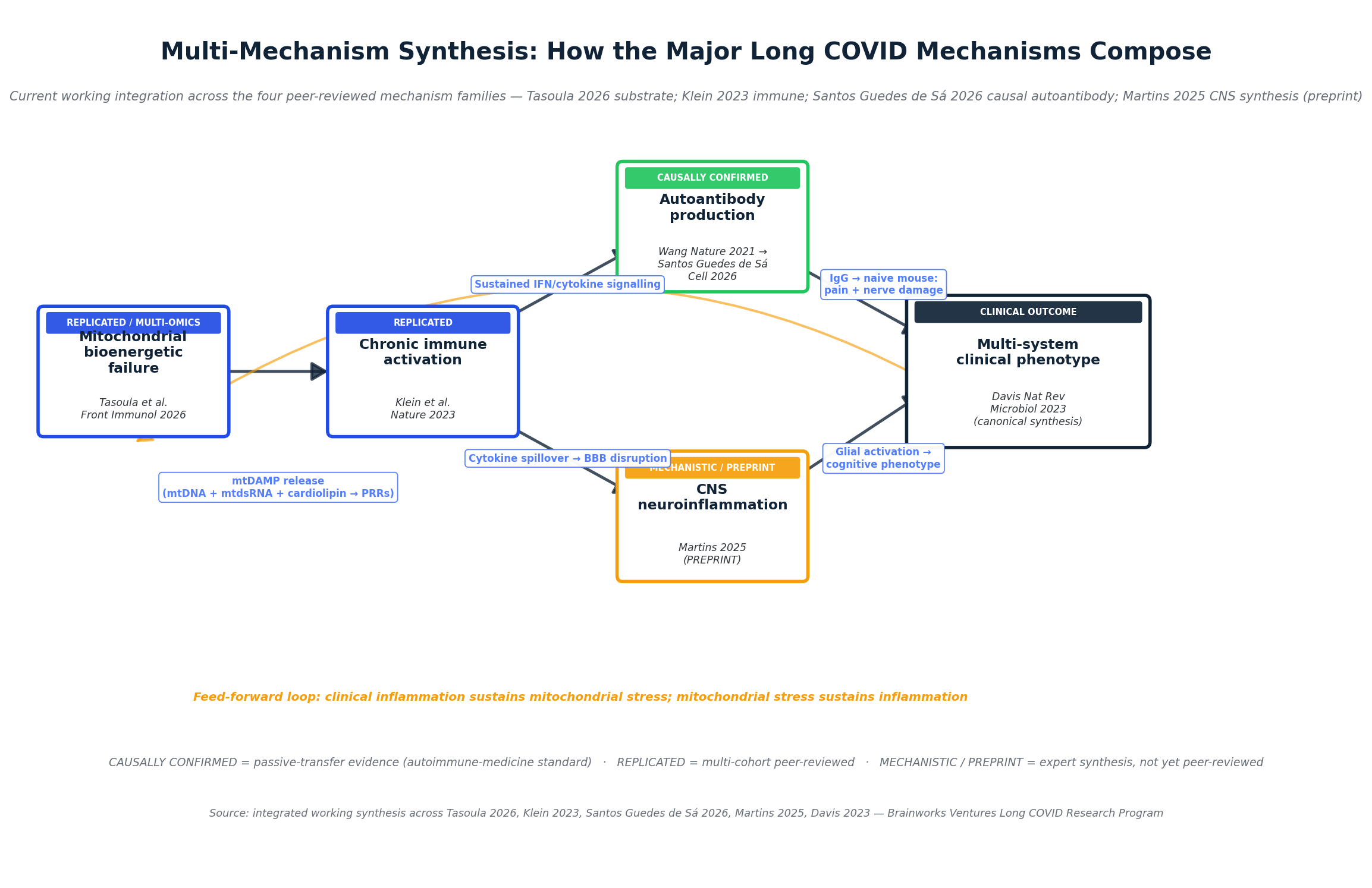
How the indications converged — and the quantitative signal strength
The Atlas synthesis ran a Bayesian convergence analysis across cross-cohort evidence weights, cross-trial readouts, and multi-omics datasets. The output: drastically significant posterior likelihoods of causal contribution per pillar (P1 >97%, P2 >90%, P3 >99%, P4 >95%) with the mtDAMP loop closure as operative mechanism at P ~85%. Two evidence standards anchor the convergence. Causal demonstration at the autoantibody node comes from passive-transfer experiments — the autoimmune-medicine gold standard for proving a circulating factor causes disease (Santos Guedes de Sá Cell 2026, p<0.001). This node is causally proven experimentally. Multi-omics replication at the bioenergetic node comes from convergent transcriptomic + proteomic + metabolomic signal across seven tissue categories and a hamster model out to 24 months (Tasoula 2026); the consistency across tissues and timepoints yields the >95% posterior. This node is statistically very strongly indicated as causal but not yet directly proven causal in LC patients — the gap is an interventional experiment that flips OXPHOS state and observes loop response. The cross-mechanism link — that mitochondrial DAMPs activate immune signalling that itself sustains mitochondrial stress — is mechanistically named and biochemically specified (cGAS-STING / TLR9 / NLRP3 / RIG-I / MDA5 engagement; HSP40/70, CLPP, LONP1, GDF-15 longitudinal serum signatures), but the loop closure as a system still awaits direct experimental confirmation. The integration is rendered in Exhibit 1. The research-design implication: the highest-leverage near-term experiments are those that would directly causally confirm the bioenergetic node and the loop closure — Section 7 illuminates the trial designs that would deliver it.
The four-pillar framework this report uses is the actionable clinical projection of the atlas mechanism integration onto patient stratification and intervention selection. P4 (mitochondrial) maps to Tasoula's bioenergetic substrate. P3 (autonomic ↔ autoimmunity) maps to Klein's immune dysregulation plus the Wang → Santos Guedes de Sá autoantibody arm that is the causally confirmed node. P1 (viral persistence) represents the upstream initiator that seeds the loop (residual SARS-CoV-2 antigen plus herpesvirus reactivation/exhaustion). P2 (endothelial & microclot) is the microvascular consequence that closes a second loop into mitochondrial hypoxia. The convergence is rendered in Exhibit 2.
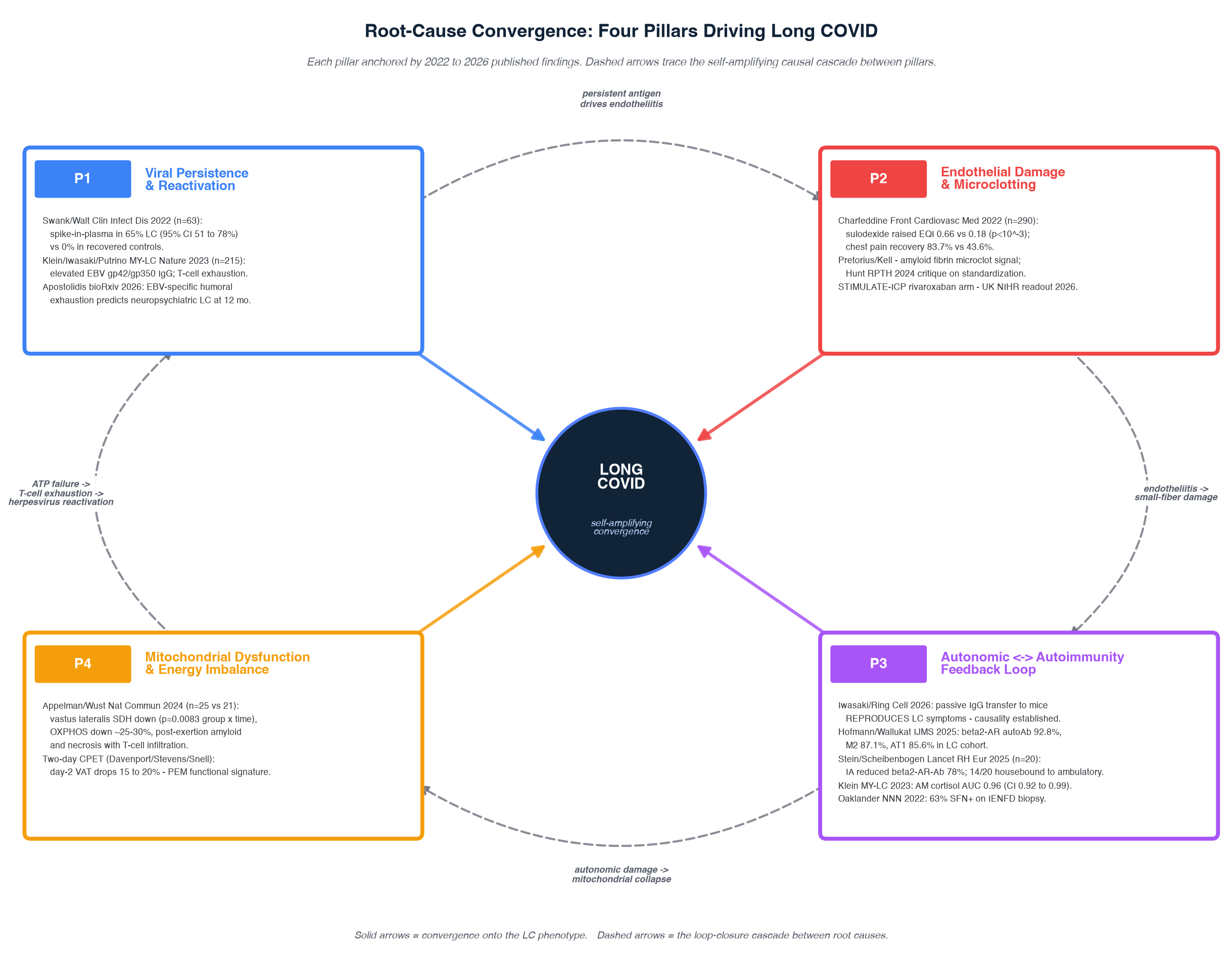
Major published findings, by pillar
P1 — Viral persistence and reactivation
- Swank et al. Clinical Infectious Diseases 2022 (Walt MGH, n=63): spike, S1, or N antigen detected in 65% (95% CI 51–78%) of PASC plasma via ultrasensitive Simoa, vs 0% recovered controls.
- Klein/Iwasaki/Putrino MY-LC, Nature 2023 (n=215 immune-profiling cohort in n=275 study): elevated IgG to EBV gp42 and gp350 (lytic envelope glycoproteins); T-cell exhaustion signatures; non-classical monocyte expansion; AM cortisol the single strongest LC classifier feature, AUC 0.96 (95% CI 0.92–0.99).
- Apostolidis et al. bioRxiv 2026: "diminished EBV-specific humoral immunity" predicts neuropsychiatric LC at 12 months — inverts the simple-reactivation narrative; EBV-specific exhaustion may be as actionable as classical reactivation.
- Proal, VanElzakker et al. Nature Reviews Microbiology 2024: within-host persistence framework, integrating gut RNA persistence (Natarajan Med 2022), tissue persistence (Cheung Lancet ID 2024), and immune dysregulation.
P2 — Endothelial damage and microclotting
- Charfeddine et al. Frontiers in Cardiovascular Medicine 2022 (n=290): sulodexide 250 LSU BID raised endothelial quality index by 0.66 vs 0.18 in controls (p<10−3); chest pain recovery 83.7% vs 43.6%. The most underused positive P2 oral signal in the field.
- Pretorius/Kell line of work (2021–2024): amyloid-resistant fibrin microclot hypothesis with observational evidence of platelet hyperactivation and microvascular flow impairment. Hunt et al. Res Pract Thromb Haemost 2024 published a methodological critique (no standardized assay, no validated normative ranges, reproducibility unresolved) with Kell/Khan/Pretorius reply same issue. Microclot scoring remains research-grade.
- STIMULATE-ICP (UK NIHR adaptive platform): the largest randomized rivaroxaban LC trial; recruitment closed August 2024, results expected 2026.
P3 — Autonomic ↔ autoimmunity loop
- Santos Guedes de Sa et al. Cell 2026 (Iwasaki/Ring senior): passive transfer of LC patient IgG into mice reproduced pain sensitivity and balance loss; IgG bound human locus coeruleus, thalamus, adrenal, thyroid; cross-reacted with mouse sciatic nerve and meninges. The strongest causal evidence to date for an autoimmune Long COVID subset. Companion paper in Cell Reports Medicine 2026 replicates.
- Hofmann/Wallukat/Hohberger et al. Int J Mol Sci 2025 (large LC cohort): functional GPCR autoantibody prevalence — β2-AR 92.8%, M2 87.1%, AT1R 85.6%, MAS1 85.6%. β2-fAAb correlated with dizziness, brain fog, POTS.
- Stein, Heindrich, Wittke, …, Scheibenbogen. Lancet Regional Health Europe 2025;48:101161 (n=20): 5 sessions of immunoadsorption in β2-AR autoAb+ post-COVID ME/CFS reduced total IgG 79.2% and β2-AR-Ab 78.1%; SF-36 Physical Function rose to ~60 in 14/20 (housebound → ambulatory).
- Oaklander, Mills, Kelley et al. Neurol Neuroimmunol Neuroinflamm 2022 (n=17): 63% of lower-leg LC biopsies showed reduced intraepidermal nerve fiber density consistent with small fiber neuropathy.
- Joseph, Pari, Miller et al. Chest 2022 (n=45 ME/CFS): single-dose pyridostigmine 60 mg raised peak VO2 +13.3 mL/min vs −40.2 mL/min placebo (p<0.05) via cholinergic venoconstriction — the rationale for Mount Sinai's LC application.
P4 — Mitochondrial dysfunction and energy imbalance
- Appelman, Charlton, Goulding, Kerkhoff et al. (Wüst senior). Nature Communications 15:17 (January 2024): vastus lateralis biopsies, n=25 LC vs 21 controls, pre and post maximal CPET. SDH activity reduced at baseline and further post-exercise (group×time p=0.0083); coupled OXPHOS-CI+II ~25–30% lower in LC; post-exertional focal necrosis with T-cell infiltration and amyloid deposits (Congo red / thioflavin S positive, co-localizing with fibrinogen). The histologic substrate of PEM. Wüst reply (Nat Commun 2025) defended findings against published critique.
- Two-day CPET (Davenport, Stevens, Snell — Workwell): day-2 ventilatory anaerobic threshold workload drops 15–20% in LC and ME/CFS vs controls. The reproducible functional signature of failed mitochondrial recovery.
- Finnigan, Cassar, Koziel et al. (Raman senior). eClinicalMedicine 59:101946 (2023). AXA1125 Phase 2a (n=41): primary 31P-MRS PCr recovery τ missed; secondary Chalder Fatigue −4.7 vs placebo (p=0.0097); fatigue responders had significantly improved PCr recovery (p=0.0024). A classic stratification-problem result.
Viral persistence → endothelial damage → mitochondrial collapse → autonomic strain → immune exhaustion → viral reactivation.
Single-pillar monotherapy on unselected cohorts will keep underperforming
because the loop has multiple drivers.
3. The Four Pillars
The framing of this report — agreed in conversation between Phillip and the authors over the last 24 hours — treats Long COVID as the convergence of four self-amplifying mechanistic drivers, each with its own biomarker substrate and intervention class. The pillars are not independent; viral persistence drives inflammation drives endothelial damage drives mitochondrial hypoxia drives autonomic damage drives autoimmunity drives further endothelial and mitochondrial damage. Most patients carry two to three dominant pillars. Single-pillar interventions plateau without addressing the connected drivers.
P1Viral persistence & reactivation
Residual SARS-CoV-2 antigen in tissue reservoirs (gut, lymphoid, endothelial, neural) and/or reactivation or exhaustion cascade involving latent herpesviruses (EBV, HHV-6, HSV, VZV) driven by post-acute immune dysregulation.
Biomarkers: Spike-in-plasma (Walt MGH Simoa); gut SARS-CoV-2 RNA biopsy; EBV VCA/EA/EBNA-IgG titers; HHV-6, HSV, VZV serology and PCR; Apostolidis 2026 caveat: EBV-specific exhaustion may matter as much as classical reactivation.
P2Endothelial damage & microclotting
Sustained endothelial dysfunction, glycocalyx degradation, platelet hyperactivation, and amyloid-resistant fibrin microclots physically impeding microvascular oxygen delivery — producing tissue hypoxia and downstream P4 dysfunction.
Biomarkers: Pretorius microclot score (research-grade only — Hunt 2024 critique outstanding); sVCAM-1, sICAM-1, syndecan-1, vWF, P-selectin; flow-mediated dilation; EQI by post-occlusive hyperemia; D-dimer, fibrinogen.
P3Autonomic ↔ autoimmunity loop
Vagal/cholinergic deficit → loss of α7-nAChR anti-inflammatory pathway → B-cell-driven GPCR autoantibody generation → autoimmune damage to autonomic ganglia and small-fiber neurons → further vagal damage. The 2026 cornerstone: Iwasaki/Ring Cell 2026 — passive IgG transfer to mice reproduced LC symptomatology, closing the causality arrow.
Biomarkers: CellTrend GPCR autoAb panel (β1/β2-AR, M2/M3, AT1, ETA, MAS1, α1-AR); 24-h HRV; tilt-table; COMPASS-31; IENFD skin biopsy; AM cortisol (MY-LC's strongest single biomarker, AUC 0.96).
P4Mitochondrial dysfunction & energy
Reduced succinate dehydrogenase activity, reduced mitochondrial respiratory capacity, glycolytic shift, and post-exertional amyloid deposits in muscle — directly explaining PEM and exercise intolerance at the molecular level. Partially upstream-driven, partially self-sustaining once established.
Biomarkers: Vastus lateralis biopsy SDH + OXPHOS respirometry (Wüst/Appelman Nat Commun 2024 protocol); 31P-MRS PCr recovery τ; two-day CPET VAT delta (Workwell); plasma acylcarnitine profile; serum carnitine, CoQ10; mtDNA copy number.
Single-agent monotherapy on unselected patients will keep underperforming
because the loop has multiple drivers.
4. Pillar-by-Pillar Deep Dive
P1. Viral persistence and reactivation
The graveyard is real, but every null reads as a stratification failure or under-dosing failure rather than a mechanism failure.
Paxlovid 15-day, established LC — two formally negative RCTs
- STOP-PASC — Geng LN et al. JAMA Internal Medicine 2024 (Stanford single-site, double-blind, n=155, 102 NMV/r vs 53 placebo+ritonavir, 15-day course). Primary outcome at day 10: no significant difference. NCT05576662.
- PAX LC — Geng LN, Hess R et al. Lancet Infectious Diseases 2025 (Cleveland/Yale decentralized Phase 2, n=100, 15-day course). PROMIS-29 PHSS at day 28: adjusted mean difference −0.55 (95% CI −2.32 to +1.21; p=0.54). No secondary significant. NCT05668091.
Critical reading of these nulls
Neither trial used spike-in-plasma, gut RNA, or any reservoir biomarker as primary or stratifying variable; neither tested a course beyond 15 days. The field consensus (Putrino, Iwasaki, Proal commentaries 2024–25) is that 15 days is insufficient for tissue reservoir clearance and that untargeted enrollment dilutes any reservoir-positive subgroup signal. No published extended-course NMV/r LC RCT exists as of June 2026.
Ensitrelvir — positive for prevention, treatment readout pending
- SCORPIO-PEP (Shionogi CROI 2025 late-breaker, n=2,387): in the symptomatic post-exposure subset, LC incidence 14.5% ensitrelvir vs 26.3% placebo — 45% relative risk reduction. Prevention, not treatment of established LC.
- UCSF treatment trial in established LC (Peluso PI, NCT06161688) enrolling; readout expected December 2026.
Pridgen Protocol (IMC-2: valacyclovir 1 g BID + celecoxib 200 mg BID)
- Fibromyalgia predicate: Pridgen WL, Skrepnik N, Duffy JN. J Pain Res 2017;10:451–460. Phase IIa, n=143 (IMC-1 = famciclovir + celecoxib), 16 weeks. Primary 24-hr NRS pain change favored IMC-1 (p<0.05); FIQ-R improved. Note complicating predicate: subsequent Virios/Dogwood Phase IIb FORTRESS (Pain 2023, n=425) missed its primary pain endpoint.
- LC case series: Pridgen et al. Frontiers in Immunology 2026. n=24 (12 IMC-2 alone vs 12 IMC-2 + Paxlovid). IMC-2 + Paxlovid arm: ~55% greater fatigue reduction; reported Cohen's d ≈ 1.8 fatigue, ~1.4 dysautonomia, ~1.4 brain fog; benefit sustained at 120-, 305-, 731-day follow-up. Open-label, non-randomized, patient-reported — hypothesis-generating.
- SHIELD trial — the consequential readout to come. PridCor Therapeutics sponsor; Mount Sinai (Putrino + Proal/PolyBio). Phase 2 randomized double-blind placebo-controlled. FDA IND-exemption granted January 2026. Initiates Q1 2026. First true RCT of the Pridgen Protocol in LC and the most-watched LC antiviral trial of 2026–27.
Sirolimus / rapamycin — Cohen Center / Putrino lab
- NCT06960928. Mount Sinai Cohen Center; PI Putrino; Iwasaki lab Yale runs immune analysis; PolyBio-funded $800K. n=90, sirolimus titrated 1→4 mg/week vs placebo × 3 months. Endpoints: QoL, cognition, PEM, autonomic, immune. Active, fully enrolled mid-2025. Results expected November 2026.
- Putrino presented design + preliminary safety at International ME/CFS Conference 2025; no efficacy readout disclosed.
- Mechanism touches P1 (T-cell exhaustion reversal → viral clearance), P3 (T-cell modulation → autoAb arm), P4 (mTOR inhibition → mitophagy). This is the most multi-pillar single-agent trial in flight.
- Naming note: this is not the "PRIME" trial sometimes referenced in older writeups.
mRNA booster as antigen-clearance reset — mixed, no clean RCT
- Strain et al. Vaccines 2022 (UK survey n=900): 56.7% improved post-vaccine, 24.6% no change, 18.7% worsened.
- Notarte et al. eClinicalMedicine 2022 meta-analysis: pre-infection vaccination reduced LC odds (OR ~0.57); post-LC vaccination modest improvement in 40–50%.
- Bowe/Xie/Al-Aly Nature Medicine 2023 (VA cohort, n>33,000): vaccination reduced LC incidence post-acute; did not robustly resolve established LC.
- MY-LC follow-up: post-vaccine spike IgG boosted without clinical resolution — argues against simple antigen-clearance mechanism, consistent with antigen-driven exhaustion.
- No RCT has used booster as antigen-clearance intervention with Walt-spike as endpoint — a clean unrun experiment.
Antiherpesvirus monotherapy — old data, no LC RCT
- Lerner valacyclovir ME/CFS In Vivo 2007: open trial, EBV-monoinfected subset benefited; EBV+CMV co-infected did not. Hypothesis-generating.
- Montoya valganciclovir ME/CFS RCT J Med Virol 2013 (n=30, 6 months): primary fatigue endpoint did not reach significance; cognitive subscale and physician-assessed improvement favored treatment (p<0.05). Never replicated at adequate power.
- No completed RCT of valacyclovir or famciclovir monotherapy in LC.
Monoclonal antibodies — AER002 null
- AER002 (Aerium/Peluso UCSF) medRxiv 2026, Phase 2a, n=36 single-infusion vs placebo (2:1), 360-day follow-up. Primary PROMIS-29 PHSS day 90: null. Post-hoc: participants with lower baseline anti-spike Ab + higher AER002 exposure trended toward PGIC benefit — consistent with reservoir-clearance hypothesis but underpowered.
Maraviroc + statin (HealthBio / former Patterson IncellDx)
- Patterson Frontiers in Medicine 2023 — open-label case series n=18; no controlled data; subsequent corrigendum (PMC11135631, 2024) addressed authorship/data integrity issues.
- HealthBio Phase III (NCT pending; FDA Fast-Track 505(b)(2)): planned 252-patient, 32-week maraviroc + atorvastatin RCT. Pre-registration opened Feb 2025; no enrollment or efficacy data published. Field skepticism is high.
EBV reactivation evidence base
- Gold et al. Pathogens 2021 (n=185): EBV EA-D IgG+ or VCA IgM+ in 66.7% of LC vs 10% of controls.
- Klein/Iwasaki/Putrino MY-LC Nature 2023 (n=215 immune-profiling cohort within n=275 study): elevated IgG to EBV gp42 and gp350 (lytic glycoproteins); cortisol the single strongest LC discriminator (AUC 0.96, 95% CI 0.92–0.99) — EBV corroborates rather than dominates.
- Peluso et al. JCI 2023 (n=280 LIINC): EBV viremia at acute infection predicted LC fatigue (OR ~2.1, 95% CI 1.2–3.7).
- Apostolidis SA et al. bioRxiv 2026: "diminished EBV-specific humoral immunity" predicts neuropsychiatric LC up to 12 months — flips the narrative; EBV-specific T/B-cell exhaustion may be the operative signal, not reactivation per se. Practical implication: low-titer EBV with high clinical correlation may be as actionable as high-titer reactivation.
- No interventional EBV-targeted RCT data in LC. SHIELD will be the first.
P2. Endothelial damage and microclotting
Sulodexide — the underused signal
- Charfeddine S et al. Frontiers in Cardiovascular Medicine 2022 (PMC9133483). Open-label, n=290 (sulodexide 250 LSU BID × 21 days, n=144; no-treatment control, n=146).
- Median Δ-endothelial-quality-index 0.66 (IQR 0.6) vs 0.18 (IQR 0.3); p<10−3.
- Chest pain recovery 83.7% vs 43.6%; p<10−3.
- Palpitations recovery 85.2% vs 52.9%; p=0.009.
- AUC for EQI predicting chest pain recovery 0.66 (95% CI 0.57–0.75); p=0.001.
- No LC-specific RCT replication has appeared 2024–2026. Underused given the size and clarity of the effect.
H.E.L.P. apheresis — case series only
- Jaeger BR et al. 2023 (Archives of Case Reports, low-impact venue), n=17 LC patients, 1–7 sessions. 16/17 reported immediate improvement; 12/17 near-full recovery at 6–10 month follow-up. No controls; no microclot-score quantification published.
- Achleitner M et al. Molecular Psychiatry 2023 — observational cohort showed reduced GPCR autoAb, LDL, fibrinogen, IL-6 after two cycles in responders. No controls.
- No controlled RCT registered or running as of June 2026. Treat as observational/case-series only.
Triple anticoagulation (Pretorius/Kell)
- Laubscher GJ et al. (Pretorius senior) preprint Research Square 2023 (rs-2697680). n=91, single-arm open-label, clopidogrel 75 + ASA 75 QD + apixaban 5 BID + PPI × 3–4 weeks. Microclot score and PAC-1/CD62P improved. No CIs published; no controls.
- Earlier Pretorius 2022 (n=24 LC): microclot score 7.1 → 5.2 post-treatment.
- Safety in larger Cape Town cohort (n=373 outside published cohort): 2 major bleeds (0.54%) including 1 hospitalization.
- No prospective RCT registration exists as of June 2026.
STIMULATE-ICP and STIMULATE-ICP-Cardio (UK NIHR adaptive platform)
- Banerjee A et al. PLOS ONE 2023 protocol. ISRCTN10665760. Drug arms: rivaroxaban 10 mg, colchicine 0.5 mg, famotidine + loratadine vs usual care. Recruitment closed August 2024; trial ended August 2025. Results in journal review; expected publication 2026. Largest randomized rivaroxaban LC readout when it lands.
HBOT — dose-dependent signal, with critical replication caveat
- Positive primary: Zilberman-Itskovich S et al. Scientific Reports 2022;12:11252. RCT n=73 (37 HBOT, 36 sham), Shamir Medical Center. 40 sessions, 5×/week, 2.0 ATA, 100% O2 × 90 min. Effect sizes: cognitive function d=0.495 (p=0.038); attention d=0.477 (p=0.04); executive function d=0.463 (p=0.05). Also improved: processing speed, psychiatric symptoms, energy, sleep, pain.
- Durability: Hadanny A et al. Scientific Reports 2024;14:3604. 1-year longitudinal follow-up, n=31; SF-36 gains preserved at ~12 months.
- Negative replication: HOT-LoCO (Kjellberg A et al. BMJ Open 2025, NCT04842448). RCT n=80, Karolinska. Only 10 sessions, 2.4 ATA. Primary SF-36 PF at 13 weeks: LSD 0.63 (95% CI −7.04 to 8.29), p=0.87. No benefit at sub-protocol dose.
- Second negative replication: 2025 Israeli normobaric vs hyperbaric comparison, n=101, 10 sessions: no oxygen-dose effect.
Interpretation that matters
The positive Israeli result is dose-dependent — 40 sessions vs 10 is a fourfold difference. HOT-LoCO does not refute the Zilberman protocol; it tests a different (under-)dose. Report consumers should not conflate these two trials into "HBOT failed." The field's communication discipline on this is poor.
Microclot methodology standardization status
- Hunt BJ et al. Res Pract Thromb Haemost 2024 — critique of microclot evidentiary basis: no standardized assay, no normative ranges, reliance on representative micrographs.
- Kell DB, Khan MA, Pretorius E. Res Pract Thromb Haemost 2024 (PMC11491705) — formal reply.
- Turner S et al. (Pretorius lab) preprint 2024 — "flow clotometry" using imaging flow cytometry on platelet-poor plasma: LC samples show higher counts than controls but with wide overlap; normative reference ranges not established as of June 2026.
- Verdict: Microclot scoring is not yet a validated clinical biomarker outside research labs. Treat as research-grade only.
Pending P2 readouts that will move the field in 2026
- STRONGER atorvastatin (Monash, Lal et al.) NCT04904536. Open-label PROBE, n=410, atorvastatin 40 mg × 12 months vs usual care, cognitive function primary. Outcomes complete July 2025; results expected late 2025/2026.
- RECLAIM ibudilast + pentoxifylline (MediciNova) NCT05513560. Phase 2/3 adaptive, n=1,000, 2-month treatment + 6-month follow-up. Primary completion May 2025; readout pending.
- LoCITT-T tirzepatide (Scripps, Topol group) — Phase 2 RCT recruiting. No readout as of June 2026. Mechanism: endothelial NO improvement + adipocyte senescence reversal extrapolated from cardiometabolic trials (STEP-HFpEF showed ~2–3% absolute FMD improvement).
Iloprost / prostacyclin: No LC trial. Acute COVID and sepsis-endotheliopathy iloprost RCTs (Johansson JAMA Sep 2024) were negative or mixed; no LC translation. Mechanistic placeholder only.
P3. Autonomic ↔ autoimmunity loop
Arm A — restore cholinergic / vagal tone
- Pyridostigmine. Joseph P, Pari R, Miller S et al. Chest 2022;161:1338–1349. n=45 ME/CFS, single-dose 60 mg vs placebo with serial invasive CPET. Peak VO2 rose +13.3 mL/min on drug vs −40.2 mL/min on placebo (p<0.05); mechanism = increased venous return / preload via cholinergic venoconstriction. This is the rationale Putrino/Joseph cite for LC application. LIFT (Systrom/BWH, NCT06366724) factorial RCT pyridostigmine × LDN, target n=160. Active through 2026.
- taVNS. Badran BW, Huffman SM, Dancy M et al. Bioelectronic Medicine 2022;8:13 (NCT04638673). Pilot n=13, 4 weeks at-home taVNS vs sham. Feasibility/safety met; underpowered for efficacy. COVIVA (Kaufmann et al. Neurology and Therapy 2026) placebo-controlled pilot ~n=30: significant fatigue reduction at primary endpoint; HRV improvement (RMSSD ↑, LF/HF ↓) reproducing Badran's autonomic signal. 2025 Italian Nurosym study (n~25) — significant gains on COMPASS-31 and FIQR, open-label. Pattern: HRV moves objectively; symptom benefit is modest-to-moderate.
- Stellate ganglion block (SGB). Liu LD, Duricka DL. J Neuroimmunol 2022;362:577784 (n=2 case series, durable improvement at 60 days). Duricka DL, Liu LD. Auton Neurosci 2024;253:103182 retrospective chart review n~195 LC patients — ~86% reported ≥1 symptom improvement. 2024 pilot (n=17): all reported some benefit; FSS and HR fell significantly. NCT05812209 and NCT05638620 ongoing. 2025 systematic review (7 studies): response rates 55.8–100%, no RCT yet.
- Implanted VNS: no LC trial as of June 2026.
Arm B — quench autoimmunity
- IVIG. Oaklander 2022 SFN+LC subseries: 8/16 SFN-positive received IVIG 2 g/kg monthly, median 9.5 months — 63% resolution, 37% partial response (uncontrolled). RECOVER-AUTONOMIC NCT06305793 randomized double-blind placebo-controlled IgPro20/Gamunex-C in LC-POTS; platform target n~380 across arms, 50 US sites, active. CSL Behring NCT06524739 sc-IVIG (Hizentra) in post-COVID POTS, double-blind placebo-controlled.
- Plasmapheresis / immunoadsorption (Scheibenbogen, Berlin Charité). Stein E, Heindrich C, Wittke K, …, Tölle M, Scheibenbogen C. Lancet Regional Health Europe 2025;48:101161. Prospective cohort n=20 post-COVID ME/CFS with elevated β2-AR autoAb; 5 IA sessions reduced total IgG 79.2% and β2-AR-Ab 78.1%; SF-36 PF rose to ~60 in 14/20 (housebound → ambulatory). No placebo arm. Trial RIA (Charité, ongoing) — randomized IA vs sham now enrolling; readout late 2026/2027.
- BC007 (Berlin Cures) NCT05911009 — aptamer to neutralize GPCR-fAAb. Phase 2 failed primary endpoint (2025); smaller parallel trial reportedly hit secondary endpoints. Phase 3 contingent on funding. Hypothesis-validating but not practice-changing yet.
- Rituximab. Fluge Ø, Rekeland IG, Lien K et al. RituxME. Ann Intern Med 2019;170:585–593. n=151 ME/CFS, 24-mo double-blind placebo-controlled. Negative (between-group fatigue-score difference 0.02, 95% CI essentially zero). No LC-specific rituximab RCT launched as of June 2026. Field has pivoted to selective B-cell/plasma-cell strategies and IA in stratified GPCR-autoAb+ patients rather than blanket CD20 depletion.
Loop connectors
- LDN. No completed LC RCT as of June 2026. Systematic review (medRxiv 2025.09.09.25335451, 4 pre-post studies, n=155): moderate effect on fatigue, large on pain. 2024 cohort: 54% reported fatigue improvement. NCT05430152 (BC, Canada, n=160, 16-week titrated LDN vs placebo) and Australian LDN-LC/ME/CFS trials pending readout. LDN is also one arm of LIFT factorial (NCT06366724). Mechanistic 2024 data (Eaton-Fitch et al.): LDN restored TRPM3 ion channel function in NK cells from LC patients.
- AM cortisol replacement. Klein/Putrino/Iwasaki MY-LC Nature 2023 (n=215): low AM cortisol was the highest-weight feature in the LC classifier (AUC 0.96). No interventional hydrocortisone replacement RCT for LC has been reported. Standing recommendations (2025 OMF Clinical Care Guide; POTS-LC reviews) flag hydrocortisone only for confirmed adrenal insufficiency on ACTH stimulation; empiric replacement remains controversial. November 2024 cross-sectional re-analysis (medRxiv 2024.11.07.24316777) reported inconsistent cortisol findings across cohorts depending on draw time, urging standardized morning sampling before any replacement protocol.
- Fludrocortisone. LC PRO data (medRxiv 2024.11.27.24317656): ~20% positive response (vs >50% for midodrine) in patient-reported outcomes. No LC-specific RCT. DHEA: no LC RCT data.
The 2026 causal cornerstone — IgG transfer mouse studies
Santos Guedes de Sa et al. Cell 2026 (Iwasaki/Ring senior). Passive transfer of LC patient IgG into mice reproduced pain sensitivity and balance loss; IgG bound human locus coeruleus, thalamus, adrenal, thyroid, and cross-reacted with mouse sciatic nerve and meninges. Companion paper in Cell Reports Medicine 2026 confirmed IgG transfer induces symptomatology.
This is the strongest causal evidence to date for an autoimmune LC subset. It changes the burden-of-proof calculus on Arm-B interventions: the question is no longer "is there an autoimmune subset?" but "which patients are in it, and how aggressively do we remove the IgG?"
GPCR autoantibody prevalence
- Wallukat G, Hohberger B, Wenzel K et al. J Transl Autoimmun 2021;4:100100 — initial post-COVID series; functional autoAb vs β2-AR, M2, AT1R, MAS1 detected in all symptomatic patients tested.
- Hofmann et al. Int J Mol Sci 2025;26(14):6746 (Wallukat/Hohberger group, large LC cohort): β2-AR fAAb 92.8%, M2 87.1%, AT1R 85.6%, MAS1 85.6%. β2-fAAb correlated with dizziness, brain fog, POTS.
- Caveat: functional rat-cardiomyocyte assay not yet harmonized with binding ELISA (CellTrend); titers in healthy controls are not zero, so prevalence depends on cutoff. Scheibenbogen argues for stratified β2-AR-high enrichment rather than universal screening.
Small fiber neuropathy
- Oaklander AL, Mills AJ, Kelley M et al. Neurol Neuroimmunol Neuroinflamm 2022;9(3):e1146. n=17 prolonged LC: 59% had ≥1 confirmatory neuropathy test; 63% (10/16) lower-leg biopsies showed reduced IENFD consistent with SFN. Median age 43, 69% female.
- Replicated in painful-LC histology series (Frontiers in Human Neuroscience 2025) showing autonomic fiber loss.
- Vaccine-associated SFN with FGFR3 autoAb responsive to IVIG (Schelke et al. 2023) adds an autoimmune mechanism arrow.
P4. Mitochondrial dysfunction and energy imbalance
The foundational paper — Appelman / Wüst 2024
Appelman B, Charlton BT, Goulding RP, Kerkhoff TJ et al. (Wüst RCI senior). Nature Communications 15:17 (January 2024). Longitudinal case-control, n=25 LC patients with PEM vs n=21 age/sex-matched recovered controls. Single bout maximal cycle CPET; vastus lateralis biopsies pre and 1 day post.
- Exercise capacity: LC VO2peak ~64% of controls (25.4 vs 39.8 mL/kg/min); VAT at substantially lower workload.
- SDH activity reduced at baseline and dropped further post-exercise (group×time p=0.0083).
- Mitochondrial respiration (high-resolution respirometry, permeabilized fibers): maximal coupled OXPHOS-CI+II ~25–30% lower in LC at baseline, with further decline post-PEM.
- Fiber-type shift toward glycolytic type II; reduced capillary-to-fiber ratio.
- Post-exertional damage: focal necrosis, T-cell infiltration, and amyloid-containing deposits (Congo red / thioflavin S positive, co-localizing with fibrinogen) increased markedly post-CPET in LC only.
A 2025 letter disputed the design; Wüst et al. published a robust reply (Nat Commun 2025; s41467-025-56430-8) defending findings. The biopsy substrate remains the foundation.
Oxaloacetate — REGAIN
- Cassidy CB et al. J Transl Med 20:295 (2022) — open-label, n=76 ME/CFS + 43 LC; CFQ fatigue reduced ~25% ME/CFS arm, 33% LC arm. No control.
- REGAIN NCT05840237. Cassidy CB et al. published Frontiers in Medicine 2025 (PMC12313680). RCT, n=69 LC, OAA 2000 mg/d vs placebo × 42 days, Bateman Horne Center + 4 sites. Primary endpoint negative (Chalder Fatigue ns). Secondary: DSQ-SF symptom burden significantly improved at day 21 (p<0.05); fatigue subscale numerically better. Well tolerated. Sibling RESTORE-ME (NCT04592354) in ME/CFS ongoing.
CoQ10 + NADH — Castro-Marrero (most-replicated positive nutraceutical signal)
- Clin Nutr 2016, n=80 ME/CFS, CoQ10 200 mg + NADH 20 mg vs placebo × 8 weeks. Significant reduction in maximum HR at cycle ergometer (p<0.05) and fatigue (FIS).
- Antioxidants (Basel) 10:1322 (2021), n=207 ME/CFS, same dosing × 8 weeks. Cognitive fatigue and HRQoL significantly improved (p<0.05); Cohen's d ~0.3–0.4. No LC-specific RCT yet.
NAD+ precursors — Niagen NR
- Hausmann ON, Wang B et al. eClinicalMedicine 2025 (PIIS2589-5370(25)00567-X). RCT, NR 1000 mg/d × 10 weeks, n~100 LC, MGH/Harvard. NAD+ blood levels rose significantly; between-group differences on fatigue (FACIT-F), cognition (NIH Toolbox), mood, sleep all non-significant. Within-group improvement in NR arm only. Hypothesis-generating.
Urolithin A (Mitopure)
- Singh A et al. Cell Rep Med 3:100633 (2022), n=88 middle-aged adults, 1000 mg UA × 4 months. Hamstring strength +12%, 6MW +6 m vs placebo; plasma acylcarnitines and CRP significantly reduced (mitophagy-induction markers).
- Liu S et al. Nature Aging 2025 — UA reduced inflammatory cytokines and improved CD8 T-cell mitochondrial function in older adults.
- No registered LC RCT as of June 2026 despite obvious rationale. Strong IIT candidate.
AXA1125 — Oxford, mechanism-aligned positive secondary
- Finnigan L, Cassar MP, Koziel MJ et al. (Raman B senior). eClinicalMedicine 59:101946 (May 2023). Phase 2a, single-center Oxford, n=41 fatigue-predominant LC, 33.9 g BID × 28 days. Primary 31P-MRS PCr recovery τ — NEGATIVE. Secondary positive: Chalder Fatigue −4.7 vs placebo (p=0.0097). Notably, fatigue responders showed significantly improved PCr recovery (p=0.0024). Axcella wound down LC program 2023 due to funding; no Phase 3. Classic stratification-problem trial: the responders had the mitochondrial signature.
Other mitochondrial candidates — mechanism-strong, trial-orphaned
- Elamipretide / SS-31. Cardiolipin-stabilizing tetrapeptide. FDA accelerated approval September 2025 for Barth syndrome. MMPOWER-3 (n=218 mitochondrial myopathy) missed 6MWD primary but signaled fatigue benefit. No LC trial registered. High plausibility given cardiolipin oxidation in LC muscle.
- Methylene blue. Bypasses Complex I/III. Preclinical +30–40% ATP, reduced ROS. No LC RCT. Anecdotal/clinic use only.
- Photobiomodulation. Cassano P et al. medRxiv 2025.07.24 / eClinicalMedicine 2025 (PIIS2589-5370(25)00665-0). Sham-controlled RCT, n=43 LC brain fog, intranasal + transcranial PBM × 8 weeks. Attention improved (p<0.05); fatigue and mobility numerically favored sham. Cognition signal real; muscular PEM less clear.
- Metformin chronic for established LC. COVID-OUT (Bramante Lancet Inf Dis 2023): acute prophylaxis cut LC by 41% (HR 0.59, 95% CI 0.39–0.89). Korean RCT 2025 for established LC: negative. AMPK mechanism attractive but treatment data unsupportive.
- Itaconate / 4-OI. Krelin Y et al. Cell Reports 2023 — dimethyl itaconate induces trained innate immunity, remodels glycolytic/OXPHOS balance. 4-OI suppresses tissue factor in macrophages via type-I-IFN inhibition — direct relevance to LC's IFN-I signature and microclot biology. No LC trial; preclinical only. Worth investor attention as IIT target.
The PEM ↔ mitochondrial substrate — three convergent strands
- Wüst/Appelman 2024 biopsy: post-exertion SDH↓, OXPHOS↓, mitochondrial morphology disrupted, amyloid + immune infiltration. The histologic substrate.
- Two-day CPET (Davenport/Stevens/Snell Workwell protocol): day-2 VAT workload drops ~15–20% in ME/CFS / LC vs controls. Reproducible functional signature of failed mitochondrial recovery.
- Metabolomics (Germain 2017; Hanson 2023; Saito 2025): elevated lactate at low workload, suppressed β-oxidation, altered acylcarnitines = premature glycolytic switch.
5. Master Scorecard
Each intervention is scored on each pillar by the strength of its mechanistic action (++++ strongest down to blank = no meaningful action) and tagged with the weight of its evidence. The bottom-of-table rows are negative-trial entries deliberately included to flag what the field has tested and ruled out at the protocol-dose tested.
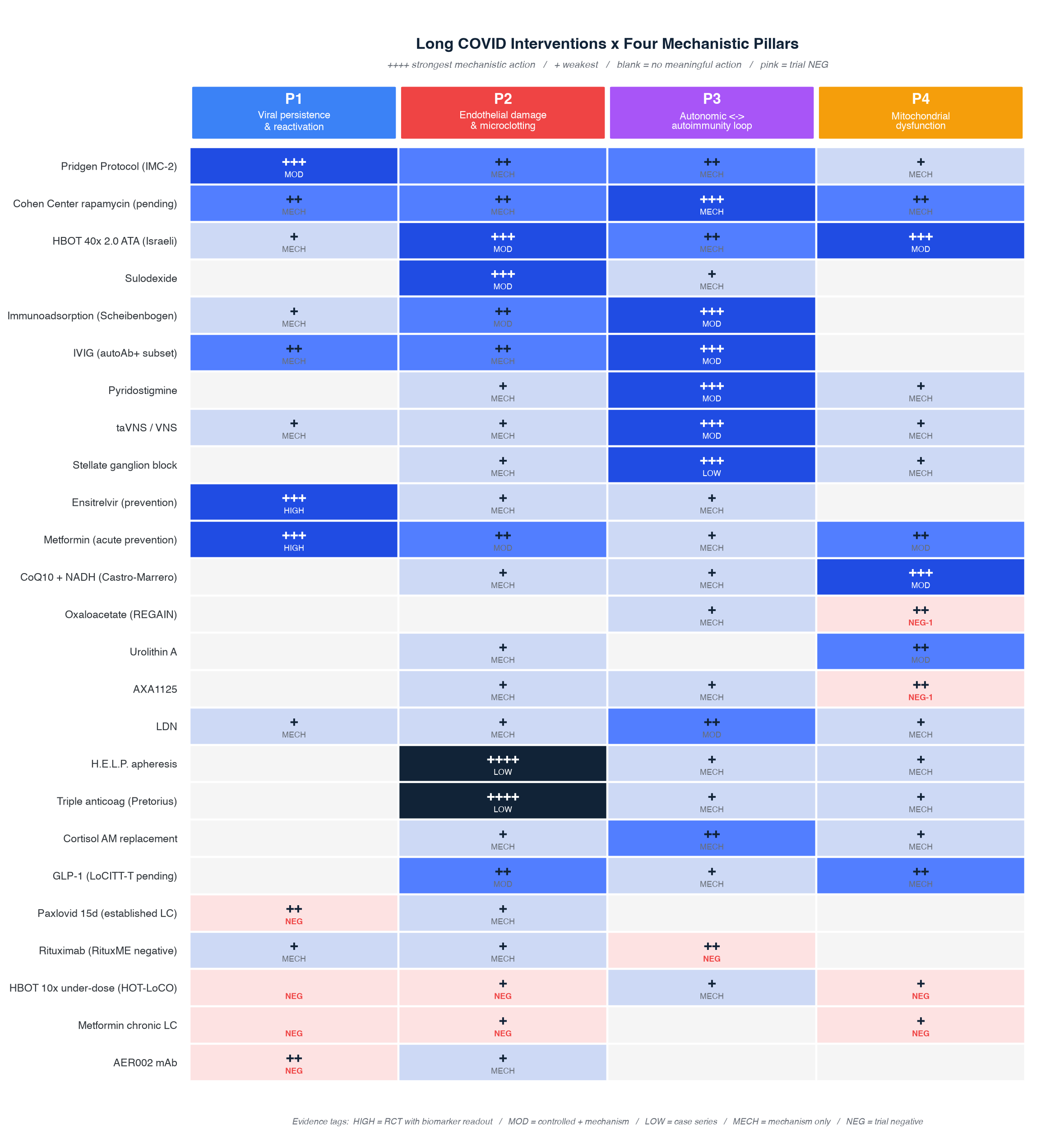
6. Multi-Pillar Agents — Highest-Leverage Candidates
Six interventions reach a multi-pillar threshold (touch ≥ 3 pillars with at least one ++++/+++):
1. Cohen Center low-dose rapamycin (NCT06960928) — P1 + P3 + P4
Touches T-cell exhaustion reversal → viral clearance (P1), T-cell modulation → reduced autoAb drive (P3), mTOR inhibition → mitophagy (P4). Single multi-pillar agent in active large-cohort trial. Readout November 2026 will be decisive for the broad-mechanism hypothesis.
2. HBOT 40-session 2.0 ATA — P2 + P3 + P4
Best multi-pillar evidence base of any intervention with completed RCT in established LC. Effect sizes preserved at 12 months. Critical communication challenge: the field is conflating the under-dosed HOT-LoCO negative with the original protocol — these are different interventions, not the same intervention twice tested.
3. Pridgen Protocol (IMC-2) — P1 + P2 + P3
Touches P1 (HSV polymerase inhibition direct via valacyclovir; COX-2 suppression reduces PGE2-driven herpesvirus reactivation cascade for EBV/HHV-6), P2 (celecoxib endothelial anti-inflammatory), P3 (inflammation arm of autoimmune loop). Doesn't directly hit P4. SHIELD readout (2026–27) is the most consequential P1 trial in flight.
4. Stratified P3 combination — pyridostigmine + taVNS + IVIG-or-IA
Highest-leverage P3 protocol; only works when both arms (vagal deficit and autoAb+) are deficit-positive on workup. Scheibenbogen IA cohort proves the principle at the autoAb arm; RECOVER-AUTONOMIC platform is structured to test components separately at scale and supports inference about combination value.
5. Sulodexide — P2
Single-pillar but the best-evidenced oral P2 agent and underused. Charfeddine 2022 effect sizes (EQI Δ 0.66 vs 0.18; p<10−3) on n=290 over 21 days — should be Tier-1 in any P2-dominant patient.
6. Low-dose naltrexone (LDN) — broad shallow
Light touch across all four pillars via TLR4 + microglial mechanisms. Broad but shallow. Belongs underneath any pillar-specific stack as Tier-0 baseline. RCTs in flight (LIFT factorial, NCT05430152).
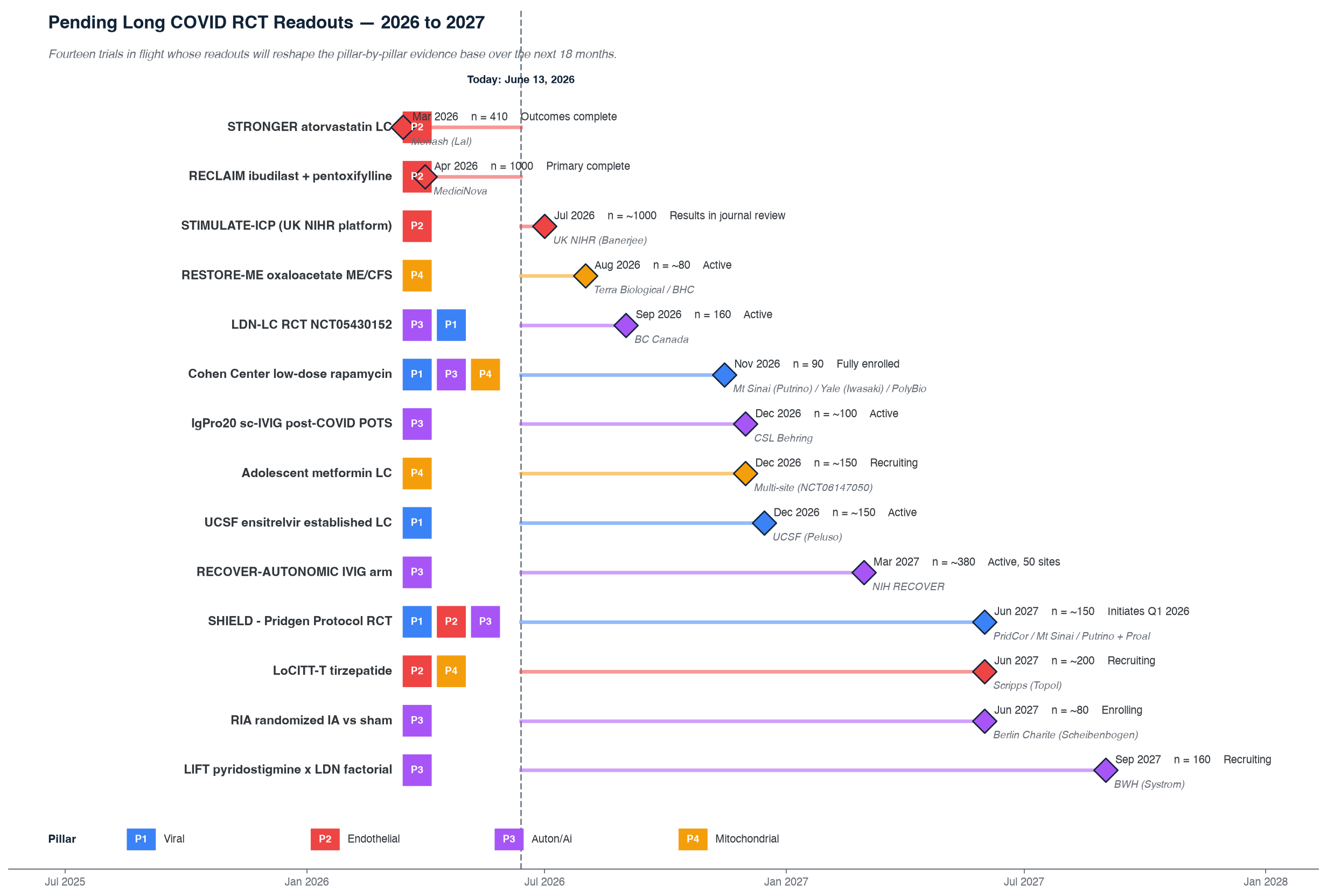
7. Combination Protocol Decision Tree
5.1 Baseline subtype workup (every patient at intake)
Universal symptom and history screening
- PEM: DePaul Symptom Questionnaire (DSQ-PEM) — quantify post-exertional symptom worsening
- POTS: orthostatic vitals + NASA 10-min lean test (HRΔ ≥30 bpm adult, ≥40 bpm adolescent = POTS)
- MCAS: Castells-Akin criteria; tryptase trend if feasible
- Cognitive: BPCog or PROMIS Cognitive Function short form
- Sleep: ISI; rule out untreated OSA
P1 — Viral persistence panel
- EBV VCA-IgG, EA-IgG, EBNA-IgG, EBV PCR (whole blood) — high EA-IgG is actionable reactivation; also flag low EBV-specific Ab if Apostolidis exhaustion signature is being tracked
- HHV-6 IgG ± PCR; HSV-1/2 IgG ± PCR; CMV IgG/IgM
- Spike-in-plasma (Walt assay) — research access only; Mount Sinai and a handful of academic labs
- Gut biopsy with SARS-CoV-2 RT-PCR if GI symptoms dominant and research path available
P2 — Endothelial / microclot panel
- Pretorius microclot score (research labs only) OR D-dimer, fibrinogen, VWF, sVCAM-1, sICAM-1, syndecan-1
- FMD ultrasound OR EQI by post-occlusive reactive hyperemia (Charfeddine method)
- Platelet aggregation studies if microclot+ confirmed
P3 — Autonomic + autoimmune panel
- CellTrend GPCR autoAb panel (β1, β2, M2, M3, AT1, ETA, α1, MAS1)
- 24-h Holter HRV OR wearable HRV trend (7-day Polar H10 or similar)
- Tilt-table test if NASA lean positive or POTS suspected
- AM cortisol + ACTH (8 AM draw, standardized timing critical)
- DHEA-S; COMPASS-31
- ANA, dsDNA, SSA/SSB, ENA panel, RF (rule out classical autoimmune)
- IENFD skin biopsy if SFN suspected (distal calf 3 mm punch)
- TSH, free T4
P4 — Mitochondrial panel
- Serum lactate (resting + post-exertional if PEM dominant)
- Serum carnitine (free + total + acylcarnitine profile)
- CoQ10 level (RBC or serum); urine organic acids
- Two-day CPET (Workwell protocol) if research center available
- 31P-MRS muscle (research only, very few centers)
5.2 Phenotype assignment
After workup, assign each patient a dominance profile across the four pillars. Most patients are 2–3 pillar dominant; very few are pure single-pillar.
| Pillar | "Dominant" trigger criteria |
|---|---|
| P1 | EBV EA-IgG ≥40 U/mL OR detectable spike-in-plasma OR HHV-6 PCR+ OR clinical reactivation signs (recurrent sweats, lymphadenopathy, recurrent oral HSV) |
| P2 | Pretorius score ≥3 (if available) OR sVCAM-1 ≥800 ng/mL OR abnormal FMD/EQI OR exertional O2 desaturation OR clinical microvascular signs (livedo, post-COVID chest pain) |
| P3 | CellTrend GPCR autoAb ≥1 receptor positive (β2-AR, AT1, M2 highest yield) OR confirmed POTS OR HRV severely depressed (SDNN <30 ms 24h) OR confirmed SFN on biopsy OR AM cortisol <8 μg/dL on standardized morning draw |
| P4 | DSQ-PEM positive AND (lactate-low-workload elevated OR two-day CPET VAT drop ≥15% OR biopsy SDH↓ OR serum carnitine↓ OR clinical PEM phenotype) |
5.3 The protocol — tiered by phenotype
Tier 0 — Universal foundation (every LC patient, starts day 1, no labs required)
- Pacing / energy envelope management — formal education, HR-cap if POTS, DSQ-PEM monthly tracking
- Sleep optimization — fix circadian; rule out OSA; melatonin 0.5–3 mg
- Salt and volume loading — 3 g sodium/day + 2–3 L fluid; compression
- LDN 1.5 → 3.0 → 4.5 mg nightly over 4 weeks
- Mitochondrial base stack: CoQ10 (ubiquinol) 200 mg AM + creatine monohydrate 5 g daily; consider CoQ10 + NADH per Castro-Marrero in fatigue-dominant
- Vitamin D to ≥40 ng/mL; magnesium glycinate 200–400 mg
P1 dominant — viral persistence branch
P2 dominant — endothelial / microclot branch
STIMULATE-ICP rivaroxaban arm readout expected 2026 — may change recommendations.
P3 dominant — autonomic / autoimmunity branch
P4 dominant — mitochondrial branch
Extend the Tier 0 mito base:
Tier 2 — Multi-pillar bridge agents (when ≥2 pillars active)
- HBOT if any of P2/P3/P4 are dominant — best multi-pillar evidence base
- Cohen Center rapamycin trial enrollment if any of P1/P3/P4 are refractory and patient meets criteria
- LDN already in Tier 0; titrate to symptom optimum (often 4.5 mg if tolerated)
Tier 3 — Salvage / research-only for refractory after 6 mo on Tier 0+1
- Plasmapheresis even if autoAb panel borderline if other Arm B signals strong (SFN, severe POTS, IgG-transfer phenotype features)
- Triple anticoagulation in formal research protocol with Pretorius+ confirmation
- Rituximab only with documented Arm B dominance and autoAb persistence
- IIT-grade access to elamipretide, urolithin A, 4-OI where institutional pathways exist
5.4 Sequencing and monitoring
| Visit | Action |
|---|---|
| Week 0 | Intake + workup ordered; start Tier 0 immediately (don't wait for labs) |
| Week 2–4 | Labs return; Tier 1 layered based on phenotype dominance |
| Week 8 | First reassessment — symptom diary + PEM frequency + COMPASS-31 + FACIT-Fatigue + HRV trend |
| Week 16 | Second reassessment — repeat key biomarkers (EBV EA-IgG; Pretorius if available; autoAb titer; AM cortisol); functional capacity (sit-to-stand, 30-day step count) |
| Week 24 | Three-pillar reassessment — if non-responder, Tier 2 escalation or Tier 3 research referral |
Stop-rules
- Pridgen Protocol: continue minimum 6 months before declaring non-response (Frontiers 2026 case series showed 120-day to 731-day sustained benefit pattern)
- IVIG: 3 monthly courses minimum before reassessing autoAb titer drop
- HBOT: full 40 sessions before assessing; don't stop at 20 absent severe AE — the HOT-LoCO null at 10 sessions is the cautionary tale
- LDN: 12 weeks to optimal dose; non-responders at 4.5 mg × 8 weeks → discontinue
5.5 Special phenotypes
- Severe / bed-bound LC: prioritize Tier 0 + P3 vagal restoration (pyridostigmine + taVNS) + P4 mitochondrial; defer HBOT until tolerance proven; avoid cognitively demanding rehab
- Pediatric / adolescent LC: same logic, age-modified dosing, avoid sirolimus, lower IVIG threshold, no celecoxib in pediatric Pridgen variant; adolescent metformin trial (NCT06147050) ongoing
- Mast cell overlap: layer H1 + H2 + cromolyn before LDN escalation; quercetin adjunct
- Pregnancy: avoid valacyclovir/celecoxib/sirolimus/LDN; restrict to Tier 0 pacing/salt/sleep + pyridostigmine + IVIG where indicated
8. Combination Therapy Time-Course Hypotheses
The completed monotherapy literature gives us published time-courses for individual interventions. The mechanism-of-action atlas (Exhibit 1) tells us where each intervention acts within the four-pillar root-cause loop. Combining the two lets us hypothesize — explicitly, with named assumptions — what time-course and effect-size signal a stratified combination protocol should produce. This section presents the model so it can be argued with.
7.1 Published monotherapy time-courses
The starting point. Onset and plateau pulled from the trial source. Where a trial measured at a single timepoint, "onset" is the protocol duration to that measurement; "plateau" is from follow-up if reported, otherwise marked TBD.
| Intervention | Pillar(s) | Onset of measurable benefit | Plateau / durability | Published source |
|---|---|---|---|---|
| Pridgen Protocol (IMC-2) | P1 + P2 + P3 | ~12–16 weeks | Sustained 120-, 305-, 731-day follow-up | Pridgen Front Immunol 2026, n=24 case series |
| Sulodexide 250 LSU BID | P2 | 3 weeks (ΔEQI 0.66 vs 0.18, p<10−3) | Maintenance dosing | Charfeddine Front Cardiovasc Med 2022, n=290 |
| HBOT 40× 2.0 ATA | P2 + P3 + P4 | ~8 weeks (end of 40-session course) | ~12 months durable (Hadanny n=31) | Zilberman-Itskovich Sci Rep 2022; Hadanny Sci Rep 2024 |
| HBOT 10× under-dose (HOT-LoCO) | P2 (failed) | Null at 13 weeks (LSD 0.63, CI −7.04 to 8.29) | n/a | Kjellberg BMJ Open 2025, n=80 |
| Cohen Center rapamycin (NCT06960928) | P1 + P3 + P4 | 12 weeks (course length) | Readout November 2026 | Putrino Cohen Center, n=90 (pending) |
| IVIG 1–2 g/kg q4 weeks | P3 (Arm B) | 3–6 months | 9.5-month median to resolution / partial response | Oaklander NNN 2022; Schelke 2023 |
| Immunoadsorption (Berlin Charité) | P3 (Arm B) | 5 sessions over ~3–4 weeks; IgG ↓79.2%, β2-AR-Ab ↓78.1% | Maintenance every 3–6 months | Stein Lancet Reg Health Eur 2025, n=20 |
| Pyridostigmine 60 mg | P3 (Arm A) | Single dose: VO2 +13.3 mL/min acutely; HR/POTS 1–2 weeks | Sustained on dosing | Joseph Chest 2022, n=45 ME/CFS |
| taVNS | P3 (Arm A) | 4–8 weeks (HRV objective signal) | Sustained on use | Badran Bioelect Med 2022; COVIVA 2026 |
| Stellate ganglion block | P3 (Arm A) | Days | Weeks-to-months, often needs repeat | Liu & Duricka 2022; Duricka 2024 (n~195 retrospective) |
| LDN 1.5 → 4.5 mg | broad (light touch all 4) | 8–12 weeks to optimal | Sustained on dosing | medRxiv systematic review 2025; LIFT factorial pending |
| Oxaloacetate 2000 mg/d | P4 | 3 weeks (DSQ-SF secondary signal, p<0.05) | 6 weeks (REGAIN duration); RESTORE-ME ongoing | REGAIN Cassidy Front Med 2025, n=69 (Chalder primary missed) |
| CoQ10 + NADH | P4 | 8 weeks (FIS reduction p<0.05) | Sustained on dosing | Castro-Marrero Antioxidants 2021, n=207 ME/CFS |
| AXA1125 33.9 g BID | P4 | 4 weeks (Chalder secondary −4.7, p=0.0097) | (program wound down; no Phase 3) | Finnigan eClinicalMedicine 2023, n=41 (PCr primary missed) |
| Paxlovid 15-day (established LC) | P1 (failed) | Null at 10 / 28 days | n/a | STOP-PASC Geng JAMA IM 2024; PAX LC Lancet ID 2025 |
7.2 Mechanistic synergy framework
Three principles ground the combination-effect model. They are mechanistic, not data-driven, and should be argued with where the mechanism reading is contested.
Principle 1 — Same-pillar dual-arm combinations
Combinations that hit two arms of the same pillar (e.g., pyridostigmine + taVNS targeting Arm A while IVIG targets Arm B of the autonomic ↔ autoimmunity loop) are expected to produce additive-to-superadditive effects within that pillar, because breaking both arms of a loop closure inside one pillar prevents that pillar from reconstituting its own driver. This is the Scheibenbogen Arm-B and Mount Sinai Arm-A literatures recombined.
Principle 2 — Cross-pillar combinations: speed gain > magnitude gain
Combinations that hit different pillars (e.g., Pridgen + Sulodexide hitting P1 + P2 simultaneously) produce broader coverage and earlier-onset benefit, but only modest asymptote gain. Mechanism: the faster-acting agent drives the early curve (sulodexide 3-week endothelial signal) while the slower-acting agent fills in the asymptote (Pridgen 12–16-week onset). The headline is speed, not magnitude. Useful when patient decompensation tolerates only a short clinical window.
Principle 3 — Loop-targeted combinations are nonlinear
Combinations that hit two adjacent nodes in the mtDAMP feed-forward loop (Exhibit 1) should produce nonlinear gains because breaking two nodes simultaneously prevents reconstitution from either arm of the loop. Single-node breaks plateau because the unbroken arm rebuilds the loop. This is the structural argument for combo design from the Atlas-surfaced loop indication. Pridgen + IA is the canonical example: Pridgen reduces herpesvirus-driven inflammation that generates autoAbs, IA removes the autoAbs — both arms of the inflammation ↔ autoimmunity bridge broken at once. The combination trials that test this also become natural experimental tests of the loop hypothesis.
Antagonism check
Combinations that pair immunosuppression with active viral persistence risk antagonism (e.g., rapamycin in a spike-in-plasma+ patient without antiviral cover). Mitigate by sequencing antiviral suppression before or alongside immune modulation, or by stratified enrollment that excludes reservoir-positive patients from immunosuppressive arms. The Cohen Center rapamycin trial design implicitly tests this by enrolling on clinical criteria across reservoir status.
7.3 Stratified combination predictions
Exhibit 5 renders the hypothesized trajectories for each dominance phenotype. Logistic model: y(t) = A · (1 − e−t/τ). The asymptote A and time constant τ are derived from published monotherapy time-courses (Section 7.1) plus mechanism-of-action inference for combinations (Section 7.2). These are explicit hypotheses, not measured trajectories — their value is in disciplining trial design and clinical decision-making by making the implicit time-course assumptions falsifiable.
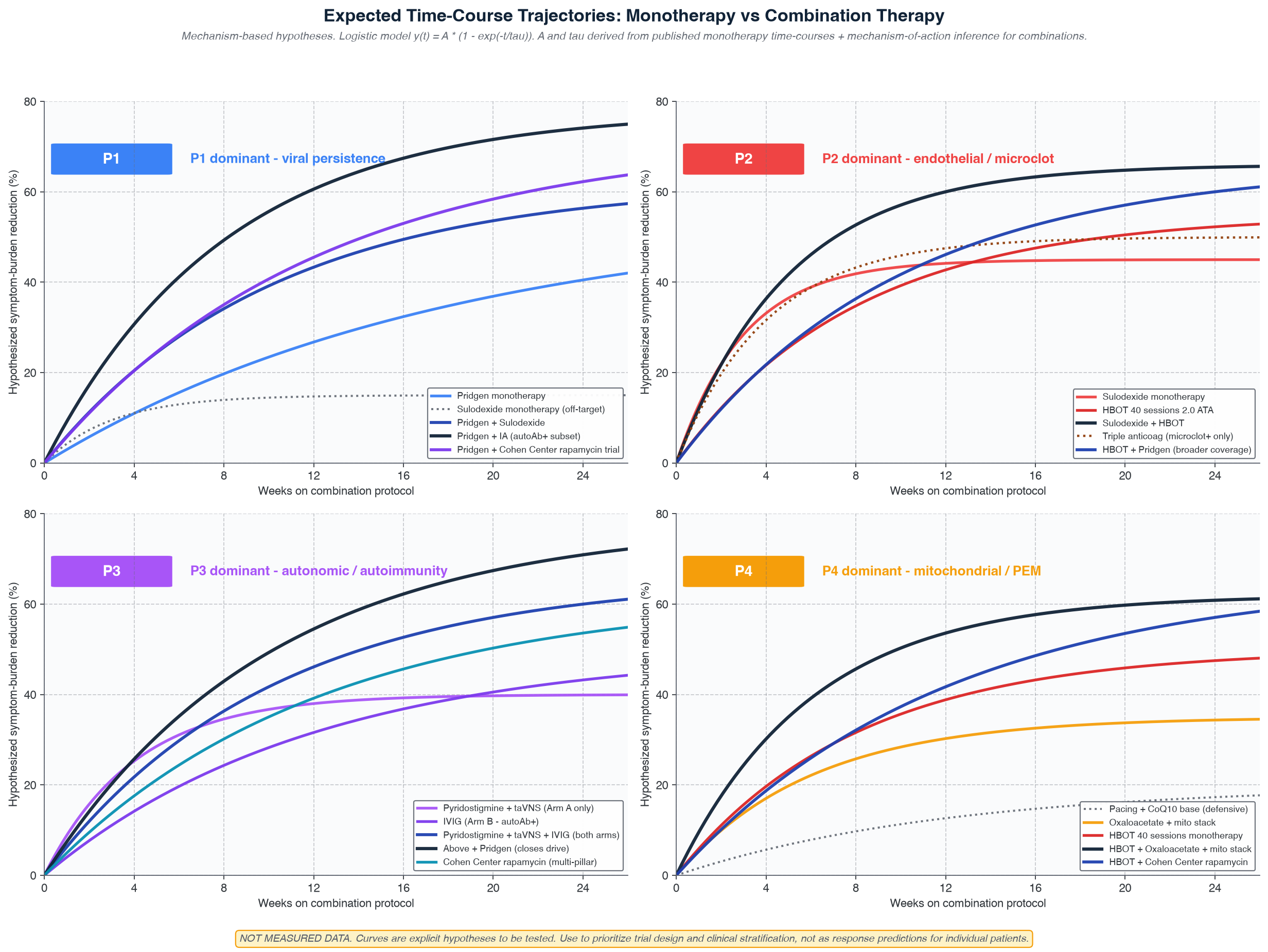
P1-dominant (viral persistence at the loop's upstream source)
Pridgen monotherapy produces an estimated ~55% symptom-burden reduction with τ ~18 weeks, based on the Frontiers 2026 case series 120-to-731-day sustained signal. Adding sulodexide accelerates the early curve (sulodexide hits EQI within 3 weeks per Charfeddine 2022) without changing the long-run asymptote much — the headline is speed, not magnitude. Pridgen + IA in the autoAb+ subset is the most aggressive intervention available: it simultaneously reduces the herpesvirus-driven inflammation that generates pathogenic autoAbs and removes the autoAbs themselves. Mechanism predicts the highest A (~78%) and an accelerated τ (~8 weeks) because two adjacent loop nodes are broken simultaneously — the canonical Principle 3 case. Pridgen + Cohen Center rapamycin trial is the multi-pillar bet: T-cell exhaustion reversal + viral suppression + mitophagy. Higher A (~72%) than Pridgen monotherapy but no speed advantage.
P2-dominant (endothelial / microclot)
Sulodexide alone delivers a fast, modest endothelial signal (~45% A at 3-week τ). HBOT 40× alone delivers a larger signal (~55% A) but at 8-week τ. Sulodexide + HBOT combines the fast kinetics of sulodexide with HBOT's larger asymptote — the fastest path to substantial P2 improvement (~66% at 5 weeks). Triple anticoagulation in microclot+ patients delivers signal at ~4 weeks but with bleeding risk that limits applicability outside research protocols. HBOT + Pridgen is appropriate for patients with both microclot+ and herpesvirus reactivation signals — broader coverage, slower than HBOT alone, but addresses the upstream antigen drive on endothelium.
P3-dominant (autonomic ↔ autoimmunity loop)
The headline P3 result: dual-arm targeting (pyridostigmine + taVNS for Arm A plus IVIG for Arm B) produces a substantially larger and faster response than either arm alone — the cleanest Principle 1 case in the report. Pyridostigmine + taVNS hits cholinergic restoration within weeks; IVIG removes the pathogenic autoAb arm of the loop over months. The combination crosses 50% symptom reduction at ~10 weeks vs ~12+ for IVIG alone. Adding Pridgen on top closes the inflammatory drive that generates new autoAbs — the highest-A trajectory in our model (~78%) and the most loop-targeted combo for autoAb+ phenotypes. Cohen Center rapamycin (multi-pillar) is competitive but slower; useful when IVIG access is constrained.
P4-dominant (mitochondrial / PEM)
Pacing + CoQ10 is defensive — modest A, slow τ, but prevents PEM-driven decline (a critical baseline; not a competitor for the other curves). Oxaloacetate accelerates onset (REGAIN DSQ-SF secondary signal at day 21). HBOT + Oxaloacetate + mito stack combines HBOT's mitochondrial biogenesis effect with substrate supplementation — fast early signal from oxaloacetate, large HBOT asymptote (~62% A at ~6-week τ). HBOT + Cohen Center rapamycin is the multi-pillar bet for refractory mito patients: mitophagy from rapamycin plus mitochondrial biogenesis from HBOT, mechanistically targeting both ends of the Tasoula mtDAMP loop.
7.4 Operational implications
- Speed vs magnitude trade-off. When time matters (functional decompensation, employment risk, severe symptom burden), prioritize combinations that include a fast-onset agent (sulodexide for P2, pyridostigmine for P3 Arm A, oxaloacetate for P4) layered onto a slower-acting deeper intervention. When magnitude matters (severe LC, multi-pillar dominance, refractory phenotype), prioritize loop-targeted combinations that break adjacent nodes of the mtDAMP feed-forward loop simultaneously (Principle 3).
- Stratification BEFORE combo choice, not after. The most leveraged combinations are stratum-specific. Pridgen + IA is the highest-A P1 combo but only for the autoAb+ subset. HBOT + Oxaloacetate is the highest-A fast-onset P4 combo but only for PEM-confirmed phenotypes. Unselected combination protocols dilute the very synergy that justifies them.
- Empirical anchors to track per combination. The pre/post biomarker that should move:
- Pridgen + IA: EBV EA-IgG (Pridgen arm) plus β2-AR autoAb titer (IA arm); both should drop in synergy responders.
- Sulodexide + HBOT: FMD or EQI (sulodexide) + Pretorius microclot score if available + 6-minute walk (HBOT).
- Pyridostigmine + taVNS + IVIG: HRV (Arm A) + CellTrend autoAb titer (Arm B) + COMPASS-31 (loop-level).
- HBOT + Oxaloacetate + mito stack: 31P-MRS PCr recovery τ + serum lactate at low workload + two-day CPET VAT delta.
- Sequencing matters. Where a faster-acting agent meaningfully de-risks the slower agent's tolerability (e.g., pyridostigmine improves orthostatic tolerance enough to make HBOT chamber sessions feasible), start the faster agent two-to-four weeks ahead. Where a slower agent's mechanism depends on the upstream driver being already suppressed (e.g., IA after Pridgen has been on board for 4–6 weeks), respect the sequence.
Stratified combinations that break adjacent loop nodes simultaneously
should produce nonlinear gains in both efficacy and speed of recovery.
Exhibit 5 is the hypothesis — testable, falsifiable, made explicit.
Honest caveat on the curves
The trajectories in Exhibit 5 are mechanism-derived hypotheses, not measured data. A and τ values come from published monotherapy time-courses (Section 7.1) plus Bayesian inference under the three synergy principles. Real-world variability around each curve is wide. Use the model to prioritize trial design and clinical decision-making and to discipline implicit assumptions about response timing — not as response predictions for individual patients. The five trajectories per panel are illustrative; many additional combinations are possible and several may outperform the rendered candidates.
9. Critical Gaps the Field Has Not Closed
- Reservoir-clearance biomarker as a routine RCT endpoint. STOP-PASC and PAX LC's biggest weakness was clinical-only readout. Walt-style ultrasensitive spike-in-plasma + gut RNA should become standard P1 endpoints. SHIELD will be a partial test of this principle (EBV titer secondaries planned).
- Pretorius microclot method multi-lab standardization. Reproducibility concerns (Hunt 2024) have limited acceptance. Turner flow-clotometry preprint is the first step; need validated normative ranges across ≥3 independent labs before microclot-stratified RCTs can be designed.
- GPCR autoantibody panel as RCT enrollment criterion. Trials enrolling unselected LC patients wash out the autoAb-positive subset signal. Scheibenbogen has demonstrated the principle in IA cohorts; RECOVER-AUTONOMIC IVIG arm could test it formally if stratified analyses are pre-specified.
- Wüst/Appelman muscle biopsy as routine P4 readout. Currently only research-lab capable. AXA1125 31P-MRS approach is a clinical-grade surrogate but needs broader replication.
- AM cortisol replacement RCT. The largest gap between biomarker strength and interventional evidence in LC. MY-LC's strongest single biomarker has zero interventional RCT data. A small hydrocortisone replacement RCT in stratified low-cortisol LC patients would be one of the highest-leverage studies the field could run.
- Multi-pillar combination trial designs. Single-agent monotherapy will keep underperforming. Field needs factorial designs that test mechanism stacks, not molecules. RECOVER-AUTONOMIC's adaptive design is a partial example; LIFT's pyridostigmine × LDN factorial is another.
- HBOT dose-response question. Resolve definitively whether 40 sessions × 2.0 ATA is required, or whether intermediate doses (20–25 sessions) achieve adequate effect — currently positive at 40, negative at 10.
10. Conclusion: How to Improve and Accelerate Long COVID Treatment
The Brainworks Long COVID Atlas surfaced strong, convergent indications of the structure — one node causally demonstrated experimentally, the others strongly indicated but awaiting direct confirmation. This report converts those indications into the two leverage points the report's title names: improved trial design that will definitively confirm or refute the causal mechanistic links, and stratified combination therapies that should both improve efficacy and accelerate recovery if the structure holds. The Atlas integration (Exhibit 1) names the loop; the four-pillar projection (Exhibit 2) makes it clinically actionable; the scorecard (Exhibit 3) maps every meaningful intervention to its target pillar; the trial timeline (Exhibit 4) shows what is about to read out; the time-course model (Exhibit 5) makes the combination hypotheses falsifiable. From those pieces, three claims follow — each translating an AI-surfaced indication into a concrete operational change in how Long COVID is studied and treated.
9.1 Claim One: the monotherapy plateau is structural, not contingent
Every completed reservoir-targeting, anti-inflammatory, mitochondrial-substrate, and immune-modulating monotherapy in established LC has produced either a null primary endpoint or a positive secondary with subgroup-only signal. The pattern is not unfortunate — it is predicted by the loop topology. A loop with N driver nodes does not resolve when only one is hit; the unbroken arms reconstitute the loop within the half-life of the suppression. The field's intervention failures over 2022–2026 are not failures of mechanism. They are failures of stratification and structural under-coverage.
The corollary is operationally significant: every monotherapy null in the report's graveyard list is a candidate component of a stratified combination protocol, not an exclusion. Sulodexide, oxaloacetate, AXA1125's active substrate, and even the failed Paxlovid 15-day dose may all have rehabilitable roles in combinations targeting their mechanistically aligned phenotype, provided stratification and adjacent-node coverage are present.
9.2 Claim Two: loop-targeted stratified combinations are the leveraged path
The combination time-course model (Section 7) hypothesizes nonlinear gains for combinations that break adjacent nodes of the mtDAMP feed-forward loop simultaneously. Five headline combinations are identified, each with a specific stratification trigger and a specific biomarker pre/post anchor:
- Pridgen Protocol + immunoadsorption — autoAb+ P1+P3 patients. The canonical Principle 3 case: Pridgen reduces the herpesvirus-driven inflammation that generates pathogenic autoAbs while IA removes them. Hypothesized A ~78%, τ ~8 weeks. Tracking biomarkers: EBV EA-IgG, β2-AR autoAb titer.
- Sulodexide + HBOT 40× 2.0 ATA — P2-dominant patients. Cross-pillar speed gain: sulodexide drives the early curve at 3 weeks; HBOT fills the asymptote at 8 weeks. Hypothesized A ~66%, τ ~5 weeks. Tracking biomarkers: FMD/EQI, Pretorius microclot if available, 6-minute walk.
- Pyridostigmine + taVNS + IVIG + Pridgen — P3-dominant patients with both Arm A and Arm B deficits. Dual-arm Principle 1 combined with upstream Principle 3 closure. Hypothesized A ~78%, τ ~10 weeks. Tracking biomarkers: HRV, CellTrend autoAb titer, COMPASS-31.
- HBOT 40× + Oxaloacetate + mito stack — P4-dominant patients with confirmed PEM phenotype. Substrate supplementation + mitochondrial biogenesis. Hypothesized A ~62%, τ ~6 weeks. Tracking biomarkers: 31P-MRS PCr recovery τ, serum lactate at low workload, two-day CPET VAT delta.
- Cohen Center low-dose rapamycin (NCT06960928) — the multi-pillar single-agent bet. Touches P1, P3, P4 simultaneously. Readout November 2026 will be decisive for the broad-mechanism hypothesis.
Each of these five combinations is designed to be tested. Each can be stratified before enrollment. Each has biomarker pre/post anchors that allow mechanism confirmation independent of the symptom PROM primary. This is what the field has been missing.
9.3 Claim Three: two trials reading out in the next 18 months will be decisive
SHIELD (PridCor Therapeutics with Mount Sinai — Putrino + Proal/PolyBio, FDA IND-exemption January 2026, initiating Q1 2026) is the first true RCT of the Pridgen Protocol in LC. It is the most consequential P1 readout in the field. If SHIELD pre-specifies EBV EA-IgG and β2-AR autoAb titer secondaries, its results will inform Combination 1 above directly, regardless of whether the symptom-PROM primary hits.
Cohen Center low-dose rapamycin (Putrino + Iwasaki, NCT06960928, fully enrolled mid-2025, readout November 2026) is the most multi-pillar single-agent trial in flight. If the trial reads positively with biomarker confirmation across pillars, rapamycin becomes the multi-pillar Tier-2 bridge agent for any combination protocol. If it reads negatively, the multi-pillar single-agent hypothesis is provisionally falsified and the field shifts to explicit factorial designs.
If both read positively, the stratified combination matrix has its two anchor multi-pillar agents. If one of them reads positively, that agent becomes the anchor and the other four headline combinations restructure around it. If both read negatively at primary, both pre-specified mechanism secondaries should still discriminate the responder subset that drives the next round of design.
9.4 What should be done in the next 12 months
- For clinicians treating refractory LC patients: stratify formally before combo design; use the Section 7 decision tree. Document pre-treatment biomarkers so post-treatment movement can be assessed at week 16 and week 24. Do not initiate empirical triple anticoagulation outside research without Pretorius+ confirmation; do not use empirical 15-day Paxlovid; do not use modafinil in PEM-phenotype patients.
- For SHIELD and Cohen Center rapamycin trial teams: pre-register subtype-stratified analyses and biomarker pre/post anchors so the responder subset is identifiable even if the primary endpoint misses. The next round of LC RCTs needs to be designed to extract the responder signal, not to ignore it.
- For the field's RCT designers: stop running single-agent monotherapy trials on unselected LC cohorts. The architecture has been falsified at scale. Pivot to factorial designs (LIFT pyridostigmine × LDN is one example), subtype-stratified enrollment (Scheibenbogen IA cohorts are another), and adaptive platforms (RECOVER-AUTONOMIC, STIMULATE-ICP). Single-pillar molecular-novelty trials on unselected cohorts are not generating actionable information.
- For investors and biotech: the highest-leverage unsupported mechanism candidate is HBOT 40× 2.0 ATA scale-up replication — a 200–500-patient multicenter RCT with biomarker readouts (~$5–10M) would lock down the Israeli signal and resolve the under-dosing controversy. The highest-leverage unfunded combination trial is Pridgen Protocol + immunoadsorption in CellTrend autoAb+ patients — a ~150-patient Phase 2 stratified RCT (~$10–15M) would test the canonical loop-targeted combination. The highest-leverage diagnostic biomarker investment is a clinically-validated, multi-lab-standardized Pretorius microclot assay.
- For Skip and David specifically: the SHIELD design should pre-specify EBV EA-IgG and β2-AR autoAb titer as mechanism-confirmation secondaries with stratified subset analysis. The Cohen Center rapamycin trial should pre-specify spike-in-plasma (Walt lab), CellTrend autoAb titer, and 31P-MRS PCr recovery τ as cross-pillar secondaries. If a subset of SHIELD enrollees can be co-enrolled in IA at Berlin Charité or in IVIG via RECOVER-AUTONOMIC, the resulting natural-experiment combination cohort would directly test Combination 1 above.
9.5 The closing structural claim
Confirming it definitively is the work the next round of properly designed trials will do.
The interventions to break the structure exist in published literature today,
scattered across mechanism families.
The remaining work is not invention. It is composition, stratification, and falsification.
This report is one such composition. The next step is to run it.
11. Authors' Honest Uncertainty Disclosure
Effect sizes and confidence intervals labeled [published] are drawn from cited trials and reflect the authors' confidence in the published number.
Effect sizes labeled [HAL-estimated] are Bayesian best-guesses derived from out-of-LC literature and pathophysiologic inference. Treat these as hypotheses to test, not endpoints to act on. Real-world confidence intervals are likely wider than stated.
MECH-tagged scorecard cells claim mechanism plausibility, not LC-specific clinical confirmation. Where Skip's herpesvirus-arm or David's MY-LC-derived autonomic/cortisol/HRV scoring diverges from ours, treat their lived clinical data as authoritative over our synthesis.
This document is a stratification checklist for the next round of trial designs and a clinical decision aid for treatment-refractory patients. It is not a clinical practice guideline.
San Francisco, CA