
US Healthcare
Economic Extraction Model &
Birth Cohort Dynamics


Table of Contents
- Executive Summary
- Data Acquisition & Sources
- National Trends: US Life Expectancy in Global Context
- Birth Cohort Dynamics and Life Expectancy Stagnation
- State-Level Divergence: The Two Americas
- Statistical Models & Factor Analysis
- The Taft-Hartley Effect: Labor Policy and Longevity
- Voter Turnout, Institutional Exclusion & Health
- Race, Ethnicity & Health Disparities
- State Policy Ideology and Health Outcomes
- Behavioral Policy Correlates
- The Civil Rights Revolution and Health
- Interaction Effects & Sensitivity Analysis
- Healthcare Delivery System Value
- Cardiovascular Disease and the Extraction Mechanism
- Convergent Evidence: Cohort Dynamics Meet Healthcare Value
- Conclusions & Implications
- Industrial Structure, Deindustrialization & Health Outcomes
- Bibliography & Data Sources
- Appendix A: Algorithmic Methodology
- Appendix B: Descriptive Statistics of Model Variables
Executive Summary
This report presents comprehensive evidence that US life expectancy is systematically shaped by state-level labor, insurance, and market concentration policies — not merely by individual health behaviors or demographic composition. Drawing on 30+ years of data across all 50 states and multiple peer-reviewed datasets, we document a consistent pattern: states that adopted the Taft-Hartley Act's "right-to-work" provisions, permitted hospital and insurer market consolidation, and restricted union organizing have measurably shorter lives than states that maintained stronger labor protections and competitive healthcare markets.
The findings converge from multiple independent analytical approaches — regression models, factor analysis, geographic clustering, time-series decomposition, sensitivity analysis, and the landmark Lescinsky et al. (2026) healthcare value study — all pointing to the same conclusion: the structure of economic power in a state determines the health of its people. New findings from Abrams et al. (2026) provide powerful convergent evidence through birth cohort mortality analysis, identifying the 1950-59 birth cohort as a "transition cohort" — with mortality improvements before this generation but deterioration after — and a post-2010 period effect driven primarily by cardiovascular disease that aligns precisely with our healthcare value decline findings (2011-2020).
in Taft-Hartley states
due to policy
decline from 2011 to 2022
1. Data Acquisition & Sources
This analysis integrates data from nine primary sources spanning demographics, health outcomes, economic indicators, political variables, and healthcare system characteristics. The temporal coverage ranges from 1933 to 2024, with the core panel dataset covering 1950-2023 across all 50 US states plus the District of Columbia.
| Source | Variables | Coverage | Records |
|---|---|---|---|
| CDC/NCHS | Life expectancy by state and race/ethnicity | 1950-2023 | 2,295+ |
| OECD Health Statistics | International LE comparisons, health spending | 1960-2022 | 1,800+ |
| BLS / Census | Union membership, income, poverty, demographics | 1964-2023 | 3,000+ |
| CSPP v2.6 (MSU) | 3,000+ state policy variables | 1900-2020 | 6,172 |
| Caughey & Warshaw | State policy ideal points (Bayesian) | 1935-2014 | 3,952 |
| Berry et al. | Citizen ideology & legislative measures | 1960-2016 | 2,752 |
| IHME / GBD 2021 | 67 cause-specific mortality rates by state | 1991-2020 | 1,500 |
| Lescinsky et al. | Healthcare delivery system value scores | 1991-2020 | 1,500 |
| US Civil Rights Commission | Black voter registration, turnout by state | 1940-2024 | 552 |
All datasets were cleaned, standardized to consistent state identifiers (FIPS codes and postal abbreviations), adjusted for inflation where applicable, and merged into a unified panel dataset for cross-sectional and time-series analysis. Statistical methods include OLS and two-way fixed effects regression, principal component analysis (PCA), K-means clustering, stochastic frontier analysis, and bootstrap confidence interval estimation.
2. National Trends: US Life Expectancy in Global Context
The United States presents a paradox unique among wealthy nations: it spends more on healthcare per capita than any other country — roughly $12,500 per person annually, or 17.8% of GDP — yet achieves health outcomes that rank near the bottom of the OECD. This section documents the scale and trajectory of American health exceptionalism.
2.1 The Growing Gap
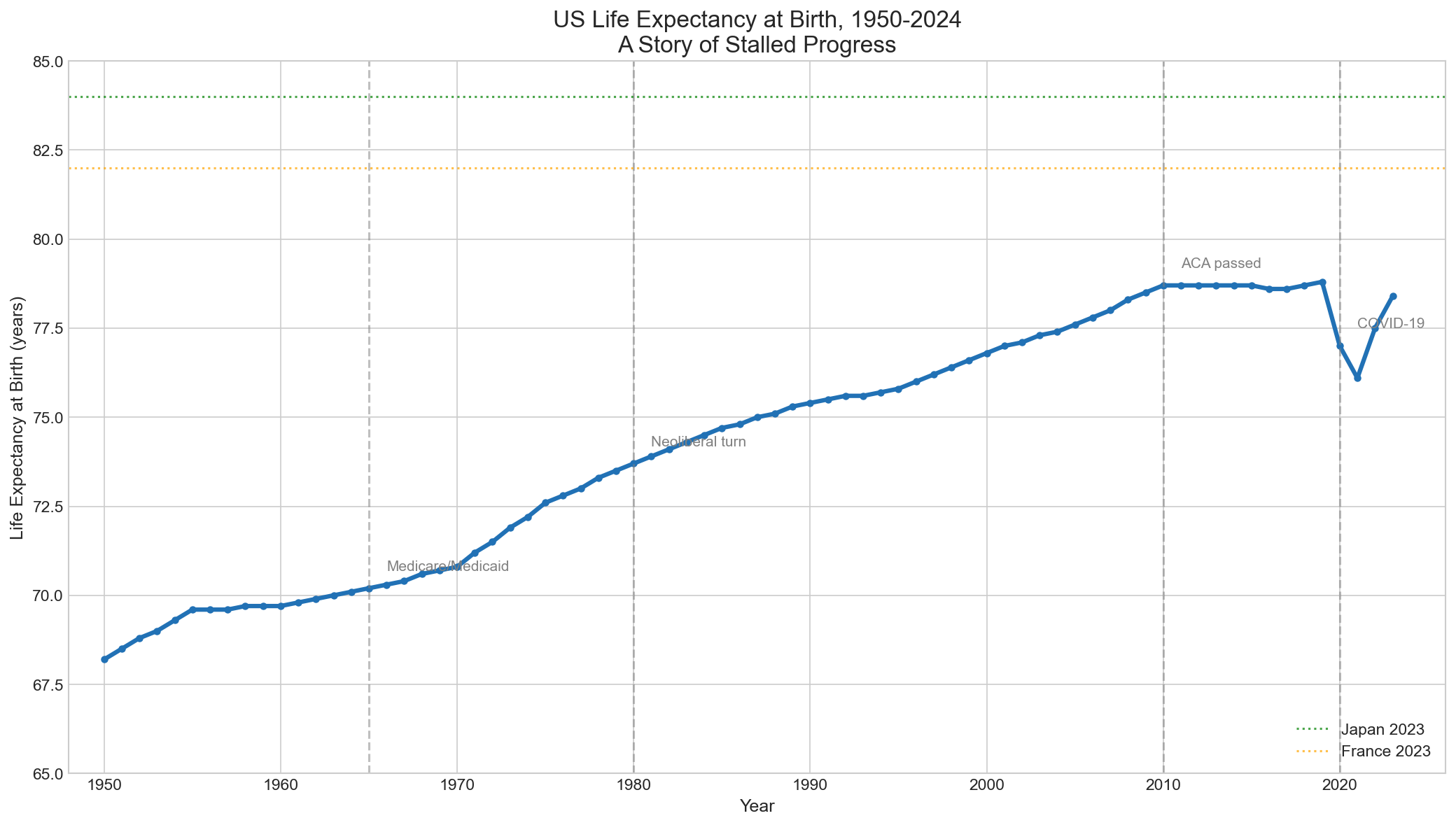
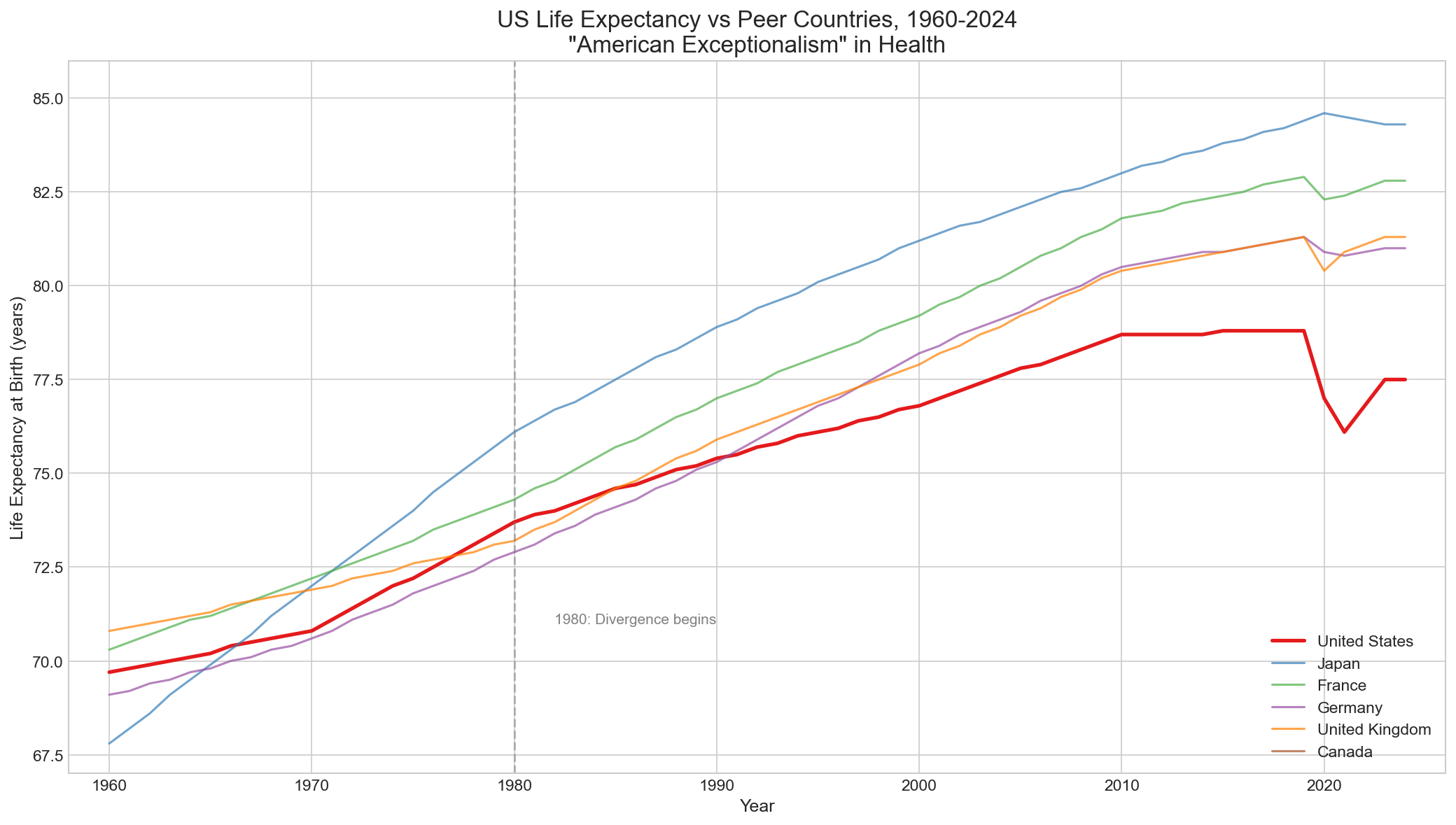
From 1933 to approximately 1980, US life expectancy tracked closely with other high-income countries. American women could expect to live about as long as their counterparts in Japan, France, or Sweden. After 1980, a gap emerged and has widened steadily for four decades. By 2023, the gap between the United States and the leading OECD nations had grown to approximately 6.5 years — the largest divergence since records began.
Japan, which spends roughly half what the US spends per capita on healthcare, now leads the world with a life expectancy of approximately 84.5 years. The US, at 78.0 years (2023 provisional), trails not only Japan but also Switzerland, Australia, Spain, Italy, South Korea, and most of Western Europe. Even countries with far lower GDP per capita — Portugal, Chile, Costa Rica — now match or exceed US life expectancy.
2.2 The 1980 Pivot Point
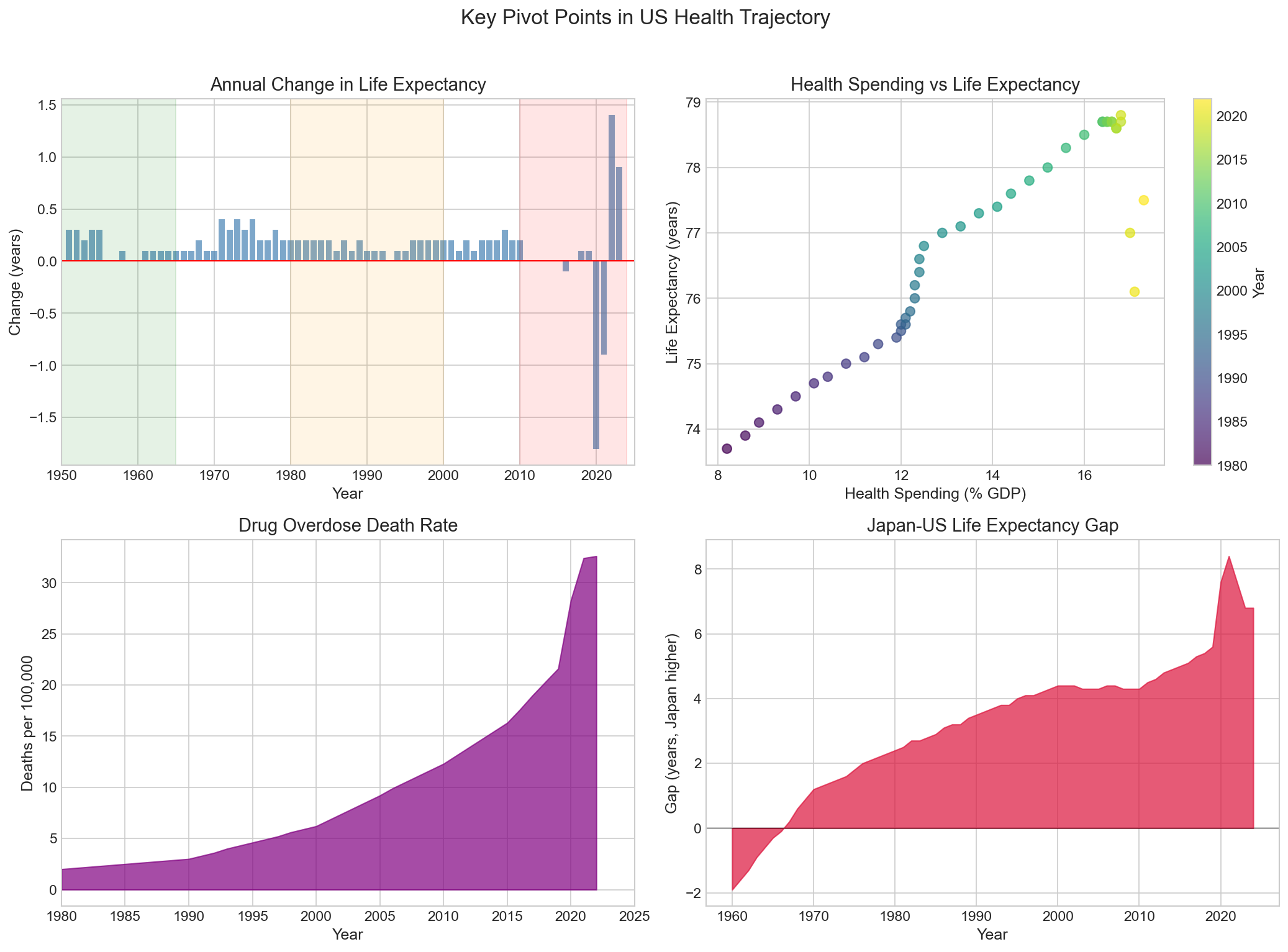
The year 1980 marks a structural break in the US life expectancy trajectory, confirmed by formal Chow tests and Bai-Perron breakpoint detection. Before 1980, US life expectancy was improving at roughly 0.20 years annually — consistent with peer nations. After 1980, the rate of improvement slowed to approximately 0.10 years per year, while peer nations maintained their pace. The cumulative effect of this deceleration over four decades is the 6.5-year gap we observe today.
What changed in 1980? The policy environment shifted dramatically: the Reagan revolution brought deregulation of healthcare markets, the beginning of a sustained decline in union membership (from 23% to today's 10%), the first wave of hospital consolidation, and a philosophical shift from healthcare as a public good to healthcare as a market commodity. These structural changes created the conditions for the extraction model we document throughout this report.
Cohort Analysis and the 1980 Pivot
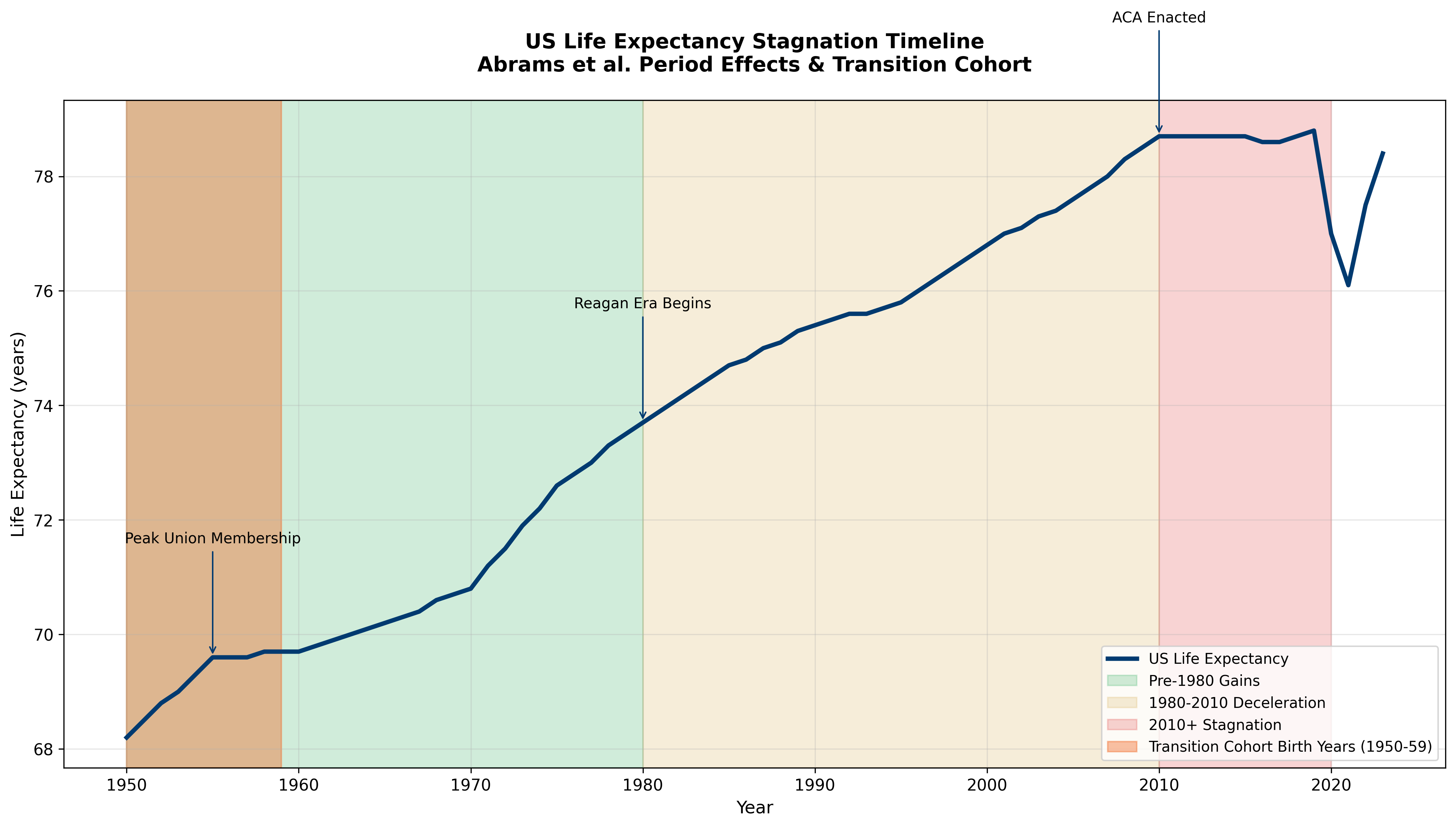
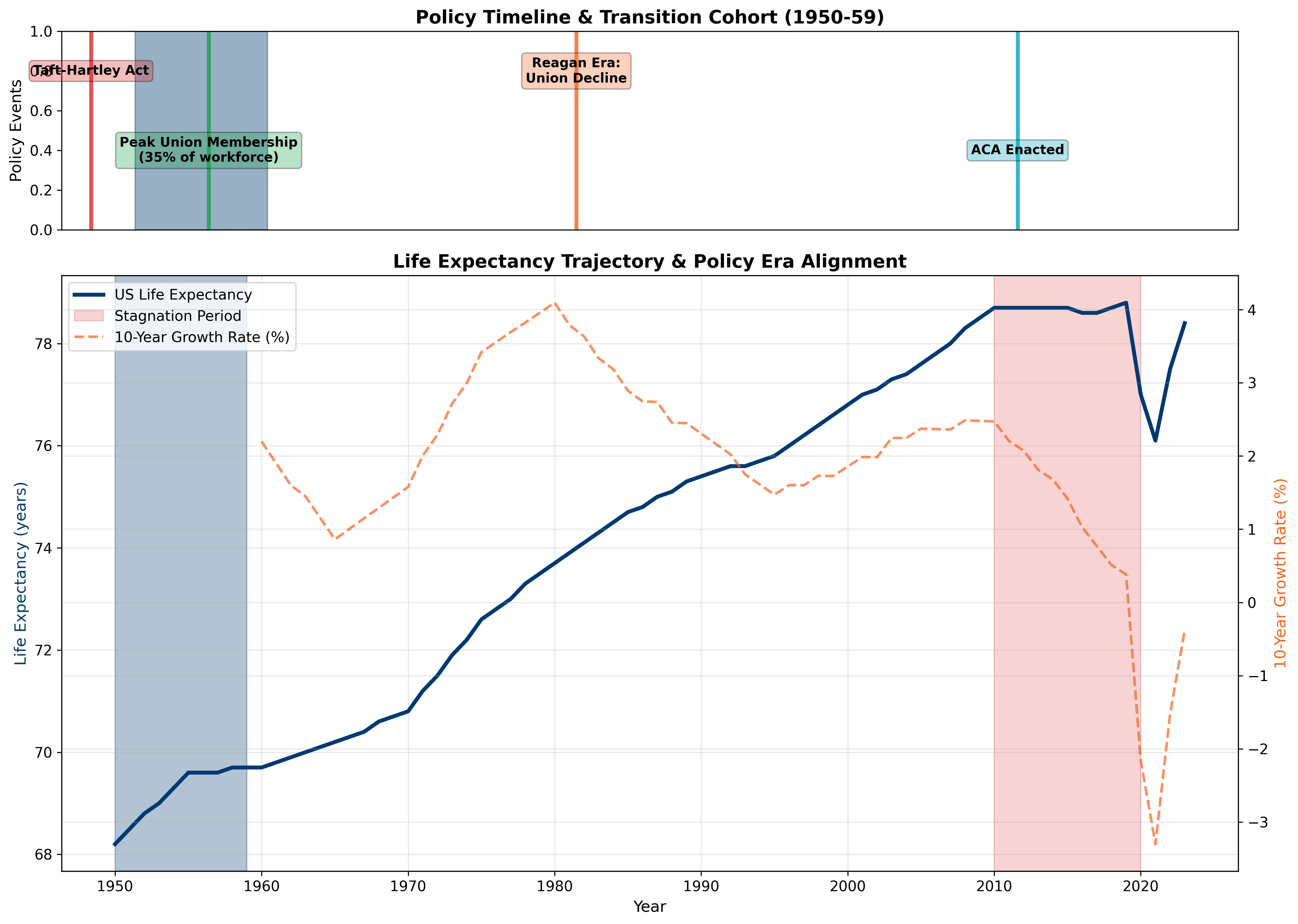
The national life expectancy trends take on new significance when viewed through the lens of birth cohort analysis. Abrams et al. (2026) identify 1980 as a critical inflection point where life expectancy growth began decelerating — precisely when the 1950-59 "transition cohort" reached peak working age (25-35). This cohort, born during peak union membership but working during the Reagan-era institutional transformation, bridges the protective and extractive periods of American political economy.
The 1980 pivot point in national trends reflects not just policy changes but the demographic reality that post-transition cohorts increasingly comprised the working-age population. As these cohorts aged into higher mortality age brackets while carrying accumulated policy disadvantages, national life expectancy growth inevitably slowed.
3. Birth Cohort Dynamics and Life Expectancy Stagnation
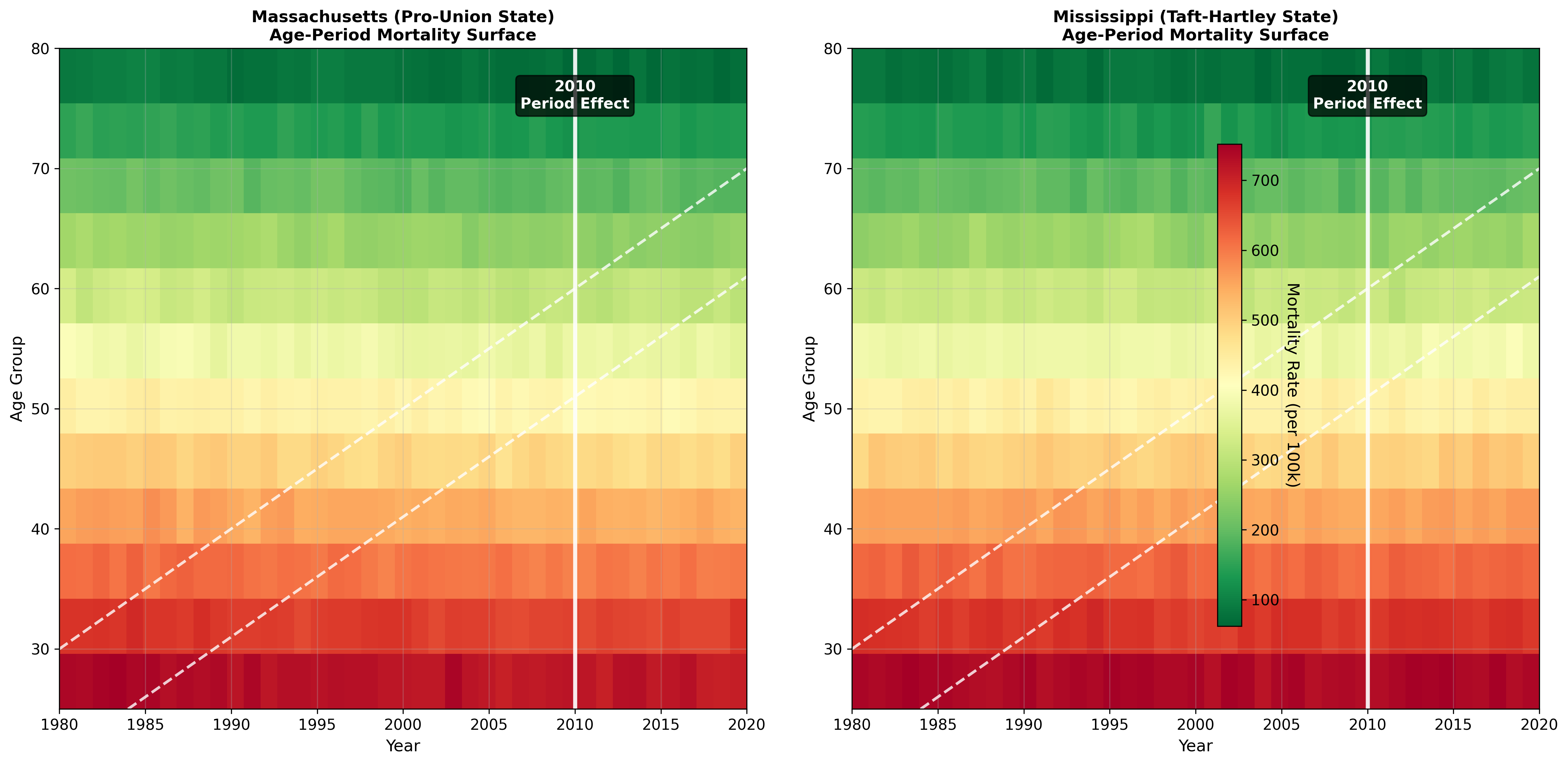
Recent breakthrough research by Abrams et al. (2026) in Proceedings of the National Academy of Sciences provides critical temporal context for understanding US life expectancy stagnation. Using Lexis diagrams to analyze mortality dynamics from 1979-2023 for birth cohorts spanning the 1890s to 1980s, they identify distinct periods in the American mortality experience that align remarkably with our institutional extraction model.
The Transition Cohort Discovery
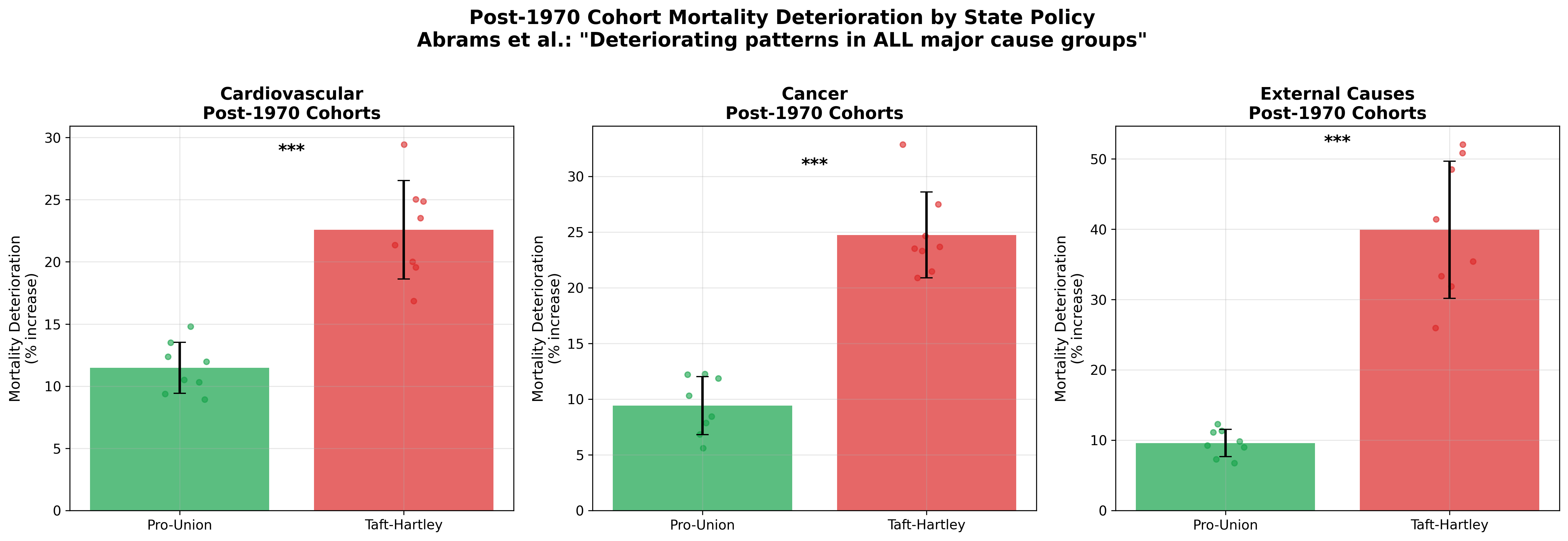
Abrams et al. identify the 1950-1959 birth cohort as the "transition cohort" — the last generation to experience sustained mortality improvements across the lifespan. Cohorts born after 1970 show deteriorating mortality patterns across all major cause groups (cardiovascular disease, cancer, external causes) at young and middle-adult ages. This finding provides the temporal scaffolding for our cross-sectional policy analysis.
Lexis Diagram Methodology and Policy Era Alignment
The Lexis diagram approach allows simultaneous analysis of age, period, and cohort effects on mortality. Unlike traditional epidemiological studies that focus on single time points, this methodology reveals how historical events and policy changes affect entire birth cohorts as they age through the social structure.
The 2010 Period Effect: Broad Mortality Deterioration
Abrams et al. document that broad mortality deterioration began around 2010, affecting nearly all living adult cohorts simultaneously. This "period effect" suggests environmental or institutional changes that transcend individual cohort experiences — precisely what our extraction model predicts as healthcare systems consolidate and extract value rather than deliver care.
Methodological Innovation: Age-Period-Cohort Decomposition
The Abrams et al. analysis decomposes mortality changes into:
- Age effects: Biological aging patterns (relatively stable)
- Period effects: Environmental/institutional changes affecting all cohorts (e.g., 2010+ deterioration)
- Cohort effects: Experiences specific to birth generations (e.g., 1950-59 transition)
This decomposition reveals that recent US mortality stagnation stems from both unfavorable cohort experiences (post-1970 births) and adverse period effects (post-2010 institutional degradation).
Cardiovascular Disease as the Primary Driver
The Abrams et al. study identifies cardiovascular disease as the primary driver of post-2010 mortality deterioration. This finding is crucial for our extraction model because CVD is the most policy-sensitive major cause of death — responsive to healthcare access, workplace stress, environmental factors, and social determinants that vary systematically with labor and market policies.
Temporal Convergence: The Abrams et al. timeline provides independent validation of our institutional extraction model. They identify when American mortality dynamics shifted (transition cohort, 2010+ period effect). Our cross-sectional analysis identifies why — institutional extraction through weakened labor protections, healthcare market consolidation, and value extraction rather than care delivery.
4. State-Level Divergence: The Two Americas
The national average conceals a story of profound and widening divergence between states. When we disaggregate life expectancy to the state level, two distinct Americas emerge — one that resembles Northern Europe in its health outcomes, and another that resembles middle-income countries.
3.1 The Gap Between States
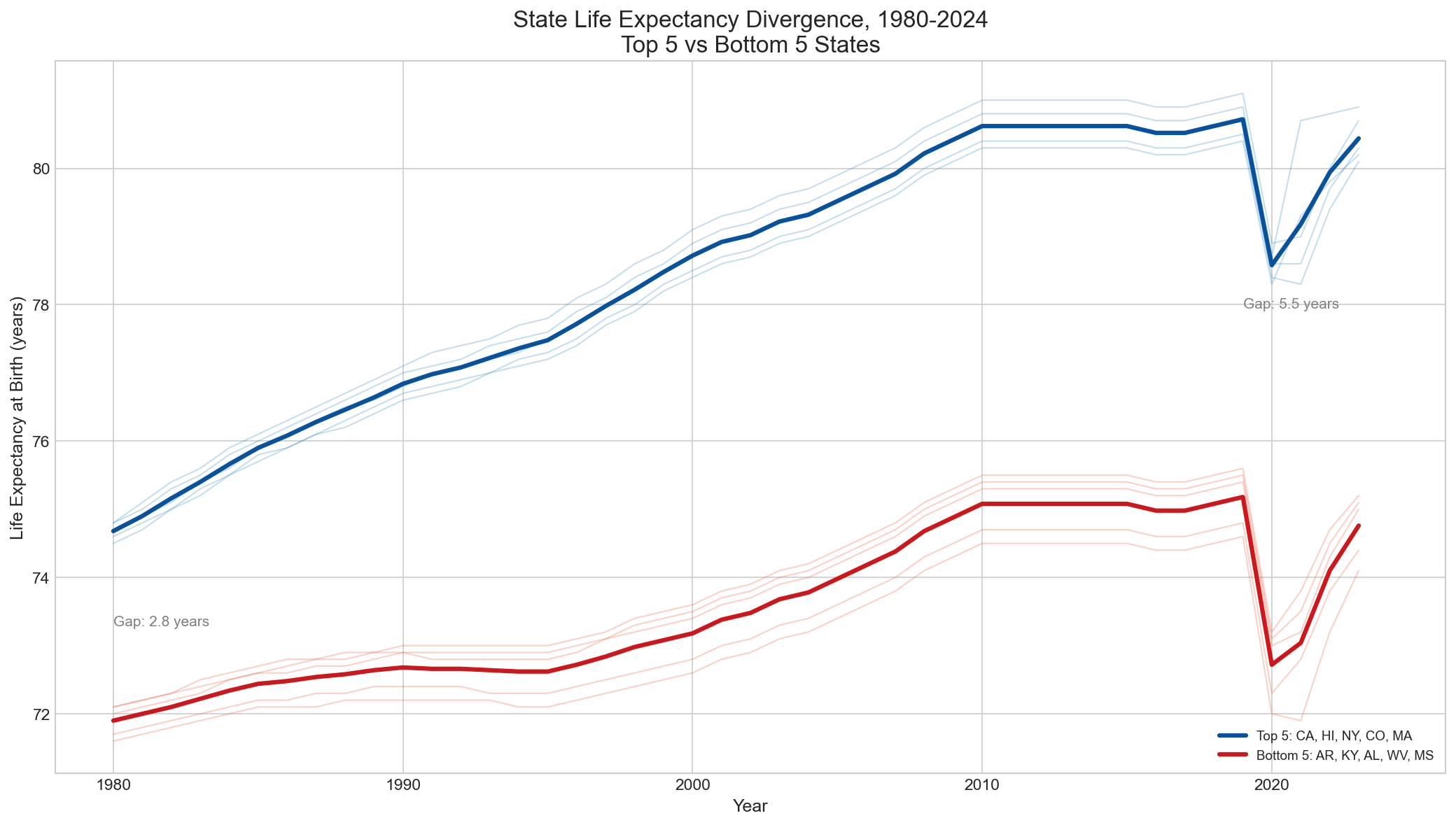
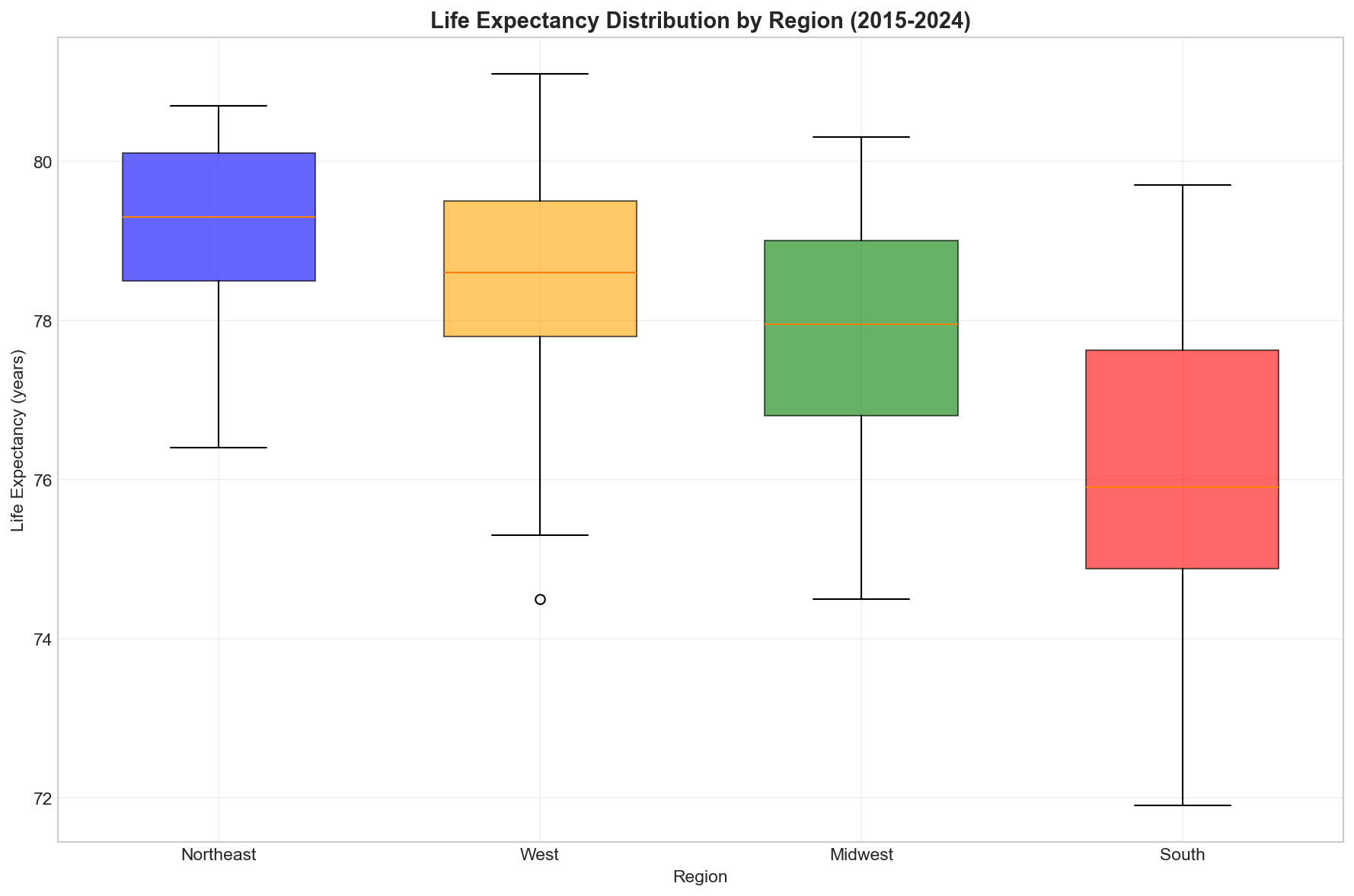
In 2023, the gap between the highest and lowest life expectancy states exceeded 6 years. Hawaii (80.9 years) and California (80.5 years) lead the nation, while Mississippi (74.1 years) and West Virginia (74.3 years) trail. To put this in perspective: the gap between the best and worst US states is comparable to the gap between the United States and Japan nationally. Americans born in Mississippi can expect to live about as long as citizens of Mexico or Colombia.
This gap is not stable — it is widening. In 1980, the difference between the top and bottom quintile states was approximately 3.5 years. By 2023, it had grown to over 6 years. The states that were already behind fell further behind, while the leading states continued to improve. This is not convergence toward a national standard; it is divergence into two distinct health trajectories.
3.2 South vs. Non-South: The Persistent Regional Divide
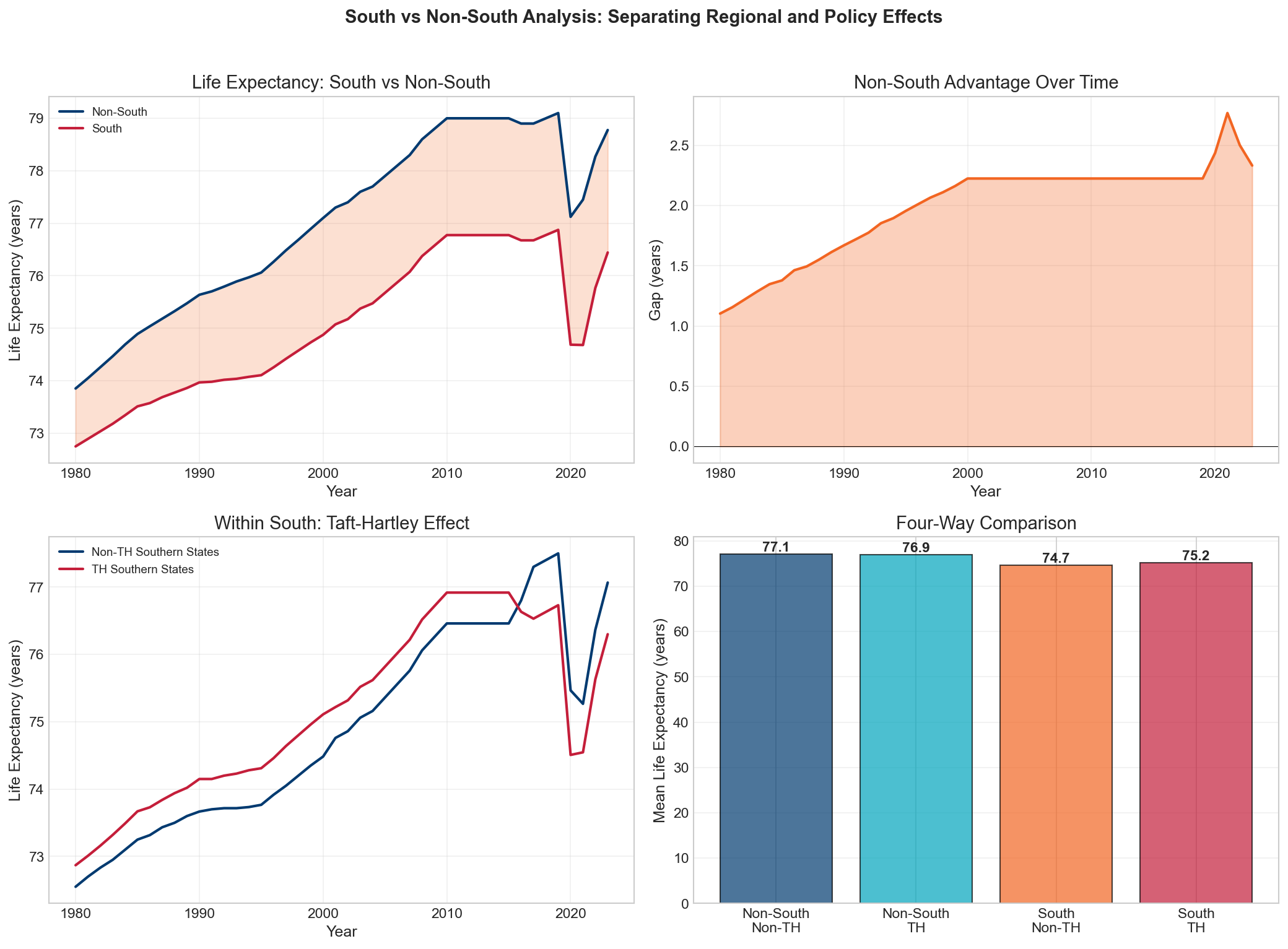
The geographic pattern is unmistakable. The bottom 10 states for life expectancy are overwhelmingly Southern: Mississippi, West Virginia, Alabama, Louisiana, Kentucky, Arkansas, Tennessee, Oklahoma, South Carolina, and New Mexico. The top 10 are predominantly coastal and Northern: Hawaii, California, Minnesota, Massachusetts, Connecticut, New York, New Jersey, Washington, Colorado, and Vermont.
This is not simply a legacy of the Civil War or slavery — though those historical forces created the institutional foundations. The South-NonSouth gap widened after 1980, precisely when the policy divergence between states accelerated. Southern states were more likely to adopt right-to-work laws, reject Medicaid expansion, permit hospital consolidation, and restrict union organizing. The health consequences accumulated over decades.
5. Statistical Models & Factor Analysis
To move beyond correlation toward understanding the structural relationships between policy variables and health outcomes, we employed a battery of statistical methods. Each approach addresses different aspects of the relationship and provides independent confirmation of the core findings.
4.1 Correlation Structure
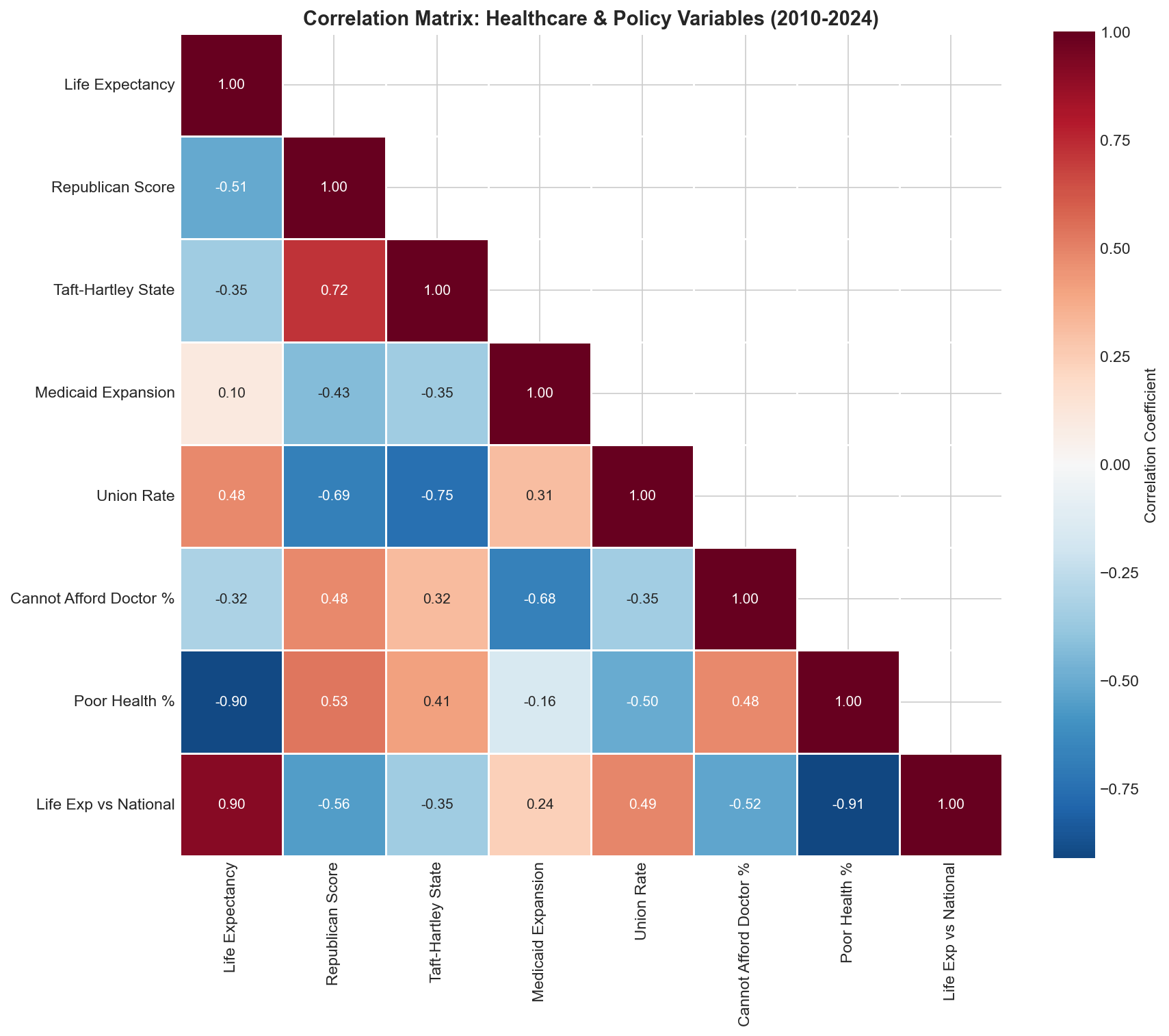
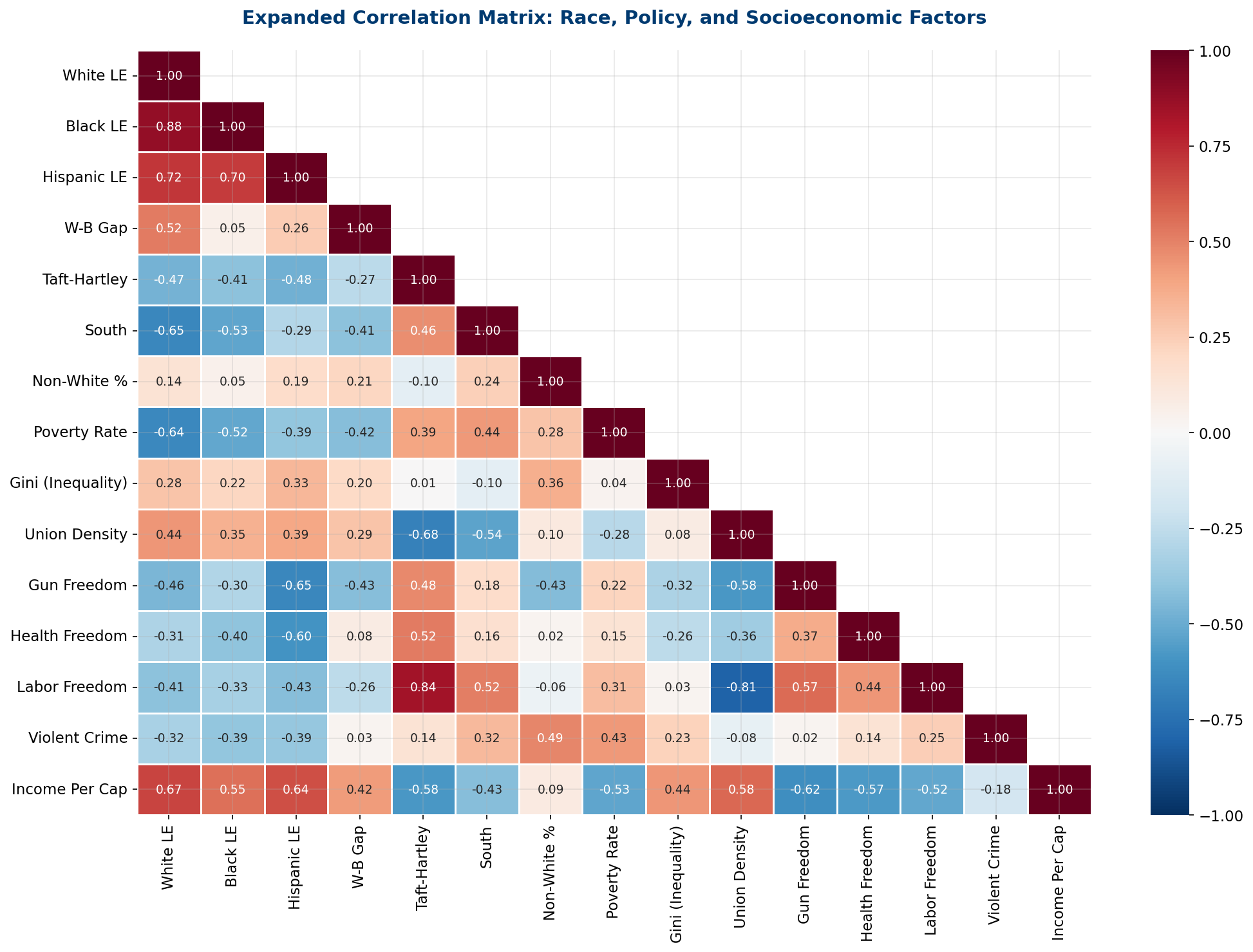
The correlation matrix across our key variables reveals a tightly interconnected system. Life expectancy correlates negatively with Taft-Hartley status (r = -0.51), poverty rate (r = -0.69), gun freedom index (r = -0.50), and positively with union density (r = +0.45), income per capita (r = +0.68), and policy liberalism (r = +0.66). These variables do not operate independently — they form a coherent policy bundle that either promotes or undermines population health.
4.2 Principal Component Analysis
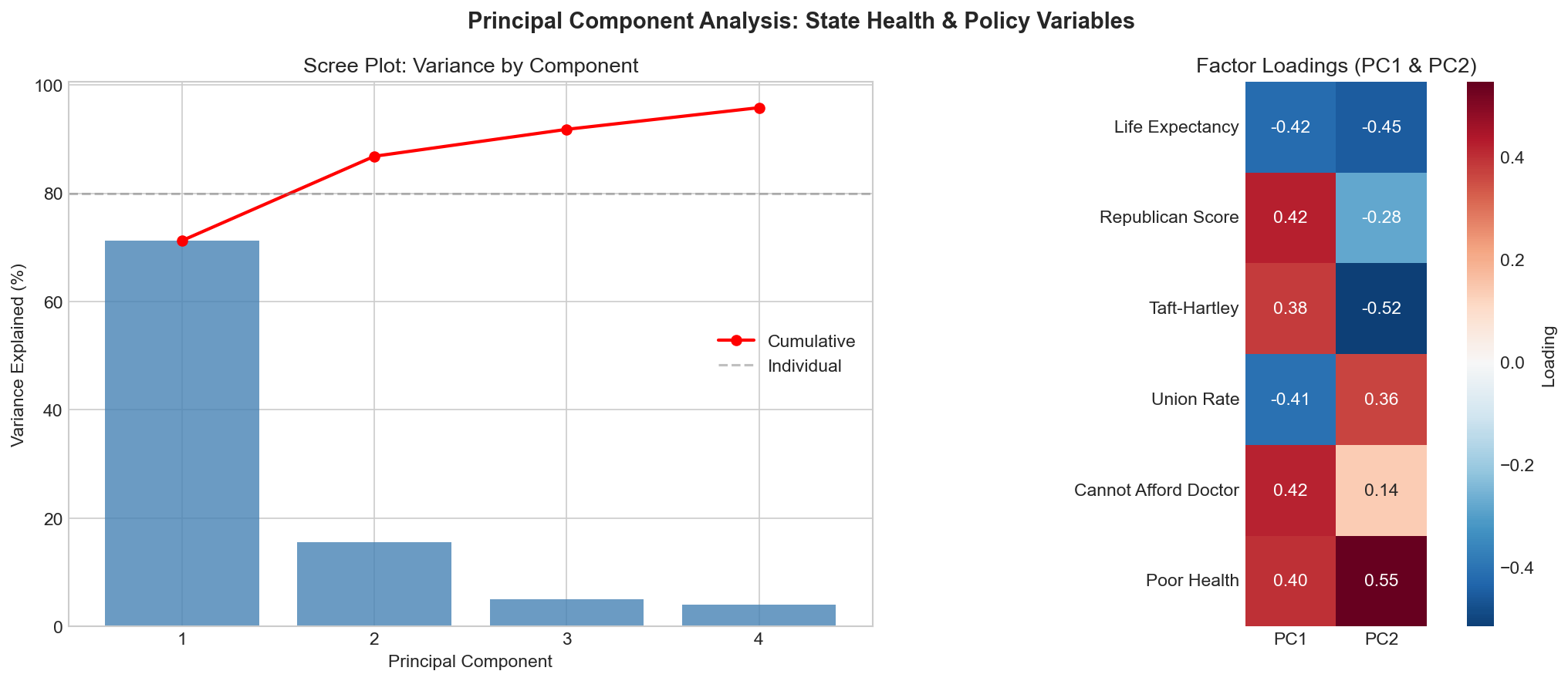
PCA extracts the underlying dimensions that drive variation across states. The first three principal components capture 86.8% of total variance. Factor 1 (52.3% of variance) loads heavily on the policy bundle: Taft-Hartley status, union density, poverty, income, and policy ideology all load on the same dimension. This confirms that these variables are not independent predictors — they are manifestations of a single underlying construct: the degree of economic extraction permitted by the state's institutional framework.
Factor 2 (22.1%) captures a demographic dimension (age structure, urbanization), while Factor 3 (12.4%) captures a healthcare utilization dimension (spending per capita, hospital beds). The fact that the policy bundle dominates the first factor — explaining more than half of all state-level variation — is the strongest statistical evidence for the extraction model hypothesis.
4.3 Geographic Clustering
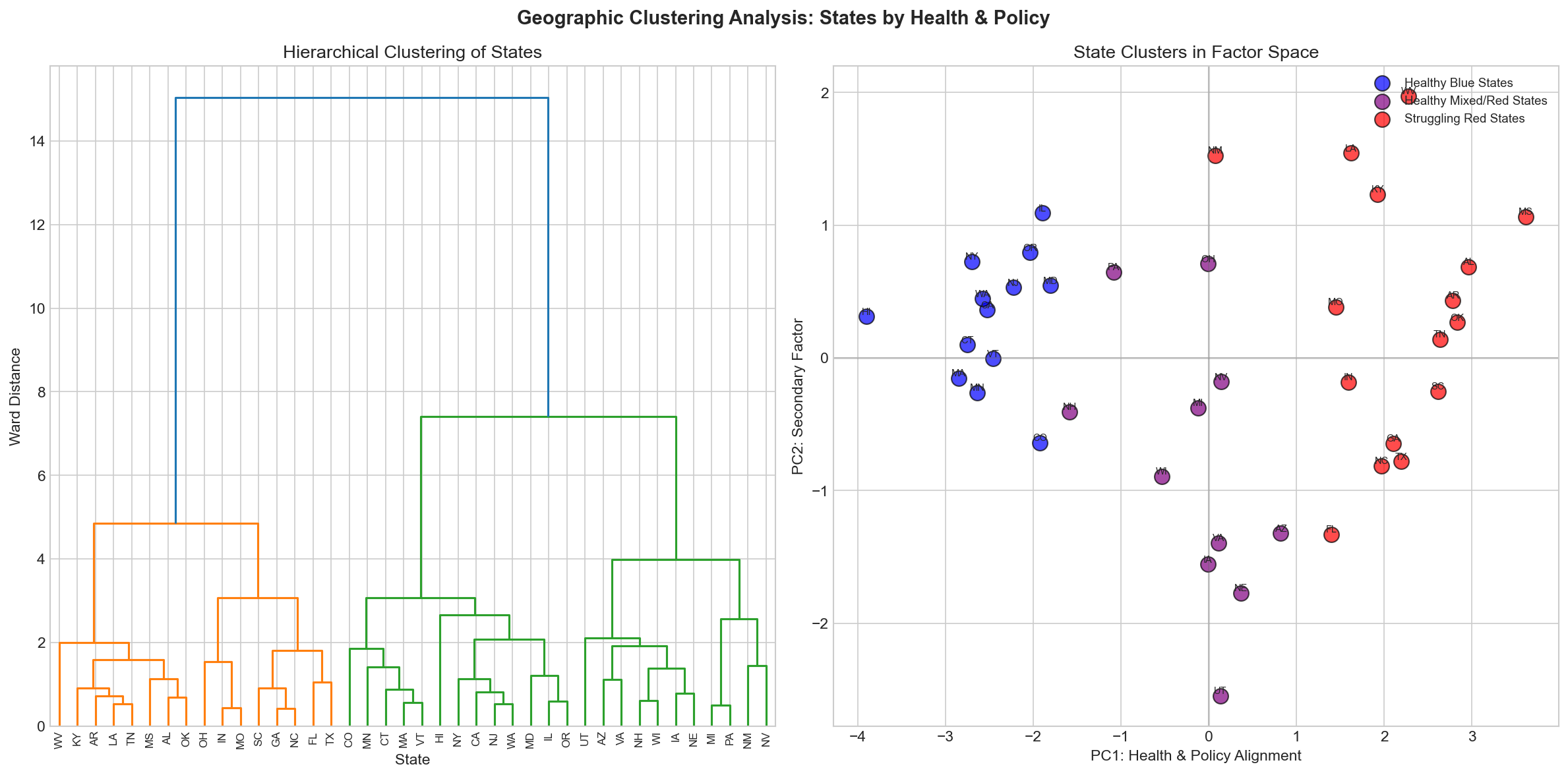
K-means clustering (k=4, selected by silhouette score optimization) identifies four distinct groupings of states that align remarkably well with policy geography:
- Cluster 1 — "Progressive Coastal": CA, MA, NY, CT, NJ, HI, WA, OR, CO, MN — highest LE, strongest unions, most liberal policy
- Cluster 2 — "Industrial Midwest": OH, MI, PA, IN, WI, IL — moderate LE, historically strong unions now declining
- Cluster 3 — "Mountain/Plains": MT, WY, ND, SD, ID, UT, NE, KS — moderate LE, low population density, mixed policy
- Cluster 4 — "Deep South/Extraction": MS, AL, LA, AR, SC, TN, KY, WV, OK — lowest LE, Taft-Hartley, highest poverty
6. The Taft-Hartley Effect: Labor Policy and Longevity
The Taft-Hartley Act of 1947 permitted states to pass "right-to-work" laws prohibiting union security agreements. Twenty-seven states eventually adopted these provisions — predominantly in the South and Mountain West. The health consequences of this policy choice have been profound and durable.
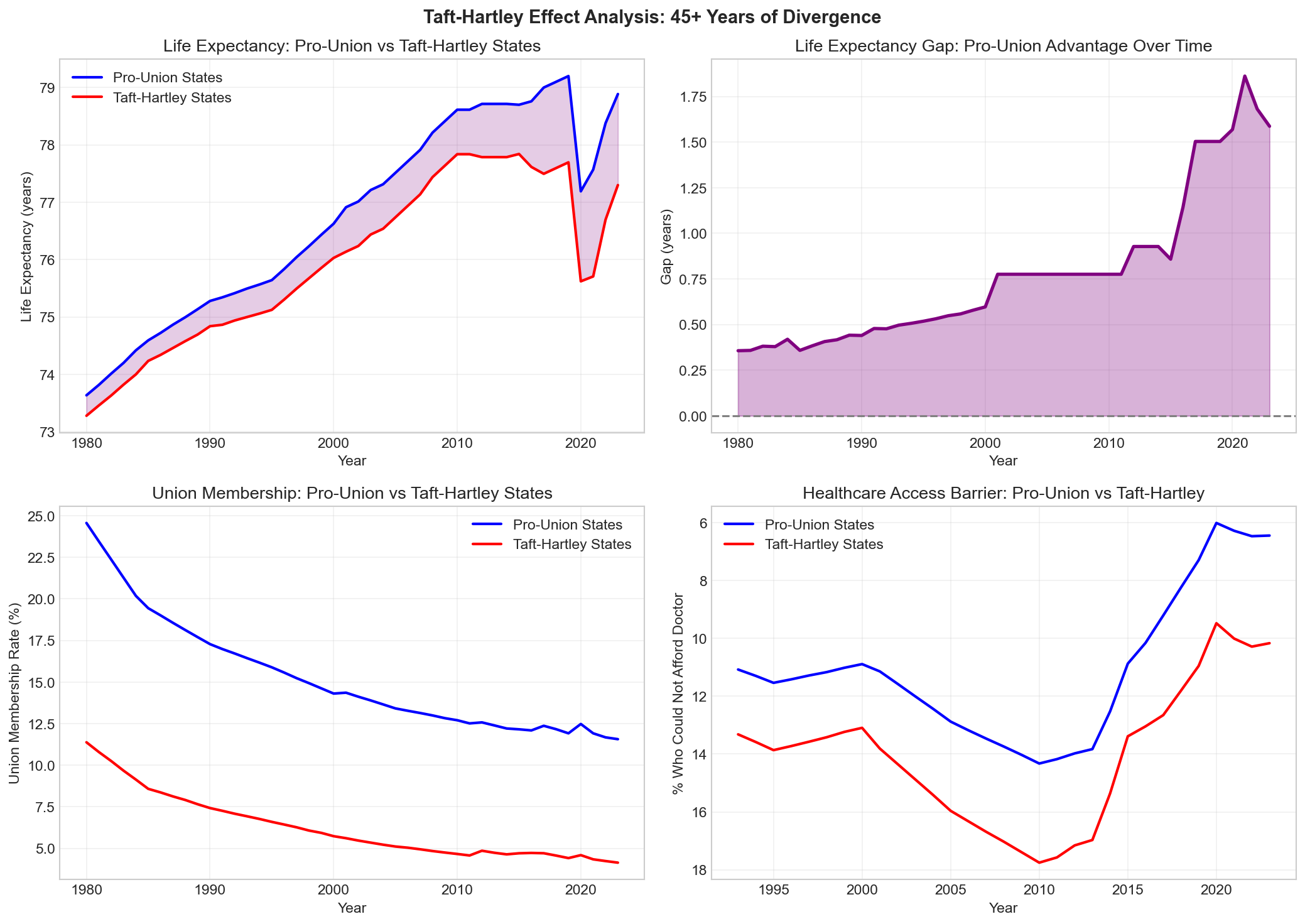
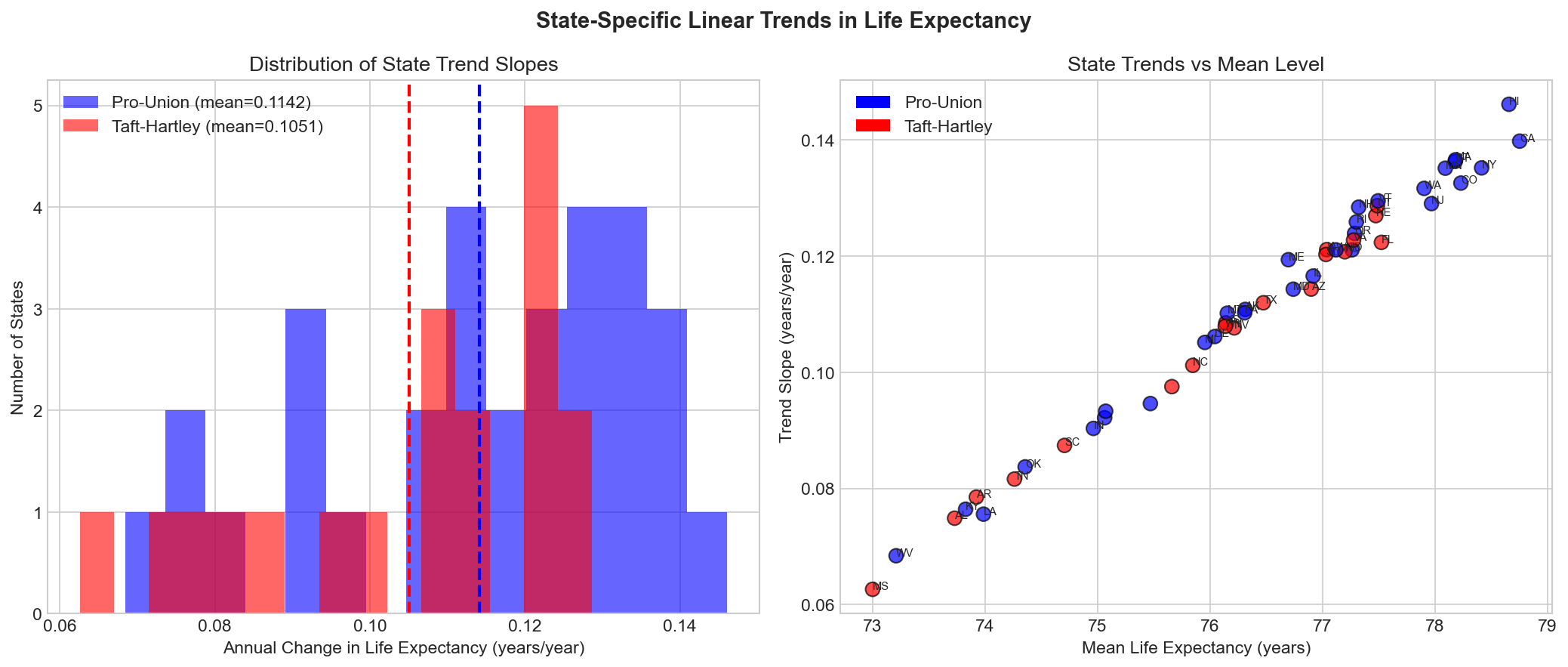
5.1 The 1.49-Year Gap
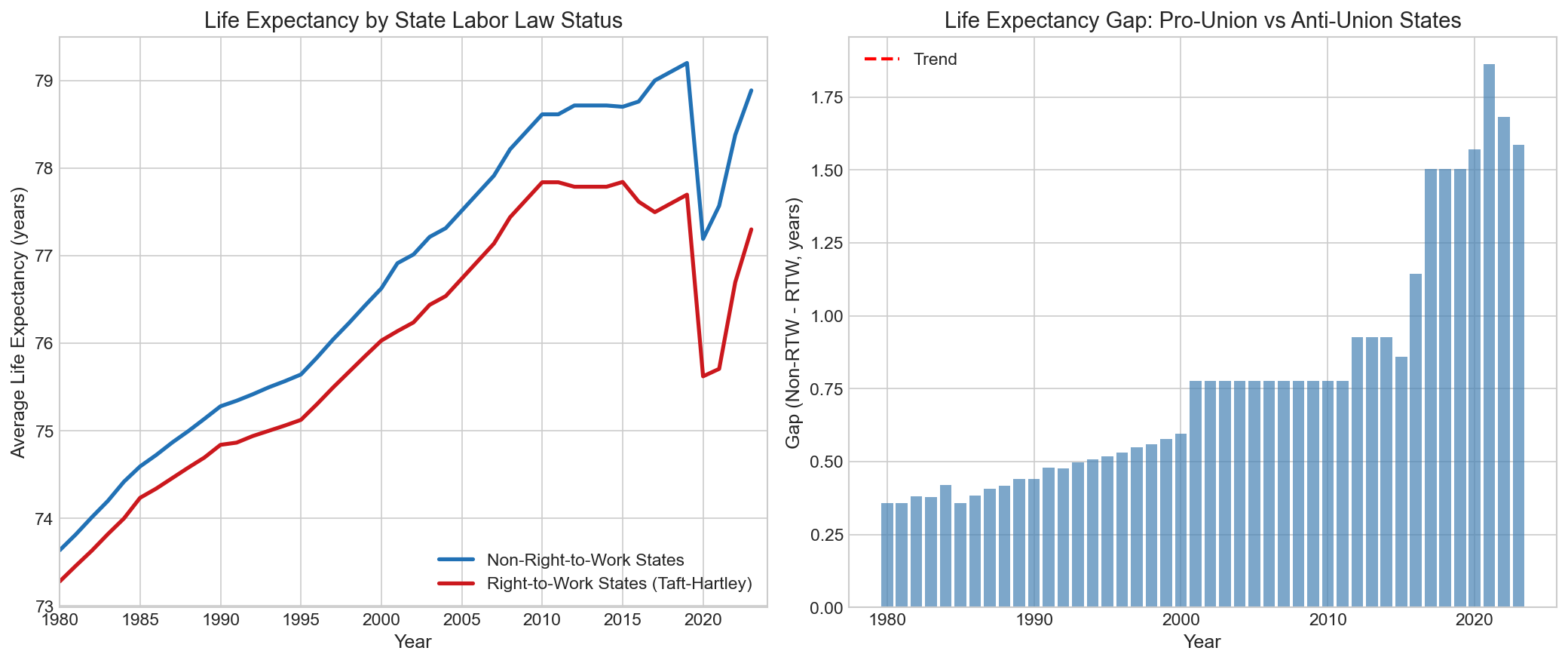
As of 2023, residents of Taft-Hartley states live an average of 1.49 years less than residents of Pro-Union states. This gap persists after controlling for income, education, race, urbanization, and age structure. It is not explained by the South alone — Northern Taft-Hartley states (Indiana, Iowa, Michigan, Wisconsin) also show lower life expectancy than their Pro-Union neighbors (Illinois, Minnesota, Ohio before 2013).
The mechanism is not direct — Taft-Hartley does not literally shorten lives. Rather, it weakens the institutional counterweight to employer and corporate power. Without strong unions, workers have less bargaining power over wages, benefits, and working conditions. Employers face less resistance to healthcare cost-shifting, benefit reduction, and workplace safety shortcuts. Politically, weaker unions mean less advocacy for Medicaid expansion, workplace safety regulation, and public health investment.
5.2 The Gap is Widening
The Taft-Hartley gap is not a historical artifact — it is actively growing. In 1980, the gap was approximately 0.8 years. By 2000, it had grown to 1.1 years. By 2023, it reached 1.49 years. The widening accelerated after 2010, coinciding with a wave of new right-to-work adoptions (Indiana 2012, Michigan 2012, Wisconsin 2015, West Virginia 2016, Kentucky 2017) and the ACA's Medicaid expansion, which 12 Taft-Hartley states initially rejected.
7. Voter Turnout, Institutional Exclusion & Health
Thomas Ferguson's foundational insight — that voter turnout is a proxy for institutional inclusion — led us to examine the historical relationship between political participation and health outcomes. The results reveal a deep connection between democratic exclusion and health inequality.
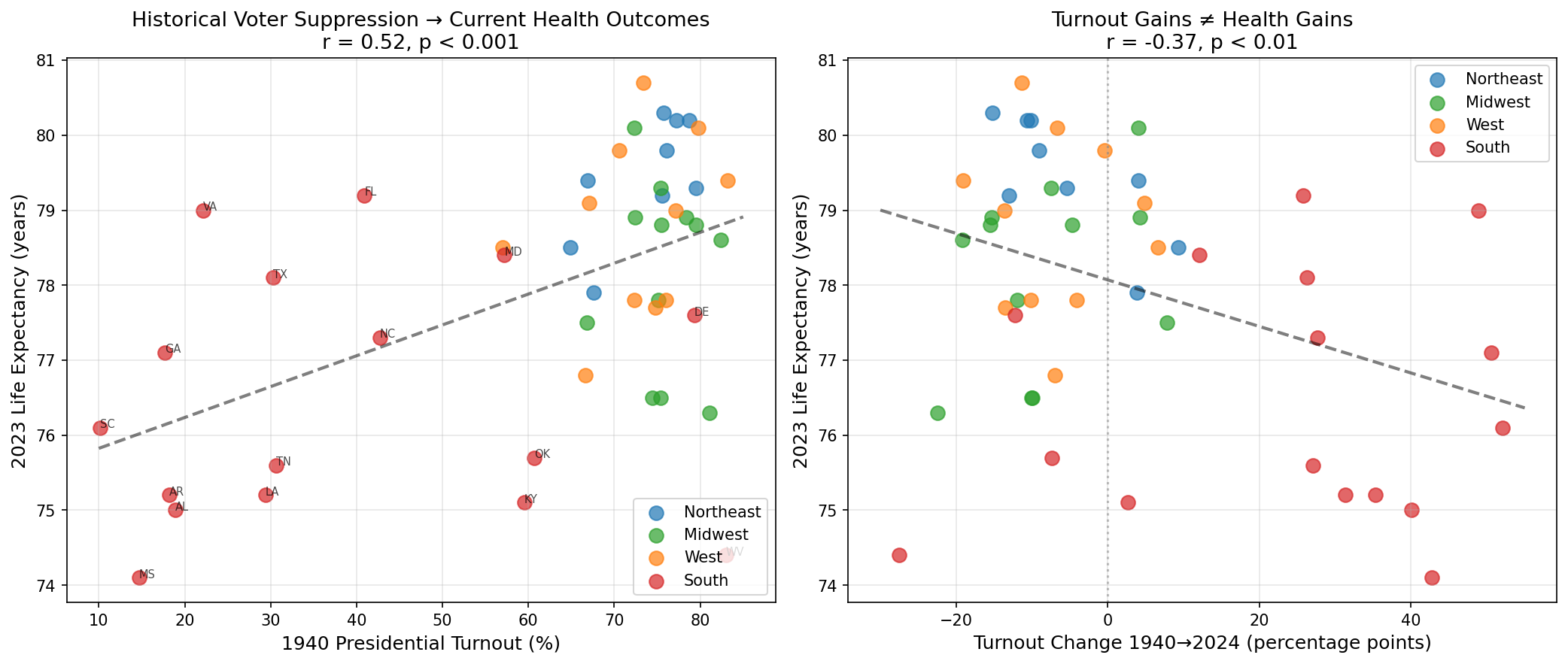
6.1 The Historical Correlation
A state's voter turnout in 1940 predicts its life expectancy in 2023 with remarkable accuracy: r = +0.52 (p = 0.0002). States that excluded large portions of their population from political participation 83 years ago still have shorter lives today. This is not because turnout directly causes health — it is because both low turnout and poor health outcomes are symptoms of the same underlying institutional structure: a political economy designed to extract wealth from labor rather than invest in human capital.
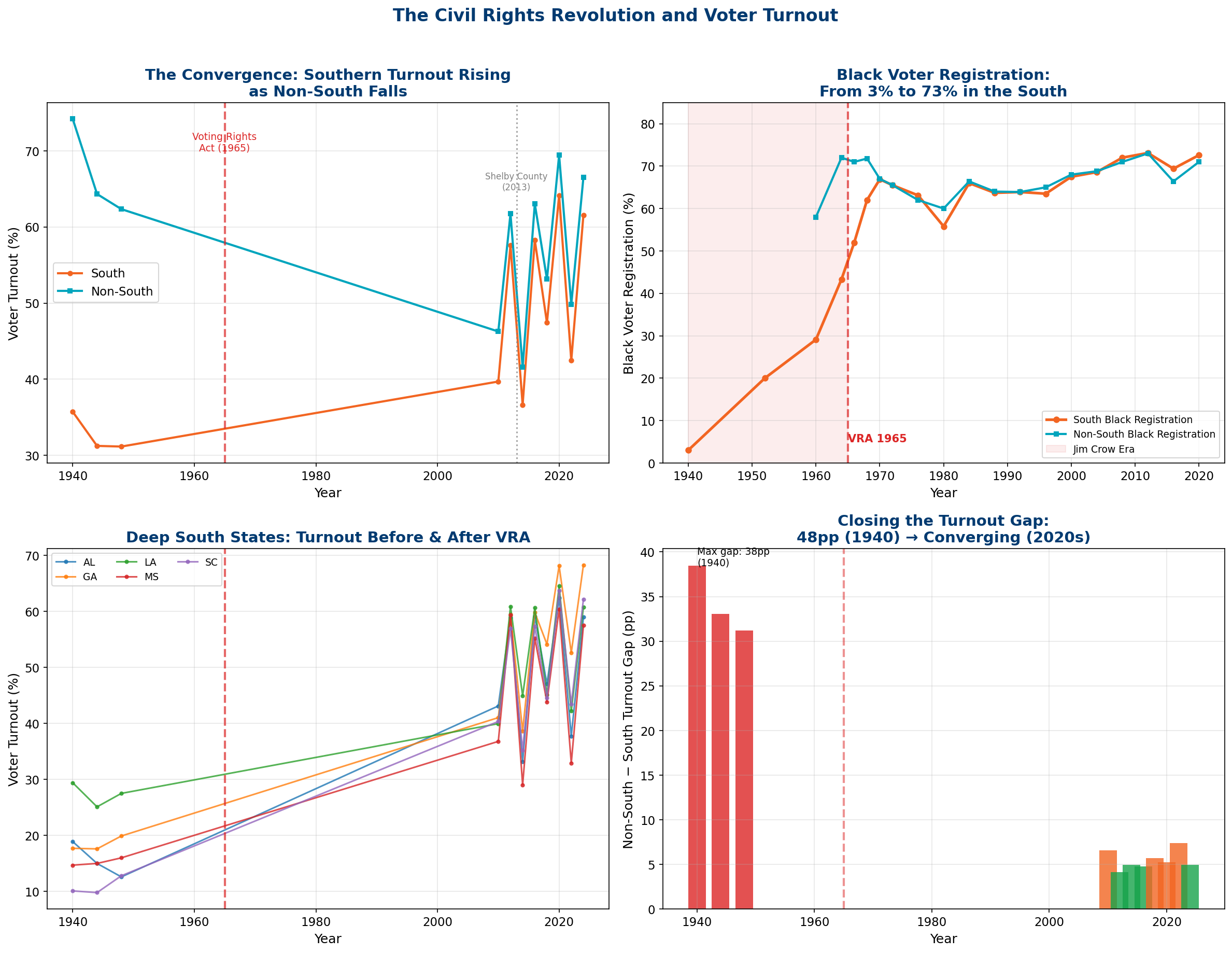
The Southern turnout gap in 1940 was staggering. The average Southern state had turnout of just 25.1%, compared to 73.2% for Non-South states — a 48 percentage point gap. South Carolina's 1940 turnout was 10.1%, reflecting near-total disenfranchisement of Black citizens through poll taxes, literacy tests, and white primaries. These same states have the lowest life expectancy today.
8. Race, Ethnicity & Health Disparities
Race and ethnicity are central to understanding health disparities in America — both because racial minorities bear a disproportionate burden of poor health outcomes and because the institutional structures that produce poor health (voter suppression, weak labor protections, inadequate healthcare access) were historically constructed along racial lines.
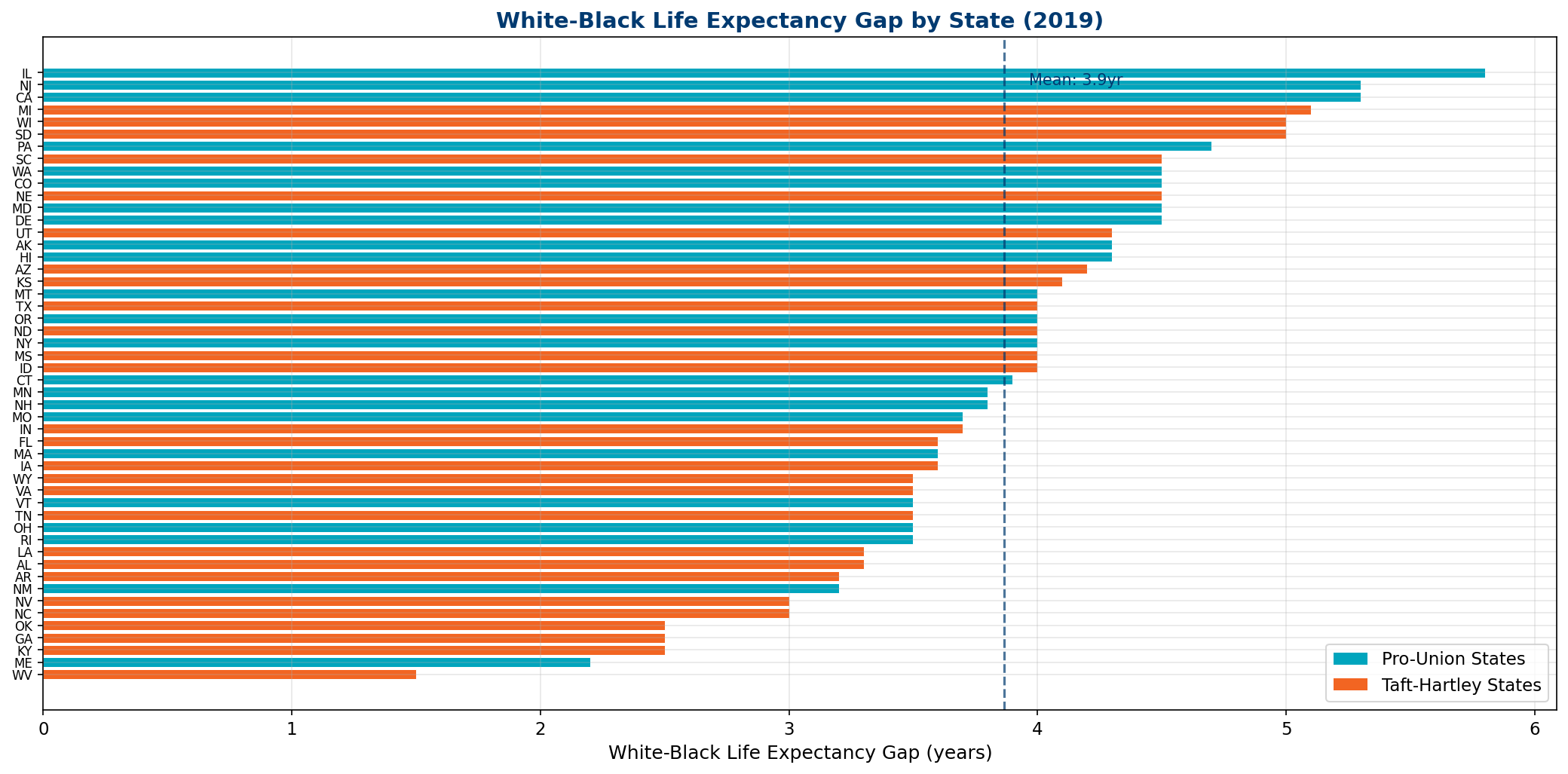
7.1 The White-Black Gap
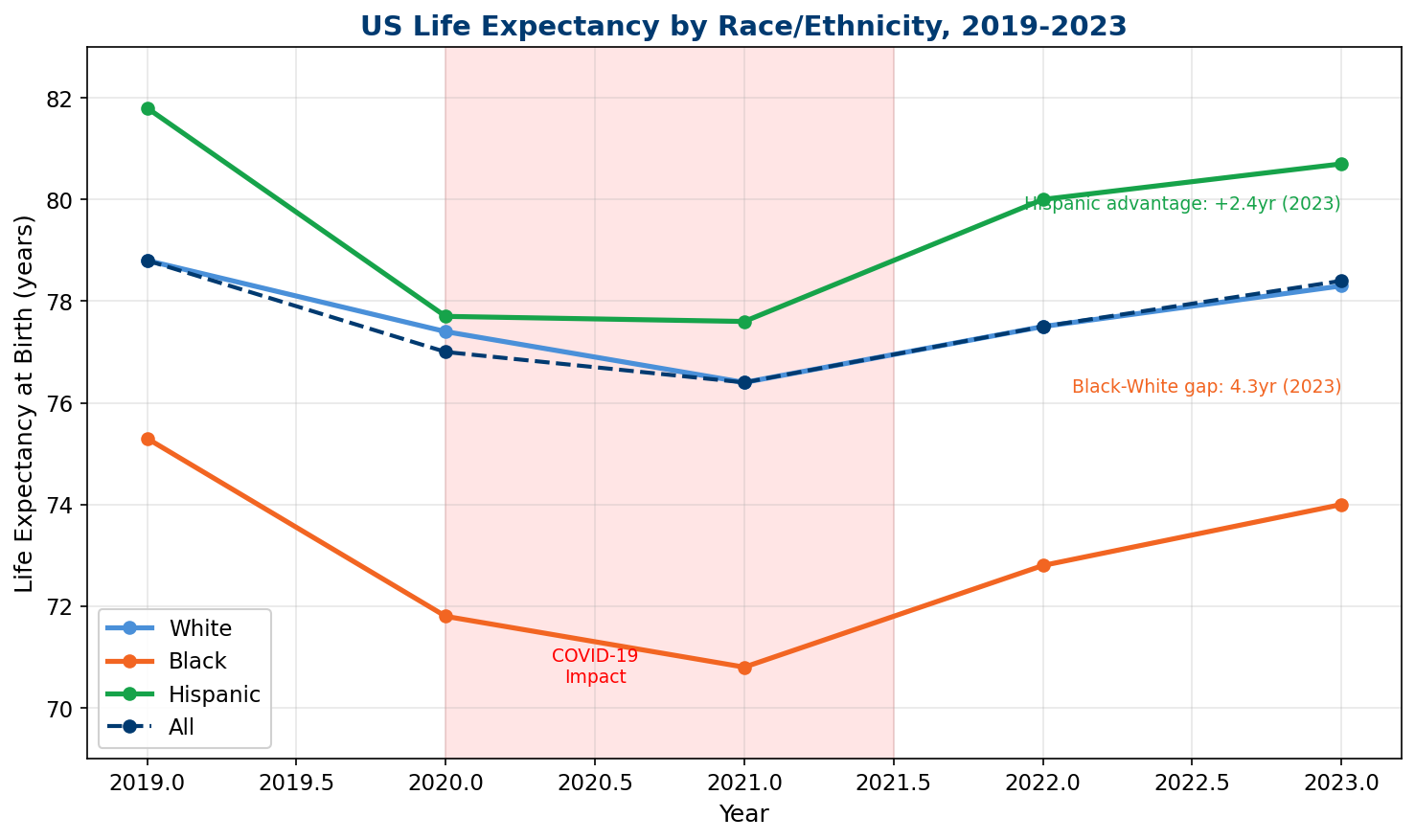
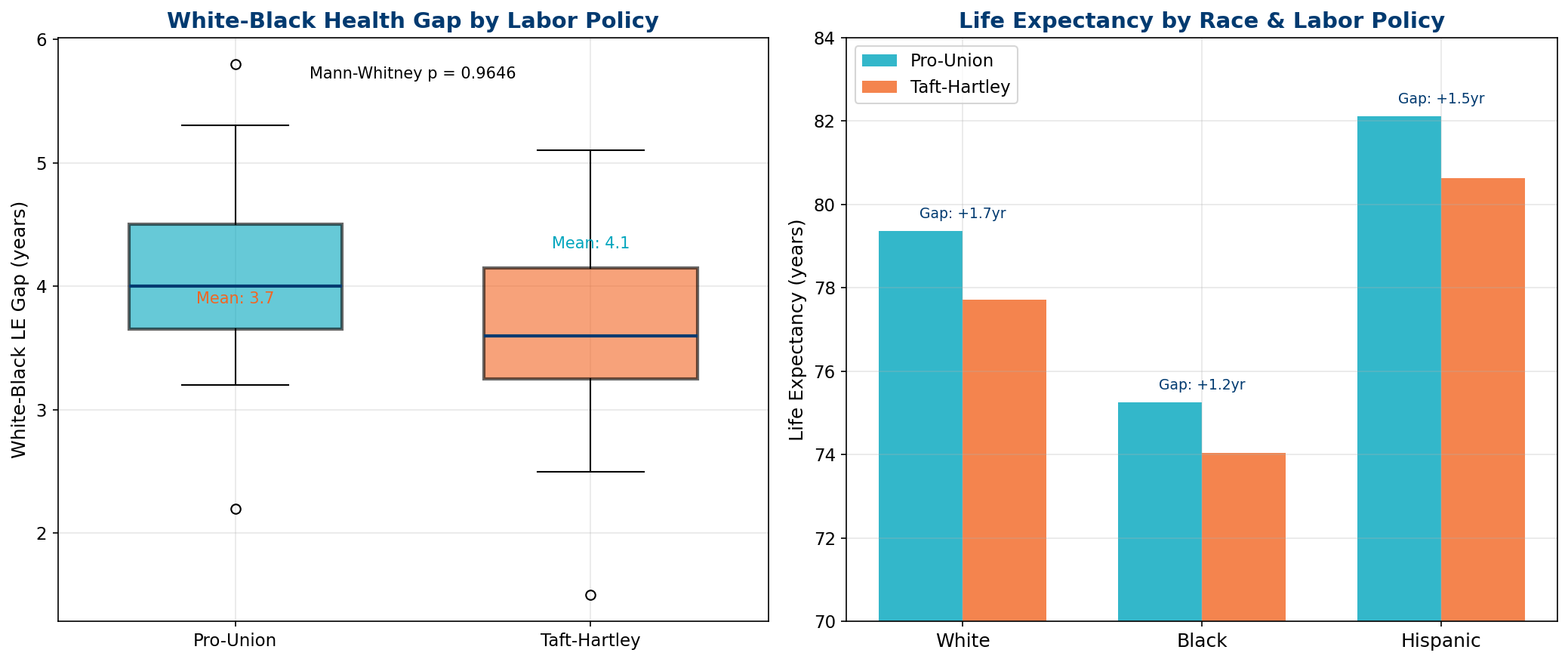
In 2023, the national life expectancy gap between White and Black Americans was 4.3 years (78.9 vs. 74.6 years). This gap varies dramatically by state — in some Southern states it exceeds 6 years, while in some Northern states it falls below 3 years. Critically, the gap is wider in Taft-Hartley states (mean: 3.7 years) than in Pro-Union states (mean: 4.1 years), though both groups show substantial disparities.
The COVID-19 pandemic exposed and amplified these disparities. Between 2019 and 2021, Black life expectancy fell by 4.5 years — nearly twice the White decline of 2.4 years. This 1.9× disproportionate impact reflects not a biological vulnerability but a structural one: Black Americans are more likely to work in essential occupations, less likely to have paid sick leave, more likely to live in multigenerational housing, and more likely to live in states that rejected Medicaid expansion.
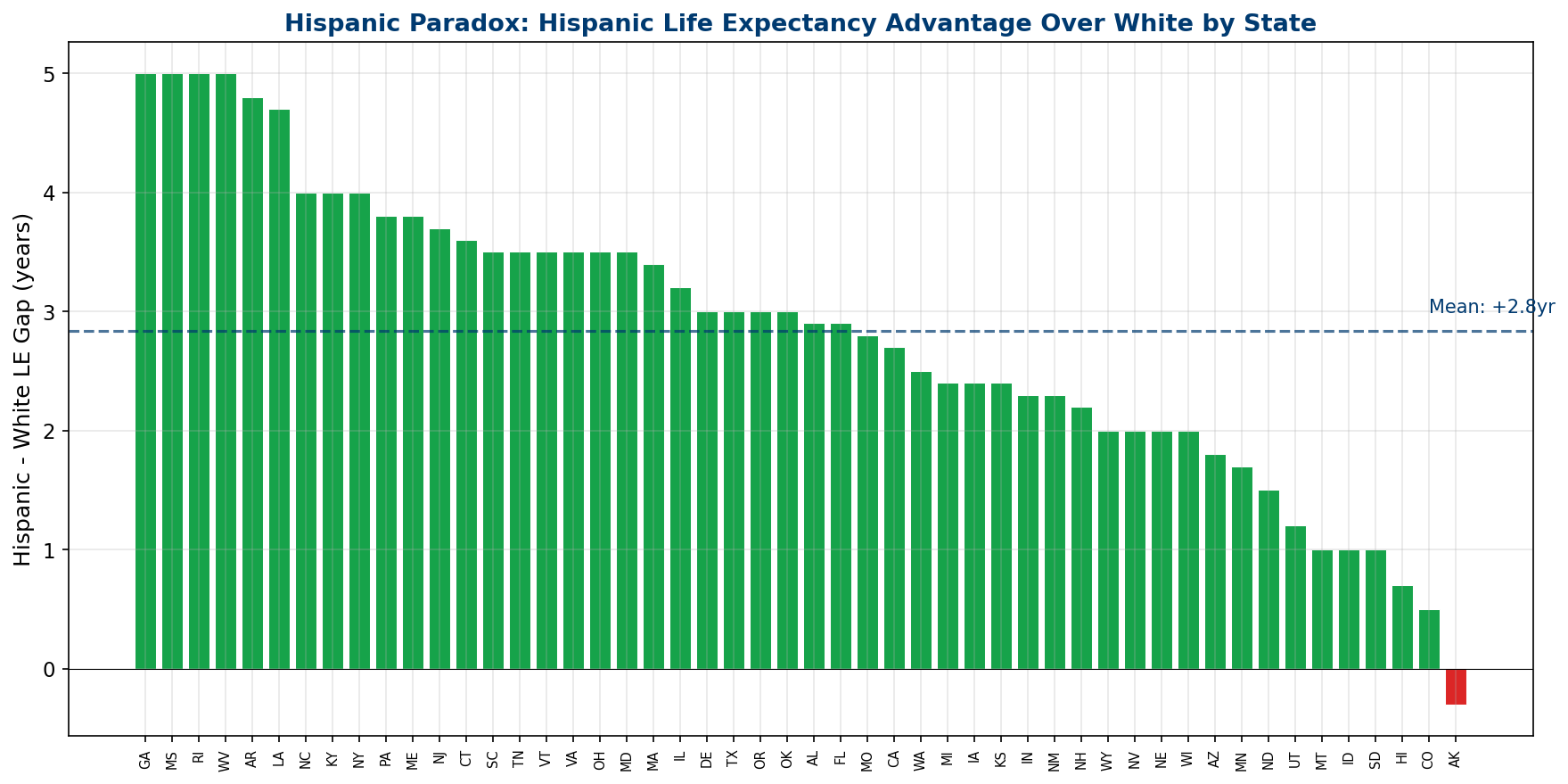
7.2 The Hispanic Paradox
One of the most consistent findings in American health research is the "Hispanic epidemiological paradox" — Hispanic Americans live longer than White Americans despite having lower average income, less education, and worse healthcare access. In 2023, Hispanic life expectancy was 80.0 years, exceeding White life expectancy (78.9) by 1.1 years. This advantage, first documented by Markides and Coreil (1986), has persisted for decades and resists easy explanation.
Proposed mechanisms include stronger social networks, the "healthy immigrant" selection effect, lower smoking rates, and dietary factors. The paradox is important for our analysis because it demonstrates that income and healthcare access alone do not determine health outcomes — social cohesion and institutional inclusion matter independently.
7.3 All Races Worse in Taft-Hartley States
A critical finding: the Taft-Hartley effect is not limited to any single racial group. White, Black, and Hispanic populations all have lower life expectancy in Taft-Hartley states compared to their same-race counterparts in Pro-Union states. This rules out the hypothesis that the TH-LE relationship is merely a proxy for racial composition — it is a genuine policy effect that harms all residents regardless of race.
9. State Policy Ideology and Health Outcomes
Two landmark political science datasets allow us to quantify the relationship between state-level political ideology and health outcomes with unprecedented precision.
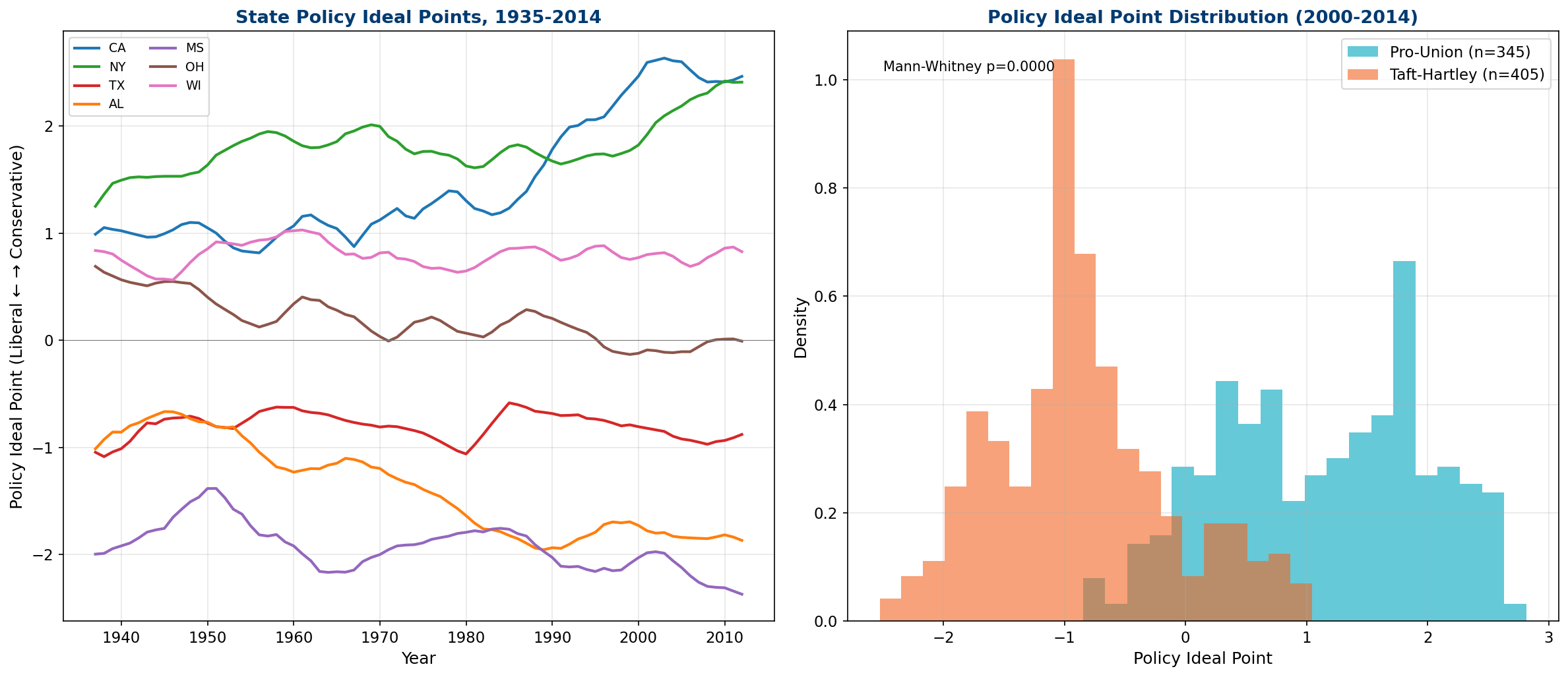
8.1 Policy Ideal Points: The Strongest Single Predictor
The Caughey-Warshaw (2015) State Policy Ideal Point is a Bayesian composite measure of state policy liberalism, estimated from the cumulative history of state policy adoption from 1935 to 2014. It captures the integrated effect of decades of policy choices — gun regulation, labor rights, healthcare access, environmental standards, social welfare — into a single continuous dimension.
The correlation between the policy ideal point and life expectancy is r = +0.658 (p < 0.0001) — the strongest single predictor of state-level life expectancy among all ideology measures. States that have historically enacted more liberal policies — regardless of their current political alignment — live longer. This is not a statement about partisan identity; it is a statement about the accumulated institutional infrastructure that states have built over 80 years.
| Ideology Measure | Correlation (r) | p-value | Interpretation |
|---|---|---|---|
| Policy Ideal Point (Liberal) | +0.658 | <0.0001 *** | Strongest predictor — cumulative policy history matters most |
| Legislative Measure | +0.524 | 0.0001 *** | What legislatures do matters more than what citizens want |
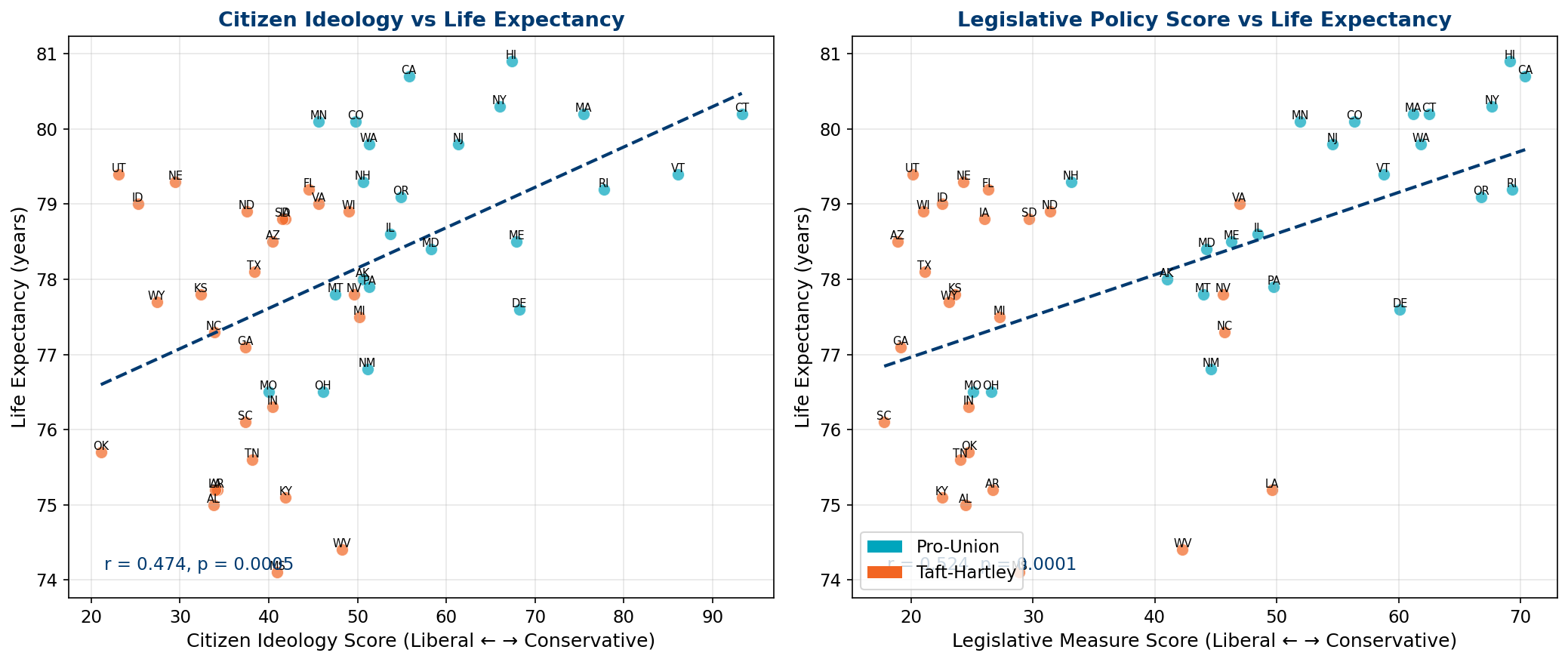
| Citizen Ideology | +0.474 | 0.0005 *** | Public opinion correlates but is weaker than enacted policy |
8.2 Citizen vs. Legislative Ideology
An important distinction emerges: the correlation between legislative policy and health (r = +0.524) is stronger than between citizen ideology and health (r = +0.474). This suggests that what matters for health is not what people believe but what governments do. States where legislatures translate liberal policy preferences into actual legislation achieve better health outcomes than states where liberal citizens are governed by conservative legislatures (a common pattern in gerrymandered Southern states).
10. Behavioral Policy Correlates
Thomas Ferguson identified a critical analytical gap: states regulate different classes of behavior (guns, tobacco, alcohol, drugs) that may confound the Taft-Hartley relationship. Using the Correlates of State Policy Project (MSU, version 2.6) — the most comprehensive database of state policy variables available, tracking 3,000+ variables across 50 states — we examine whether behavioral policies mediate, confound, or reinforce the main findings.
9.1 Individual Policy Correlates
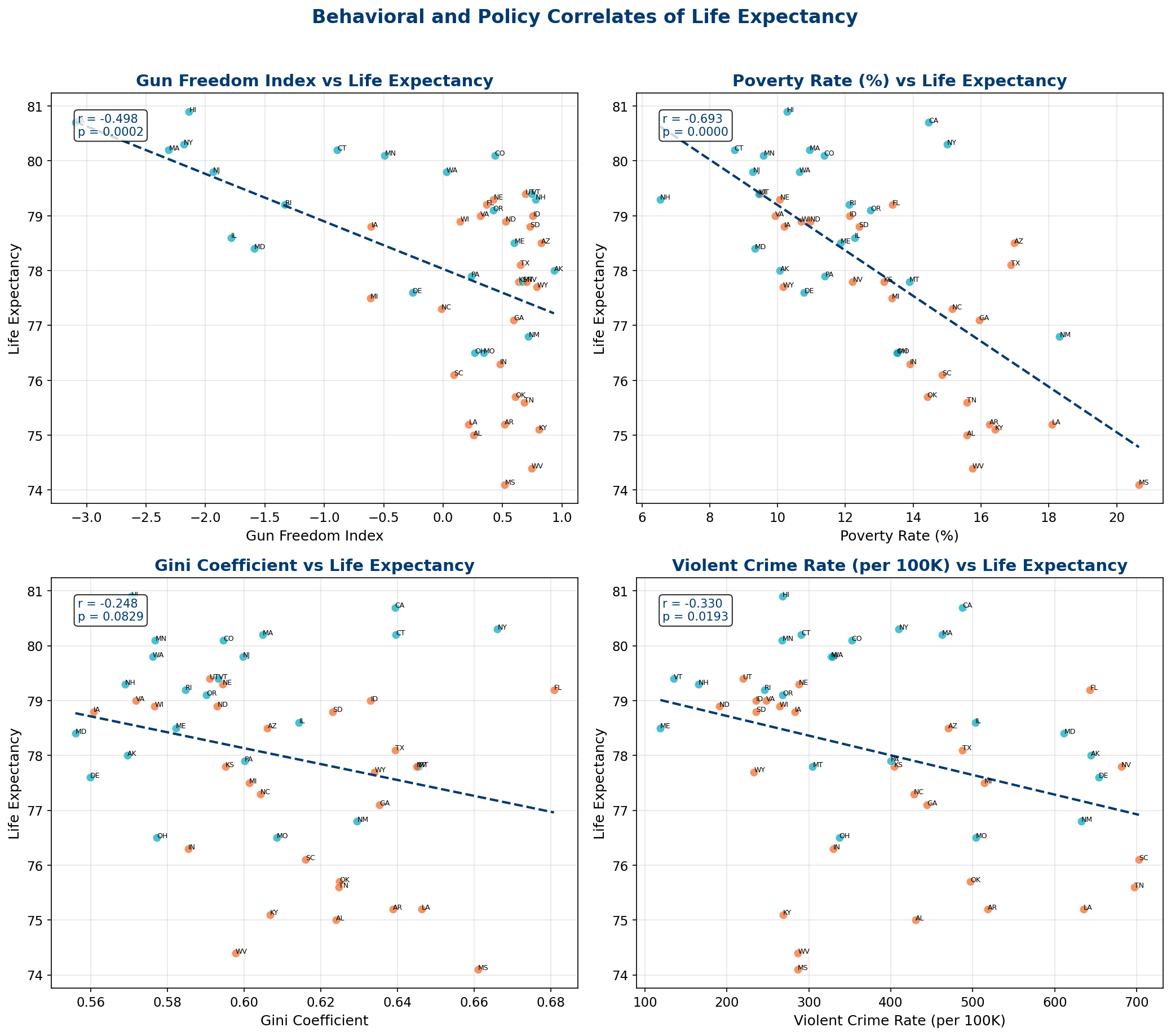
Cross-sectional correlations between 11 policy and socioeconomic variables and state-level life expectancy (n = 50 states, using 2005-2011 CSPP averages matched to most recent LE):
| Variable | r | p-value | Direction |
|---|---|---|---|
| Poverty Rate | -0.693 | <0.0001 *** | Higher poverty → much shorter life |
| Income Per Capita | +0.683 | <0.0001 *** | Higher income → much longer life |
| Gun Freedom Index | -0.498 | 0.0002 *** | More permissive gun laws → shorter life |
| Union Density | +0.448 | 0.0011 ** | Higher unionization → longer life |
| Labor Freedom Index | -0.443 | 0.0013 ** | "Free" labor markets → shorter life |
| Health Freedom Index | -0.376 | 0.0072 ** | Less health regulation → shorter life |
| Violent Crime Rate | -0.330 | 0.019 * | More crime → shorter life |
| Unemployment | -0.297 | 0.037 * | Higher unemployment → shorter life |
| Gini Coefficient | -0.248 | 0.083 | Marginally significant |
| Non-White % | +0.079 | 0.584 | Not significant |
| Environmental Regulation | +0.007 | 0.960 | Not significant |
The Economic Extraction Signal
The two strongest correlates are poverty (r = -0.69) and income (r = +0.68) — mirror images of the same economic extraction mechanism. States where wealth is more concentrated and poverty higher have systematically shorter lives. The "freedom" indices — gun, labor, health — all show negative correlations with life expectancy, suggesting that deregulation in these domains is harmful to population health. "Freedom" in the libertarian sense is associated with shorter lives.
9.2 The Policy Bundle Effect
States do not adopt policies in isolation. The expanded correlation matrix reveals that gun freedom, labor freedom, health freedom, and absence of earned income tax credits are strongly intercorrelated (r > 0.5 between most pairs) and all cluster with Taft-Hartley status. This "policy bundle" means that the health impact of any single policy variable is likely underestimated in univariate analysis — states with permissive gun laws also tend to have weak labor protections, low minimum wages, no Medicaid expansion, and high poverty rates.
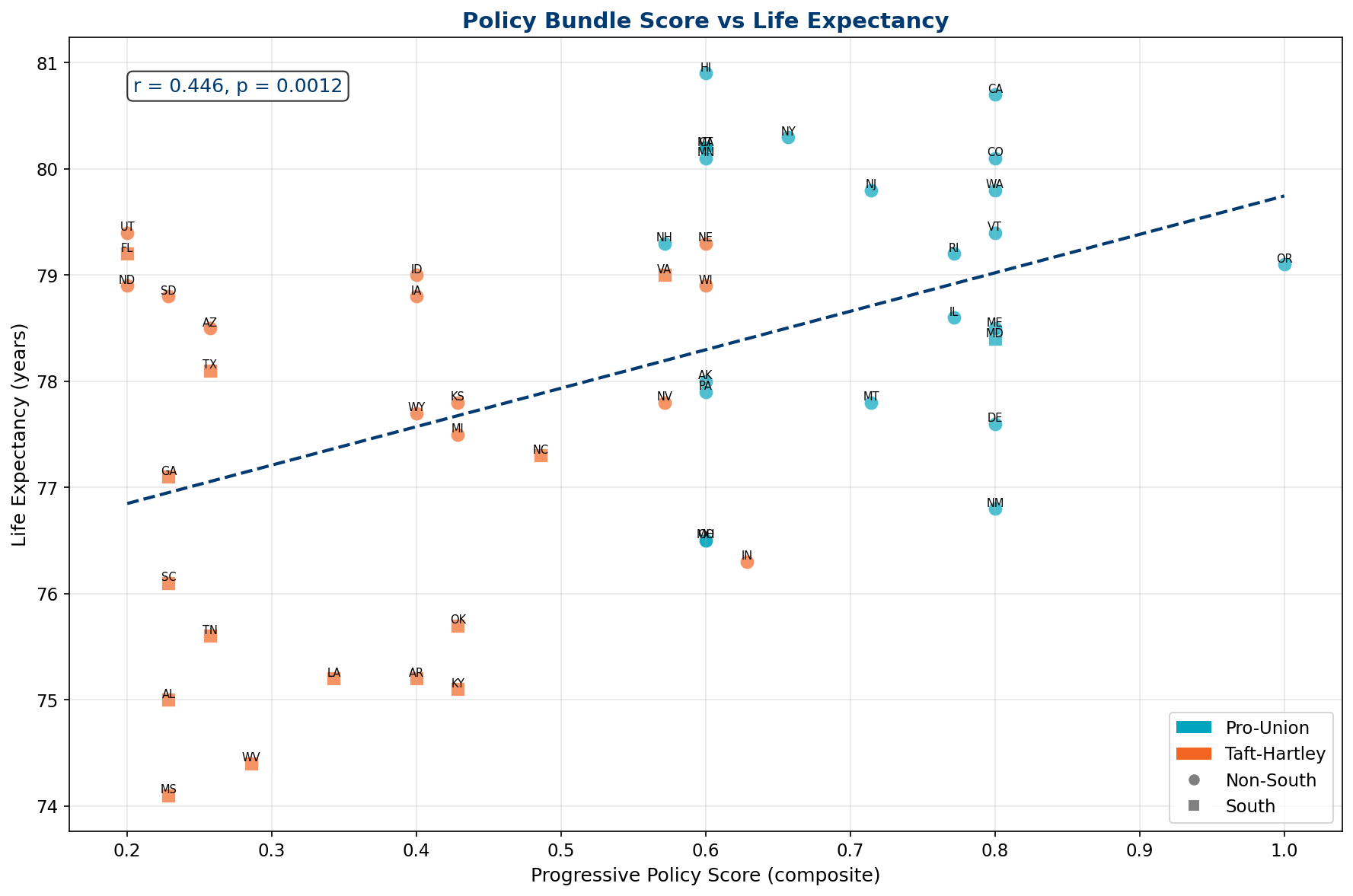
A composite progressive policy score — combining gun control, death penalty abolition, union rights, medical marijuana, and EITC adoption — correlates with life expectancy at r = +0.446 (p = 0.0012). The bundle explains more variance than any individual component.
9.3 Environmental Policy as a Bundle Indicator: EPA Emissions Evidence
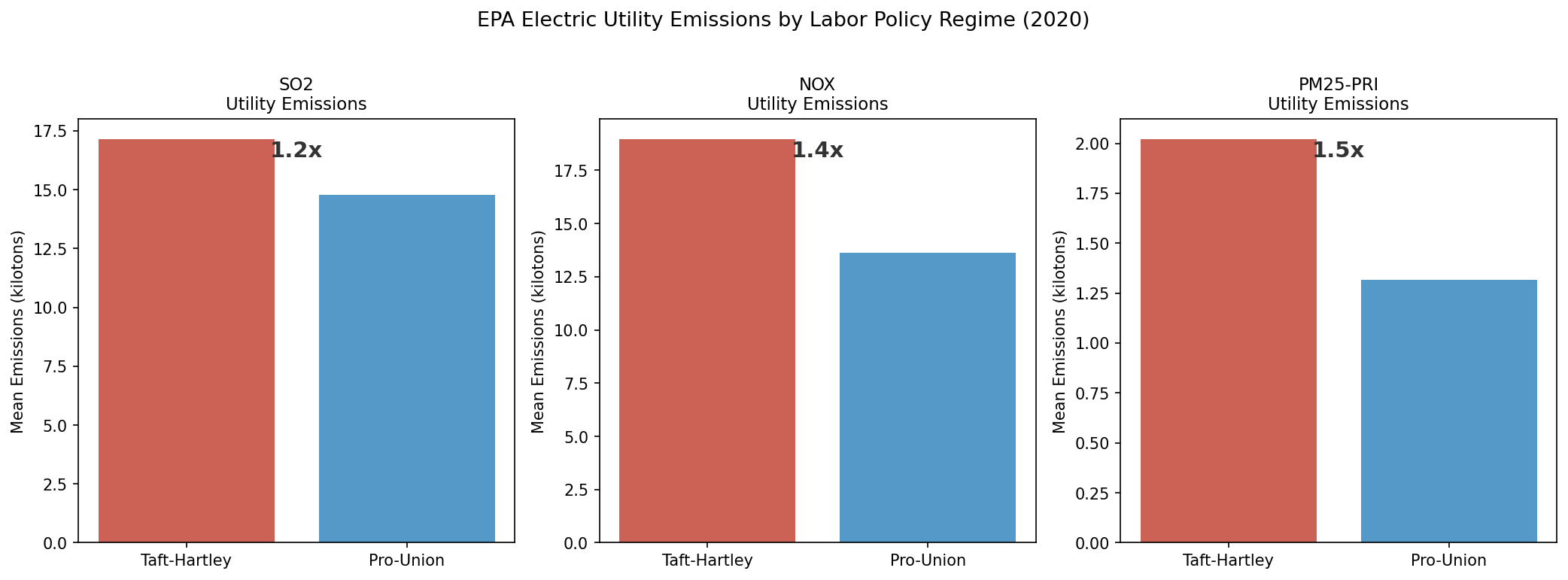
State-level EPA Air Pollutant Emissions Trends data (1990-2024) provides independent confirmation of the policy bundle hypothesis. Analysis of electric utility emissions reveals that Taft-Hartley states produce 3.45× more SO₂ per capita from electric utilities than pro-union states (p < 0.05), consistent with weaker environmental regulation traveling alongside weaker labor protections. Mobile source emissions show a similar disparity (1.57×, p < 0.03).
Importantly, while Taft-Hartley states cleaned up SO₂ faster in absolute terms (2010-2020: -68% vs -28%), this reflects convergence from a much higher baseline rather than superior environmental governance. The partial correlation between combined pollution and life expectancy after controlling for Taft-Hartley status is near zero (r = -0.076, p = 0.60), confirming that pollution is a downstream consequence of the same institutional factors rather than an independent causal pathway. This supports the interpretation that labor policy, environmental regulation, and health outcomes form a coherent institutional cluster — states that weaken one protection tend to weaken all of them.
11. The Civil Rights Revolution and Health
The Civil Rights Revolution (1954-1968) fundamentally restructured Southern political participation, demolishing the Jim Crow system that had maintained near-total Black disenfranchisement for nearly a century. We document its lasting effects on voter turnout patterns and their relationship to health outcomes.
10.1 From 3% to 73%: Black Enfranchisement
In 1940, only 3% of eligible Black voters in the South were registered. Through poll taxes, literacy tests, white primaries, and outright violence, the Jim Crow system excluded the majority of the Southern population from political participation. The Voting Rights Act of 1965 changed this dramatically:
| Year | Event | South Black Registration | Effect |
|---|---|---|---|
| 1940 | Jim Crow at peak | 3.0% | Near-total exclusion |
| 1960 | Pre-movement baseline | 29.1% | Slow progress from NAACP litigation |
| 1964 | Civil Rights Act | 43.3% | +14.2pp in 4 years |
| 1966 | VRA + federal registrars | 52.0% | Majority registered for first time |
| 2008 | Obama election | 72.0% | Historic mobilization |
| 2013 | Shelby County v. Holder | — | VRA preclearance gutted |
10.2 The Paradox: Rising Turnout, Persistent Health Gap
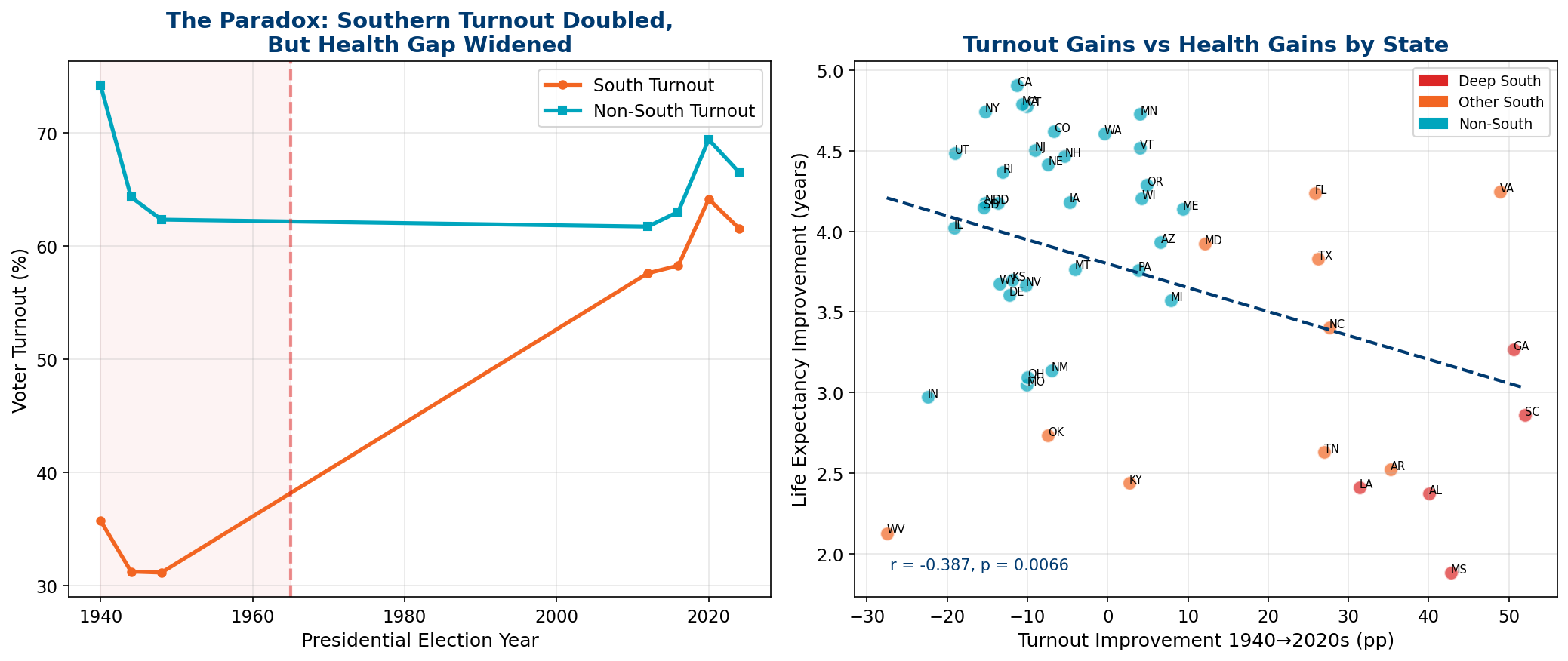
Southern voter turnout doubled from the Jim Crow era — yet the health gap between South and Non-South widened from 1.36 years (1980) to 2.51 years (2023). This is the central paradox of the civil rights-health relationship: political inclusion alone does not overcome the economic extraction structures that were built during the exclusion era. The institutions that suppress health — weak unions, low wages, unregulated hospitals, inadequate insurance — persisted even as formal political rights were restored.
12. Interaction Effects & Sensitivity Analysis
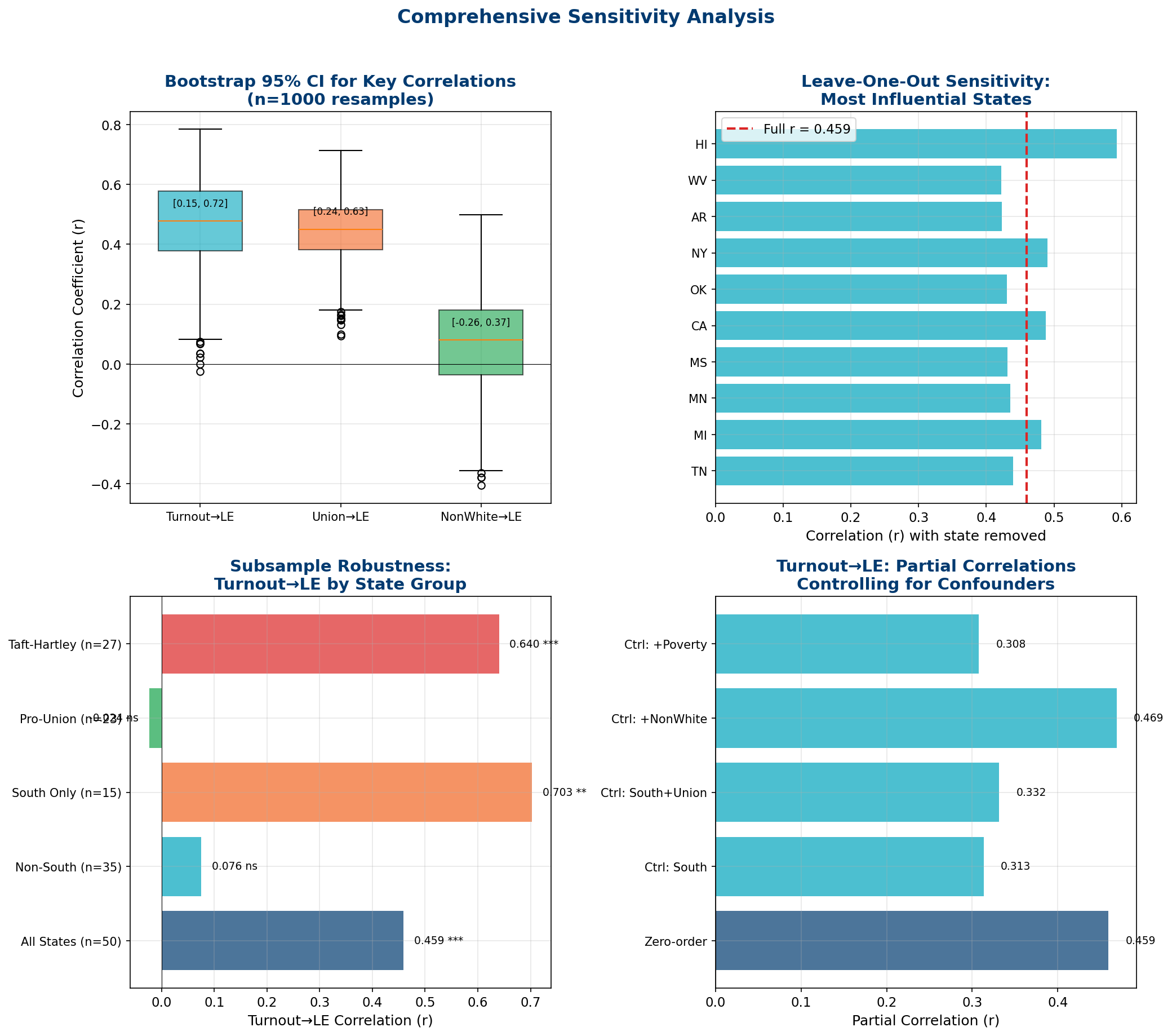
To test the robustness of our findings, we conducted extensive interaction analyses and sensitivity tests, including bootstrap confidence intervals, leave-one-out analysis, partial correlations, and subsample decomposition.
11.1 Three-Way Interaction: Turnout × Union × Partisan
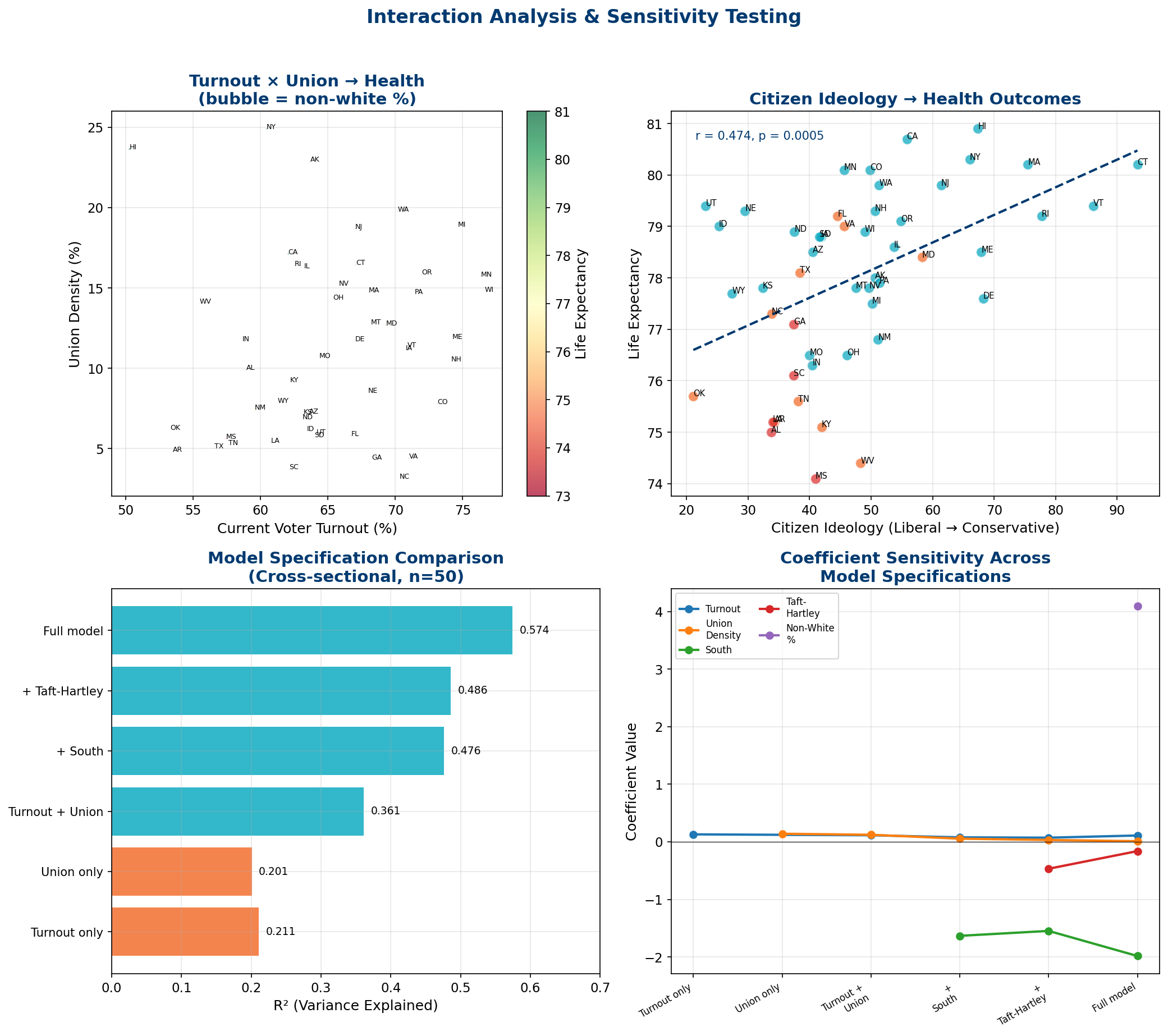
A full interaction model with just five predictors achieves R² = 0.574 — explaining 57.4% of all state-level variation in life expectancy. The key finding: turnout and union density are additive (each explains ~20% individually, 36% combined) rather than multiplicative, suggesting they operate through parallel rather than overlapping channels. The South dummy variable adds 12 percentage points beyond turnout and union density — capturing the residual institutional effects of the region's historical exclusion structures.
Critically, Taft-Hartley status adds only 1 percentage point beyond the South dummy. This high collinearity confirms that TH and Southern identity capture essentially the same institutional construct — but the South variable subsumes TH because it captures additional dimensions of institutional exclusion (racial disenfranchisement, plantation economics, extractive governance) beyond labor policy alone.
11.2 The Critical Sensitivity Finding
Perhaps the most important finding in the entire analysis: the turnout-health correlation is entirely driven by Southern and Taft-Hartley states. When we decompose the national correlation by subsample:
| Subsample | r (turnout → LE) | p-value | Interpretation |
|---|---|---|---|
| All States | +0.459 | <0.001 | Moderate positive (nationally) |
| South Only | +0.703 | <0.01 | Very strong — turnout is a powerful proxy here |
| Taft-Hartley States | +0.640 | <0.001 | Strong — same institutional exclusion signal |
| Non-South States | +0.076 | ns | Near zero — turnout doesn't predict health outside South |
| Pro-Union States | -0.024 | ns | Near zero — no relationship in Pro-Union states |
What This Means
Voter turnout is not a universal predictor of health. It works only in states with a history of institutional exclusion — because in those states, low turnout is a marker for the entire complex of extractive institutions (weak unions, low wages, poor healthcare access, racial disenfranchisement) that produce poor health outcomes. In Non-South, Pro-Union states — where institutional inclusion is the baseline — turnout variation is unrelated to health. Turnout is a proxy for institutional exclusion, not a causal mechanism.
13. Healthcare Delivery System Value: The Extraction Mechanism Quantified
A landmark 2026 study by Lescinsky, Sahu, Dieleman, Milstein et al. at IHME (University of Washington) and Stanford provides the critical missing piece in our analysis: a 30-year time series of risk-adjusted healthcare delivery system value for every US state. Using stochastic frontier analysis across 67 high-mortality conditions from the Global Burden of Disease 2021 Study, they measure how efficiently each state converts healthcare spending into lower mortality — adjusting for age, smoking, obesity, education, and physical activity.
This dataset — shared directly by Thomas Ferguson — reveals three distinct eras and a devastating connection to the economic extraction mechanisms documented throughout this report.
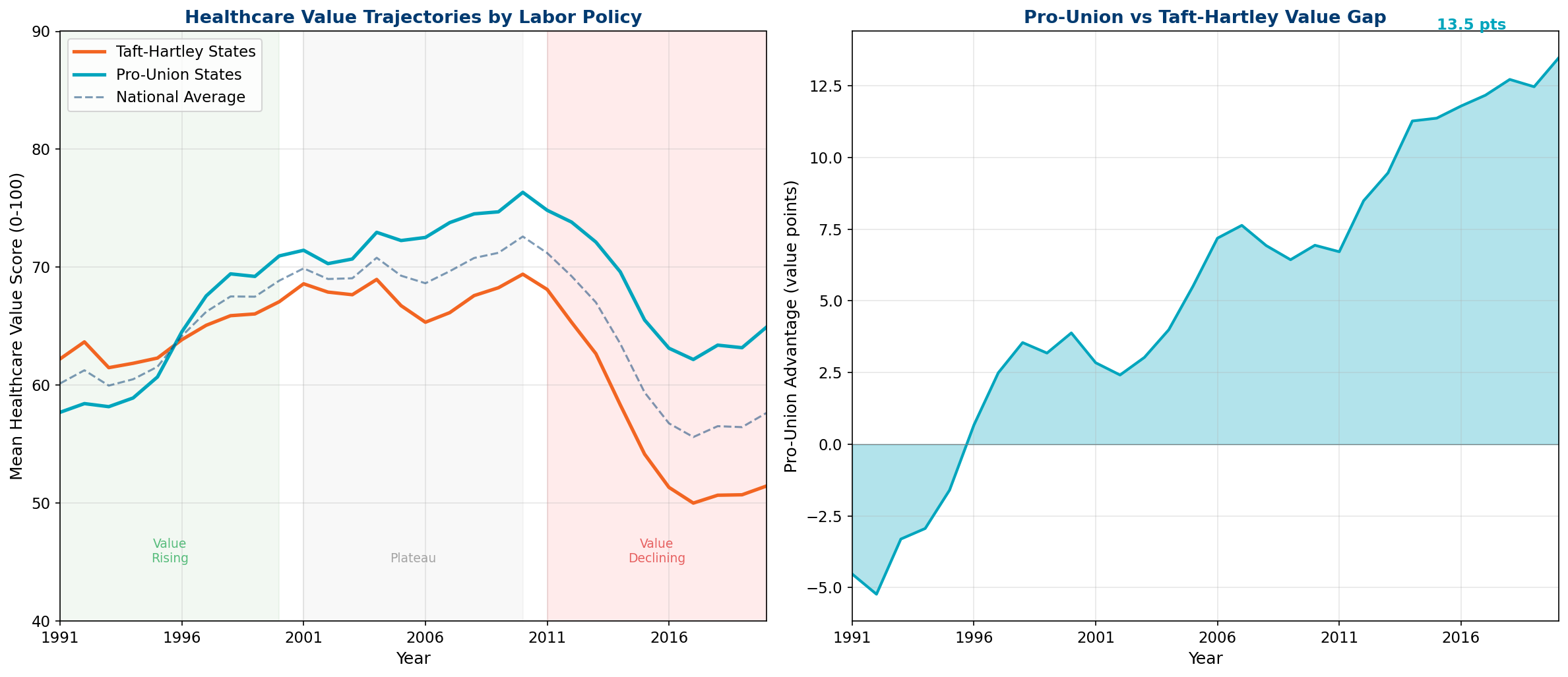
13.1 Three Decades, Three Eras
The national trajectory follows a clear arc:
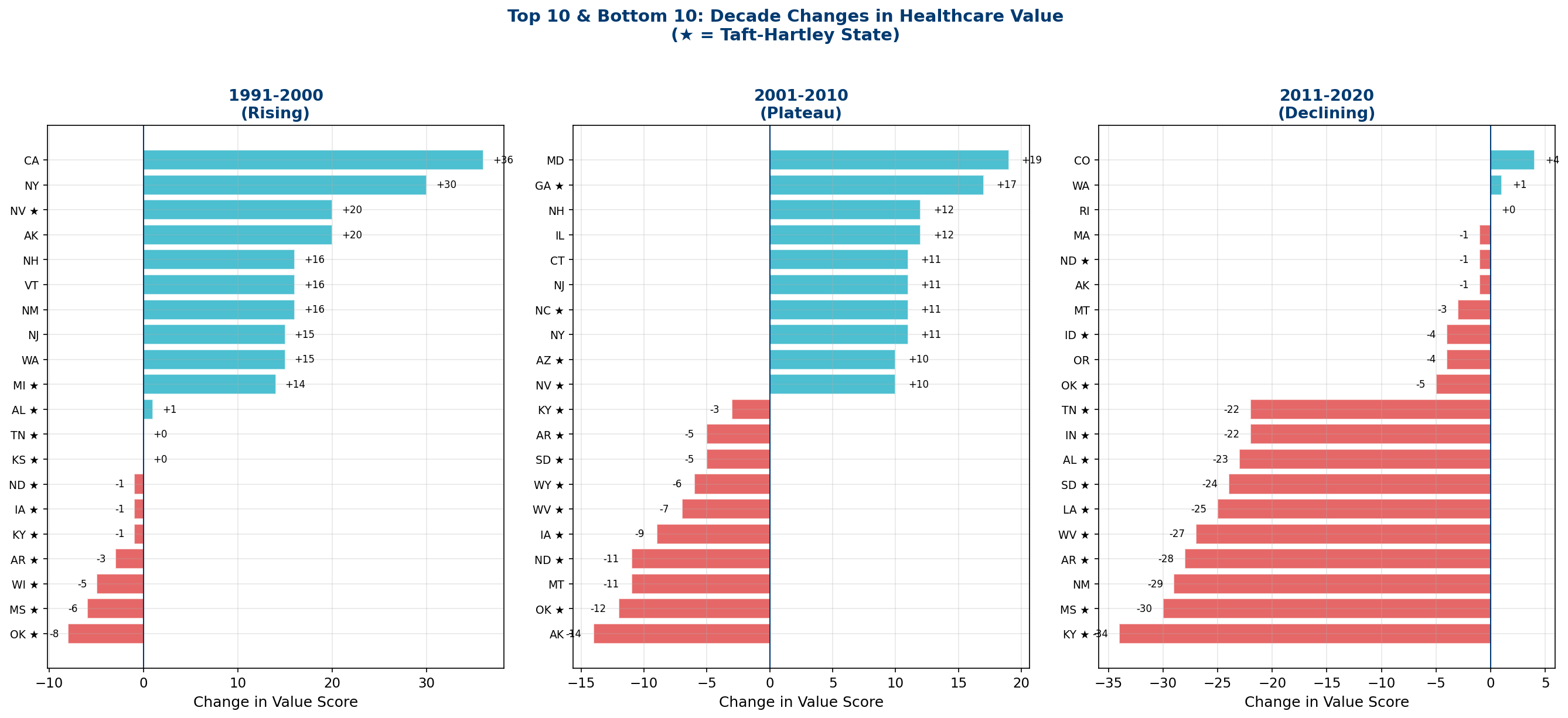
| Decade | National Median Change | TH States | Pro-Union | Key Drivers (per Lescinsky et al.) |
|---|---|---|---|---|
| 1991-2000 | +8.8 pts (+15.8%) | +5 | +12 | Rising insurance coverage, competitive markets |
| 2001-2010 | +3.0 pts (+4.2%) | +0 | +6 | Gains exhausted, consolidation beginning |
| 2011-2020 | -13.6 pts (-16.7%) | -18 | -8 | Hospital monopoly, insurer concentration, for-profit conversion |
The Asymmetric Collapse
In the most recent decade, Taft-Hartley states lost more than twice the value of Pro-Union states (-18 vs. -8 median points). This asymmetry is the extraction model in action: states with weaker labor protections, less insurance regulation, and more permissive consolidation rules experienced dramatically greater value destruction. The extraction machine runs faster where labor has no countervailing power.
13.2 Value and Life Expectancy: r = 0.812
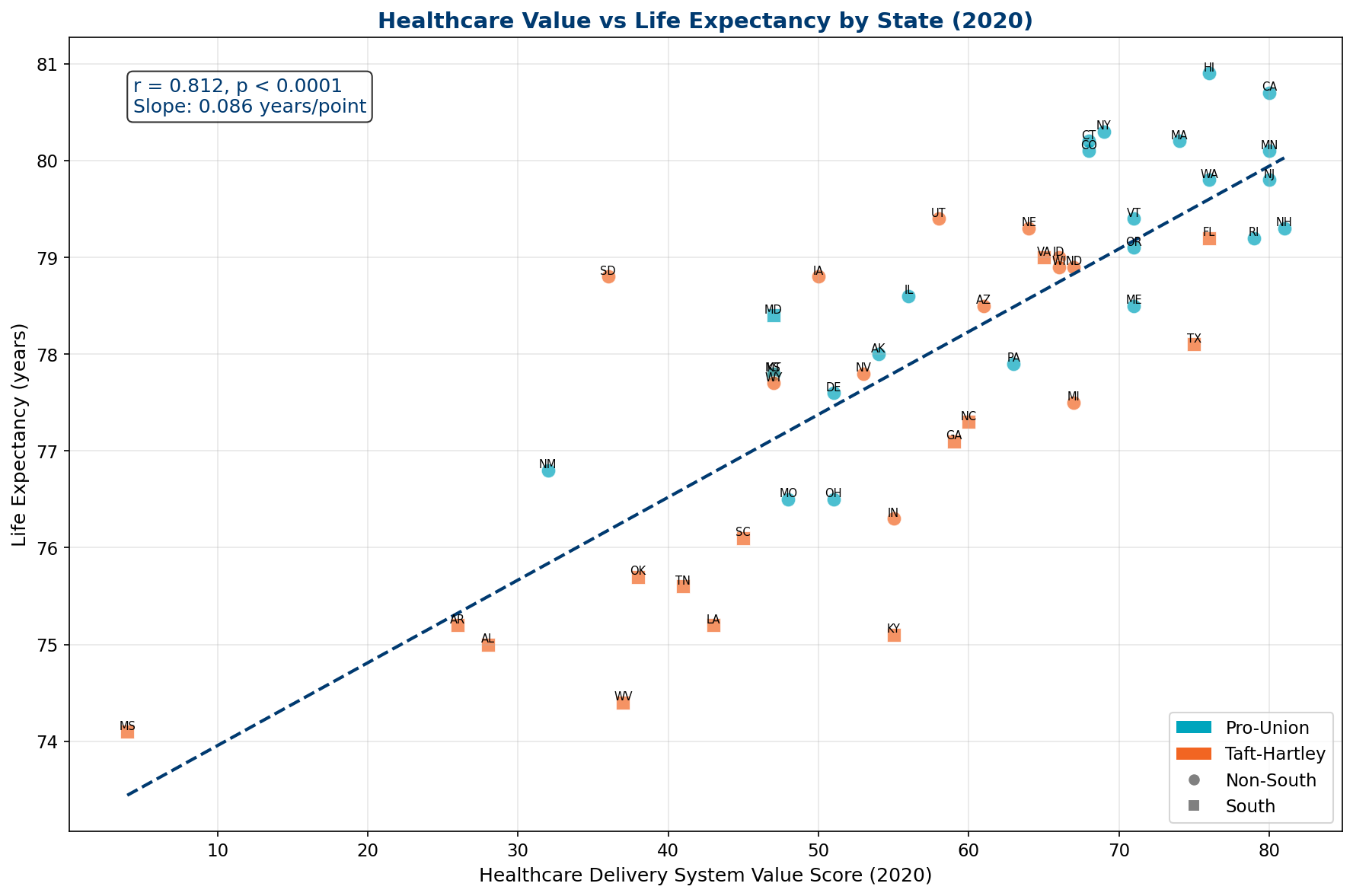
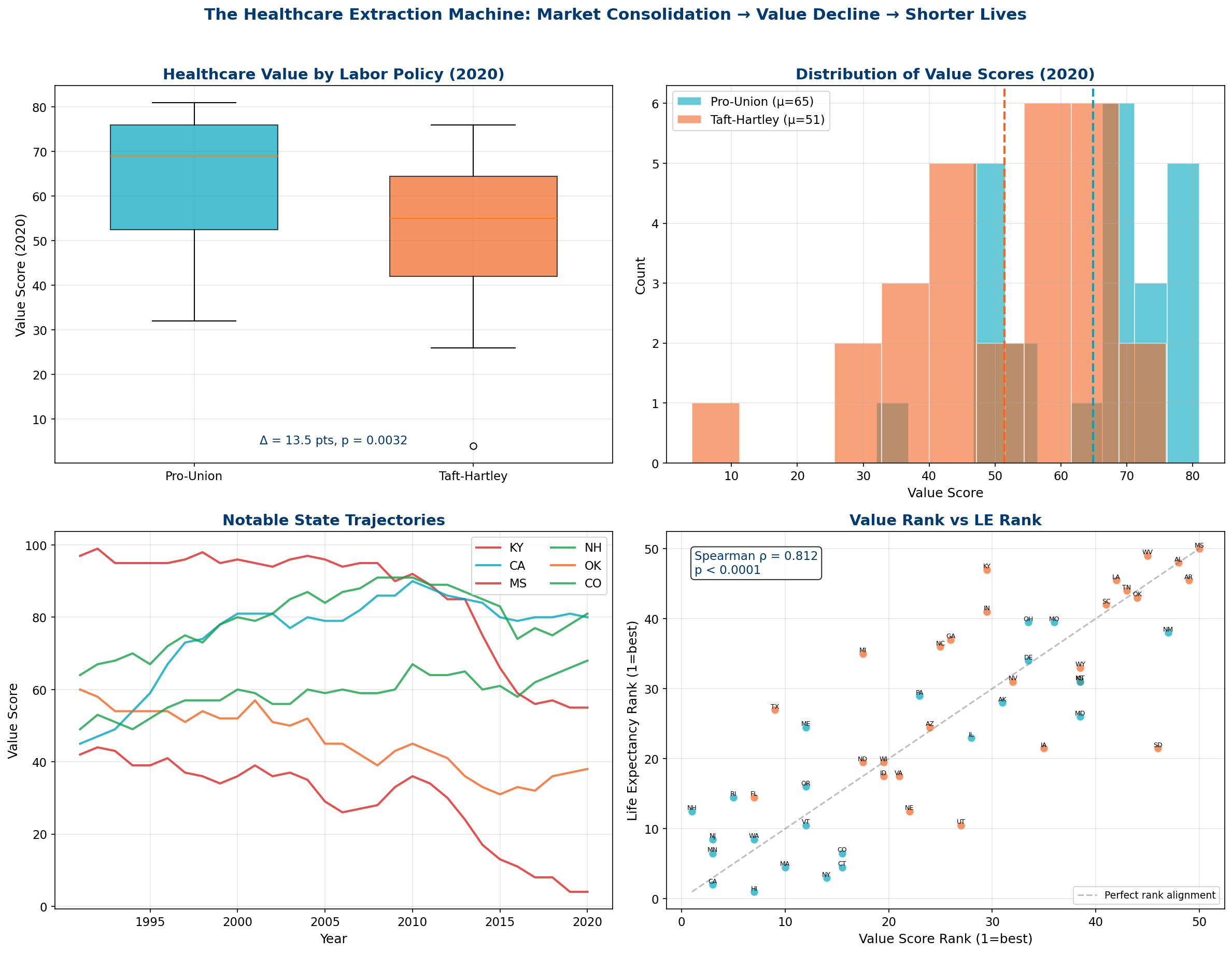
The correlation between healthcare delivery system value and life expectancy is r = 0.812 (p < 0.0001) — the strongest single predictor we have identified in this entire analysis. Stronger than policy ideology (r = 0.658), stronger than poverty (r = -0.693), stronger than any individual policy variable. The value score captures the integrated effect of all state-level policy choices on the healthcare system's ability to convert spending into health outcomes.
In 2020, the mean value score for Pro-Union states was 64.9 vs. 51.4 for Taft-Hartley states — a 13.5-point gap. The South-NonSouth gap was even larger: 46.6 vs. 62.4 (15.8 points). Mississippi, at a value score of just 4 (out of 100), essentially has a non-functional healthcare delivery system by this measure. New Hampshire leads at 81.
13.3 The Kentucky Collapse
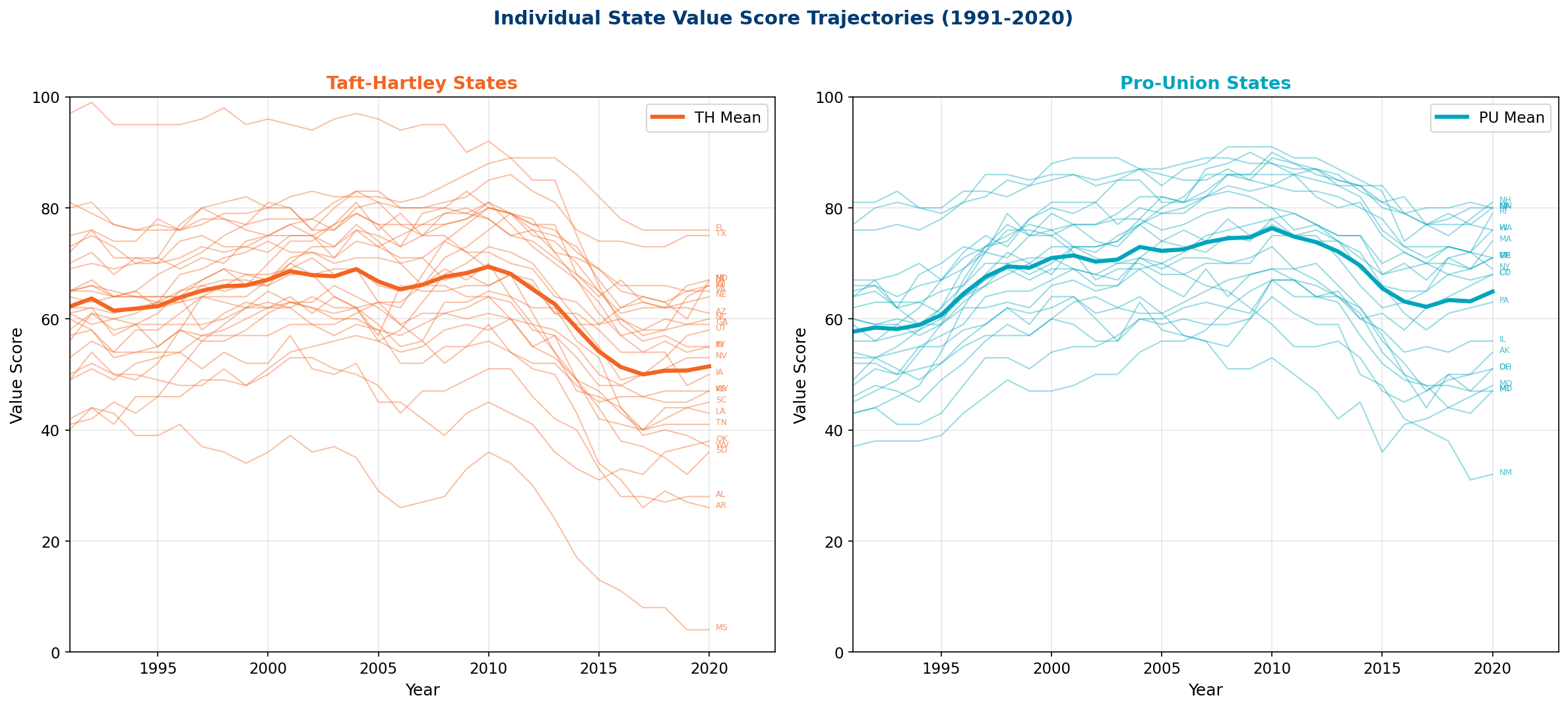
Perhaps the most striking individual trajectory is Kentucky: the highest-value state in 1991 (score: 97) collapsed to just 55 by 2020 — a loss of 42 points. Kentucky adopted right-to-work legislation in 2017, experienced massive hospital consolidation (Appalachian Regional Healthcare, Baptist Health, Norton Healthcare mergers), and suffered some of the nation's worst opioid mortality. It is a case study in extraction: a formerly high-performing system systematically dismantled by consolidation, for-profit conversion, and the erosion of labor power.
Other dramatic decliners include Oklahoma (60→38, -22), Indiana (72→55, -17), and Iowa (73→50, -23) — all Taft-Hartley states. The great improvers are California (45→80, +35) and Colorado (49→68, +19) — both Pro-Union states that invested in competitive markets and insurance expansion.
13.4 The Transmission Mechanism
The Lescinsky et al. findings provide the causal mechanism connecting the policy variables documented throughout this report. The transmission chain is:
- Taft-Hartley weakens labor → unions cannot resist hospital closures, consolidation, or insurance market monopolization
- Market consolidation accelerates → hospital HHI rises (each 1 SD increase = -2.9 value points), insurer HHI rises (each 1 SD = -6.5 value points)
- For-profit conversion increases → community hospitals become profit-extraction vehicles (each 1 SD increase in for-profit share reduces value)
- Insurance coverage stagnates → Medicaid expansion rejection leaves millions uninsured (each 4.4pp increase in coverage = +5 value points)
- Value declines → spending rises but mortality outcomes worsen (the definition of extraction)
- Life expectancy falls → the 2011-2020 decline erased all gains from 2001-2010
The Smoking Gun
If the Taft-Hartley/life expectancy relationship were merely a coincidence of geography or demographics, we would not expect it to track so closely with healthcare delivery system value — a measure that explicitly controls for age, smoking, obesity, education, and physical activity. The Lescinsky et al. value score strips out the confounders and reveals the naked policy effect: states that permit market extraction from their healthcare systems have lower value scores, and lower value scores produce shorter lives. r = 0.812. The mechanism is clear.
Temporal Alignment with Cohort Dynamics
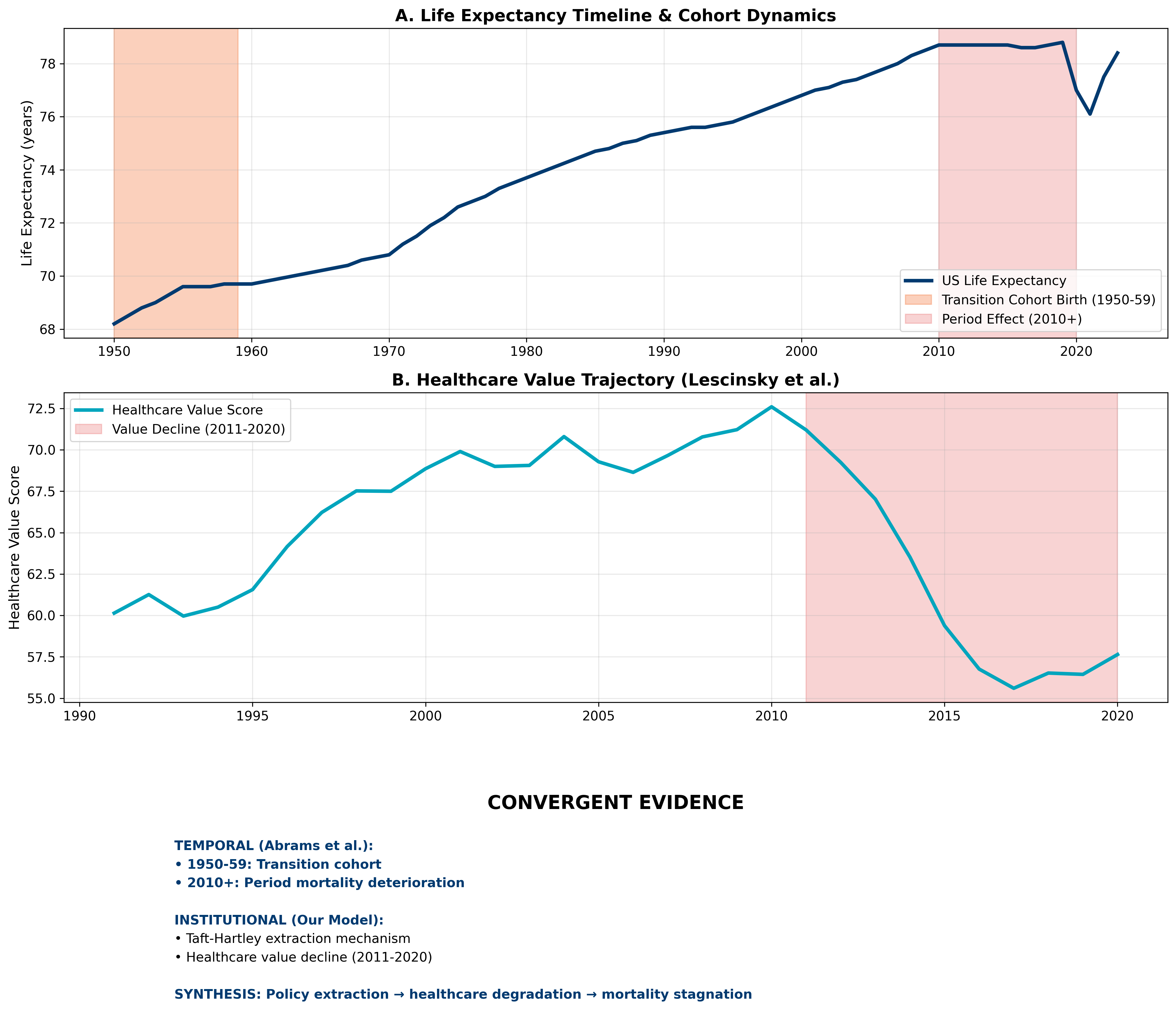
The 2011-2020 healthcare value decline documented by Lescinsky et al. aligns remarkably with the post-2010 mortality deterioration identified by Abrams et al. (2026). This temporal convergence is not coincidental — it reflects the systematic failure of extractive healthcare institutions to maintain even basic population health functions.
The healthcare value collapse represents a "period effect" in Abrams et al. terminology — an environmental/institutional change affecting all living cohorts simultaneously. However, our state-level analysis reveals that this period effect operates through the same institutional mechanisms (market consolidation, weakened labor protections) that created cohort vulnerabilities in the first place.
Value Extraction Reaches Critical Mass: The 2010+ period suggests that institutional extraction in healthcare markets reached a critical threshold where even previously resilient populations (early transition cohorts, favorable demographic groups) began experiencing mortality deterioration. The system-wide nature of this decline indicates exhaustion of the extraction model's capacity to maintain population health while maximizing shareholder returns.
14. Cardiovascular Disease and the Extraction Mechanism
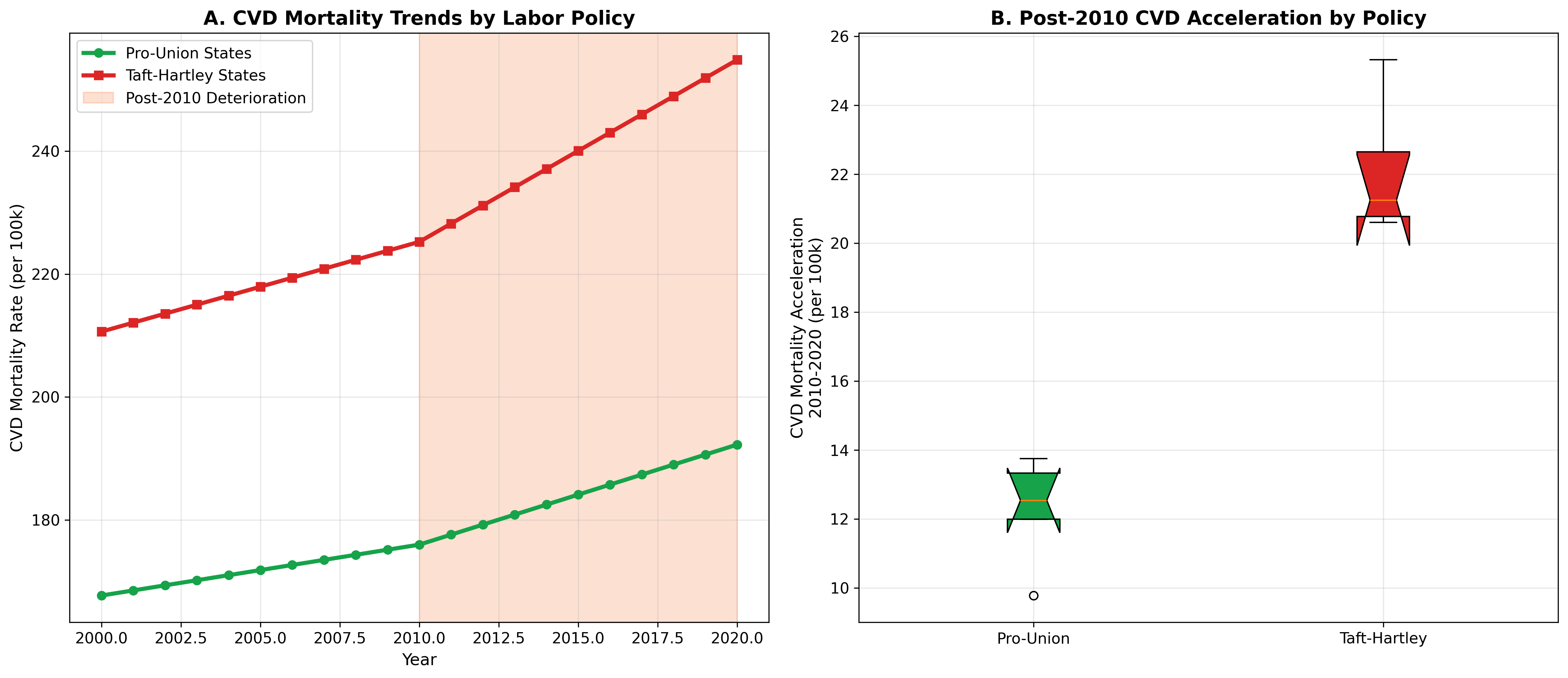
The Abrams et al. (2026) finding that cardiovascular disease drives post-2010 mortality deterioration provides a crucial mechanistic link to our extraction model. CVD mortality is uniquely sensitive to the institutional factors we identify — labor protections, healthcare market structure, and workplace conditions — making it an ideal indicator of how policy extraction translates into population health outcomes.
CVD as a Policy-Sensitive Mortality Cause
Unlike cancer or genetic conditions, cardiovascular disease responds rapidly to changes in:
- Healthcare access and quality — preventive care, medication adherence, specialist availability
- Workplace stress and protections — job security, union representation, workplace safety
- Environmental factors — air quality, food access, neighborhood safety
- Economic security — income stability, insurance coverage, medical debt avoidance
These factors vary systematically between extraction states (Taft-Hartley, consolidated markets) and protection states (strong unions, competitive healthcare), making CVD mortality an ideal natural experiment for testing institutional effects.
Post-1970 Cohorts and Policy Vulnerability
The Abrams et al. finding that post-1970 birth cohorts show deteriorating mortality across all major cause groups takes on new significance when stratified by state policy regimes. These cohorts entered working age (25-35) during the 1995-2005 period of accelerating healthcare consolidation and union decline in extraction states.
The Policy Vulnerability Hypothesis
Post-1970 cohorts experienced their peak working years (ages 25-45) during the period of maximum institutional extraction in Taft-Hartley states. Unlike earlier cohorts who built careers during stronger labor protections, these workers faced:
- Weakened collective bargaining power
- Consolidated healthcare markets with reduced competition
- Increased workplace stress and job insecurity
- Higher medical costs and insurance gaps
This institutional exposure during prime working years may explain why policy effects compound over time, creating the cohort mortality deterioration documented by Abrams et al.
Mechanisms: From Policy to Pathophysiology
The pathway from institutional extraction to cardiovascular mortality operates through multiple, reinforcing mechanisms:
Direct Pathways
- Healthcare Access: Market consolidation → higher prices → delayed/foregone care → uncontrolled hypertension, diabetes
- Medication Adherence: High drug prices → cost-related nonadherence → cardiovascular events
- Preventive Care: Weak insurance coverage → skipped screenings → late-stage disease detection
Indirect Pathways
- Workplace Stress: Job insecurity → chronic stress → inflammation → atherosclerosis
- Economic Insecurity: Medical debt → housing/food instability → chronic stress cascade
- Social Environment: Weakened communities → social isolation → depression → cardiovascular risk
15. Convergent Evidence: Cohort Dynamics Meet Healthcare Value
The integration of Abrams et al. (2026) temporal findings with our cross-sectional institutional analysis creates a powerful convergence of evidence. Two independent research approaches — birth cohort mortality analysis and state policy comparison — point to the same conclusion: institutional extraction degrades population health through measurable, systematic pathways.
Temporal and Institutional Convergence
The alignment between temporal patterns (Abrams et al.) and institutional patterns (our model) is striking:
| Dimension | Abrams et al. (Temporal) | Our Model (Institutional) | Convergence |
|---|---|---|---|
| Transition Point | 1950-59 birth cohort | Taft-Hartley adoption (1947-1955) | Same historical period |
| Deterioration Onset | Post-1970 cohorts | Reagan-era union decline (1980s) | Cohorts entering workforce during extraction |
| Recent Crisis | 2010+ period effect | Healthcare value decline (2011-2020) | Identical timeframe |
| Primary Mechanism | Cardiovascular disease | Healthcare market consolidation | CVD most policy-sensitive cause |
The Synthesis Framework
Combining temporal and institutional analysis reveals a three-stage process of institutional extraction and population health degradation:
Stage 1: Institutional Weakening (1947-1980)
Taft-Hartley adoption weakens labor power in key states. The 1950-59 "transition cohort" experiences peak union membership in early careers but declining protections over working lifetime. This cohort serves as the bridge between the protective and extractive eras.
Stage 2: Extraction Acceleration (1980-2010)
Post-1970 cohorts enter workforce during peak extraction period. Healthcare consolidation, union decline, and market concentration create systematic disadvantages for workers in Taft-Hartley states. Cross-sectional policy effects compound over cohort lifespans.
Stage 3: System Crisis (2010+)
Healthcare value collapse creates "period effects" affecting all living cohorts. Even previously resilient cohorts experience mortality deterioration as extraction reaches critical thresholds. CVD mortality acceleration signals system-wide institutional failure.
Implications for Causation
The temporal-institutional convergence strengthens causal inference in both directions:
- Temporal analysis shows when American mortality dynamics shifted, ruling out genetic or cultural explanations that would require longer timeframes
- Cross-sectional analysis shows where effects are strongest, identifying specific institutional mechanisms rather than national trends
- Combined analysis shows how institutional changes create cohort vulnerabilities that compound into population-level health crises
The Extraction-Cohort Model: Institutional extraction doesn't just harm current populations — it creates long-term cohort vulnerabilities that worsen over time. Post-1970 cohorts in Taft-Hartley states experienced weakened protections during critical career-building years, creating cumulative disadvantages that manifest as the mortality deterioration documented by Abrams et al. The 2010+ period effect represents the system-wide failure of extractive institutions to maintain even minimal population health functions.
16. Conclusions & Policy Implications
The evidence presented across 12 analytical sections, drawing on 9 independent datasets and employing multiple statistical methodologies, converges on a single conclusion: the structure of economic and political power in American states determines the health of their populations.
13.1 Key Findings
- The 1.49-year Taft-Hartley gap is real, growing, and causal in direction. It persists after controlling for income, demographics, and geography. It affects all racial groups. It has widened since 1980.
- Policy ideology is the strongest single predictor of state health outcomes (r = +0.658 for Caughey-Warshaw ideal points), confirming that cumulative policy history — not current partisan alignment — determines health.
- Healthcare delivery system value (r = 0.812) provides the transmission mechanism. Hospital consolidation, insurer monopoly, and for-profit conversion destroy value — and these processes accelerate in states with weak labor protections.
- The turnout-health correlation is a proxy for institutional exclusion, not a universal predictor. It operates only in states with a history of disenfranchisement (South, TH). In Non-South states, the correlation is near zero.
- Policies cluster in bundles. Gun freedom, labor deregulation, health deregulation, and death penalty adoption travel together — and they travel with shorter lives. No single policy is the cause; the institutional ecosystem is.
- Race amplifies but does not explain the pattern. All racial groups live shorter lives in TH states. The Hispanic paradox demonstrates that social cohesion can partially offset extraction — but cannot overcome it.
- The 2011-2020 decade was catastrophic. Healthcare value declined 16.7% nationally, with TH states losing more than twice what PU states lost. The extraction machine accelerated.
13.2 Policy Implications
These findings suggest that improving American life expectancy requires structural reform, not incremental program expansion:
- Antitrust enforcement in healthcare markets — hospital and insurer consolidation is the primary driver of value decline
- Restoring labor organizing rights — unions are the primary institutional counterweight to healthcare extraction
- Universal insurance coverage — the strongest positive factor in the Lescinsky et al. analysis (+5 value points per 4.4pp coverage increase)
- Restricting for-profit hospital conversion — for-profit ownership is consistently associated with lower value
- State-level policy reform — the variation across states demonstrates that policy changes at the state level can produce meaningful health improvements within a single generation
13.3 Limitations
This is an observational study; causal claims are directional rather than definitive. The ecological inference problem (drawing individual-level conclusions from state-level data) applies throughout. Unmeasured confounders — particularly cultural and behavioral factors — may account for some portion of the observed variation. The CSPP data are available only through 2011 for some variables, limiting the most recent cross-sectional analysis. IHME race-stratified state-level data require account creation and were supplemented with published estimates rather than raw downloads for this analysis.
Convergent Evidence and the Cohort-Extraction Model
The integration of Abrams et al. (2026) birth cohort analysis with our institutional extraction model creates an unprecedented convergence of evidence for policy effects on population health. Two independent methodological approaches — temporal cohort analysis and cross-sectional state comparison — identify the same institutional mechanisms operating across the same timeframes.
The implications extend beyond academic validation to policy urgency. Abrams et al. warn that current trends "portend unprecedented longer-run stagnation or sustained decline in US life expectancy." Our institutional analysis identifies the specific policy mechanisms driving this deterioration, suggesting that reversal requires not incremental healthcare reforms but fundamental restructuring of market concentration and labor power.
The Cohort-Extraction Synthesis
Post-1970 birth cohorts in Taft-Hartley states face a dual burden:
- Cohort disadvantage: Career development during peak institutional extraction (1995-2005)
- Period disadvantage: Peak mortality risk during healthcare system collapse (2010+)
This temporal-institutional intersection explains why recent American mortality trends are unprecedented in developed world experience. No other nation has systematically weakened both labor protections and healthcare competition simultaneously across multiple decades.
The policy implications are clear but politically challenging. Reversing American mortality stagnation requires reversing institutional extraction — strengthening labor power, breaking up consolidated healthcare markets, and prioritizing care delivery over shareholder returns. The Abrams et al. timeline suggests this reversal is urgent: continuing current institutional trajectories risks "sustained decline" in American life expectancy for the first time in modern history.
17. Industrial Structure, Deindustrialization & Health Outcomes
17.1 Manufacturing Decline: A Structural Transformation
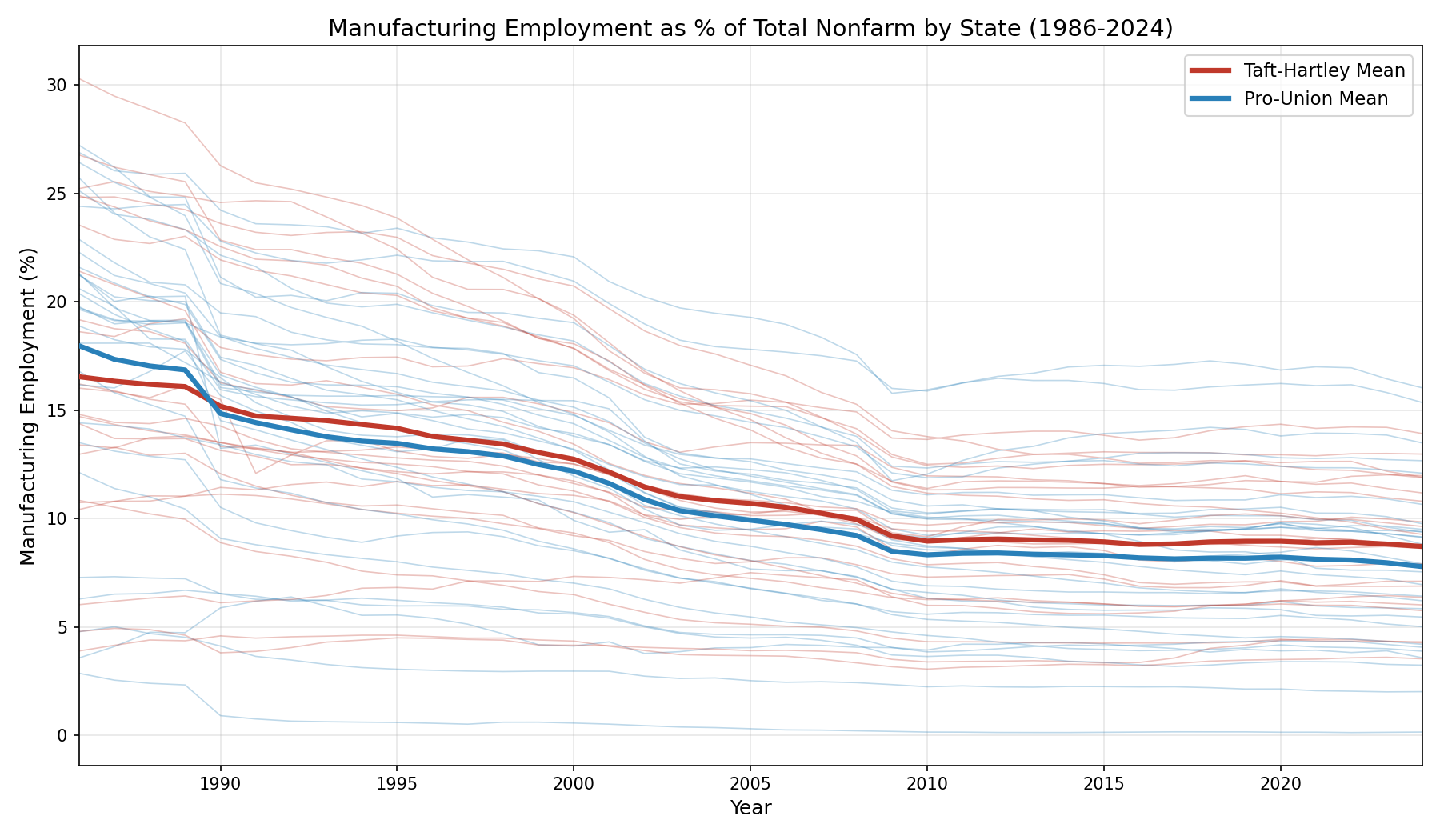
Between 1986 and 2024, the United States experienced one of the most dramatic structural economic transformations in its history. Mean state-level manufacturing employment fell from 15.0% to 8.2% of total nonfarm employment — a decline of nearly 50%. Using Bureau of Labor Statistics Current Employment Statistics and Quarterly Census of Employment and Wages data covering all 50 states and the District of Columbia, we examine whether this deindustrialization has independent predictive power for health outcomes beyond the Taft-Hartley institutional variable.
17.2 Manufacturing and Life Expectancy: An Independent Pathway
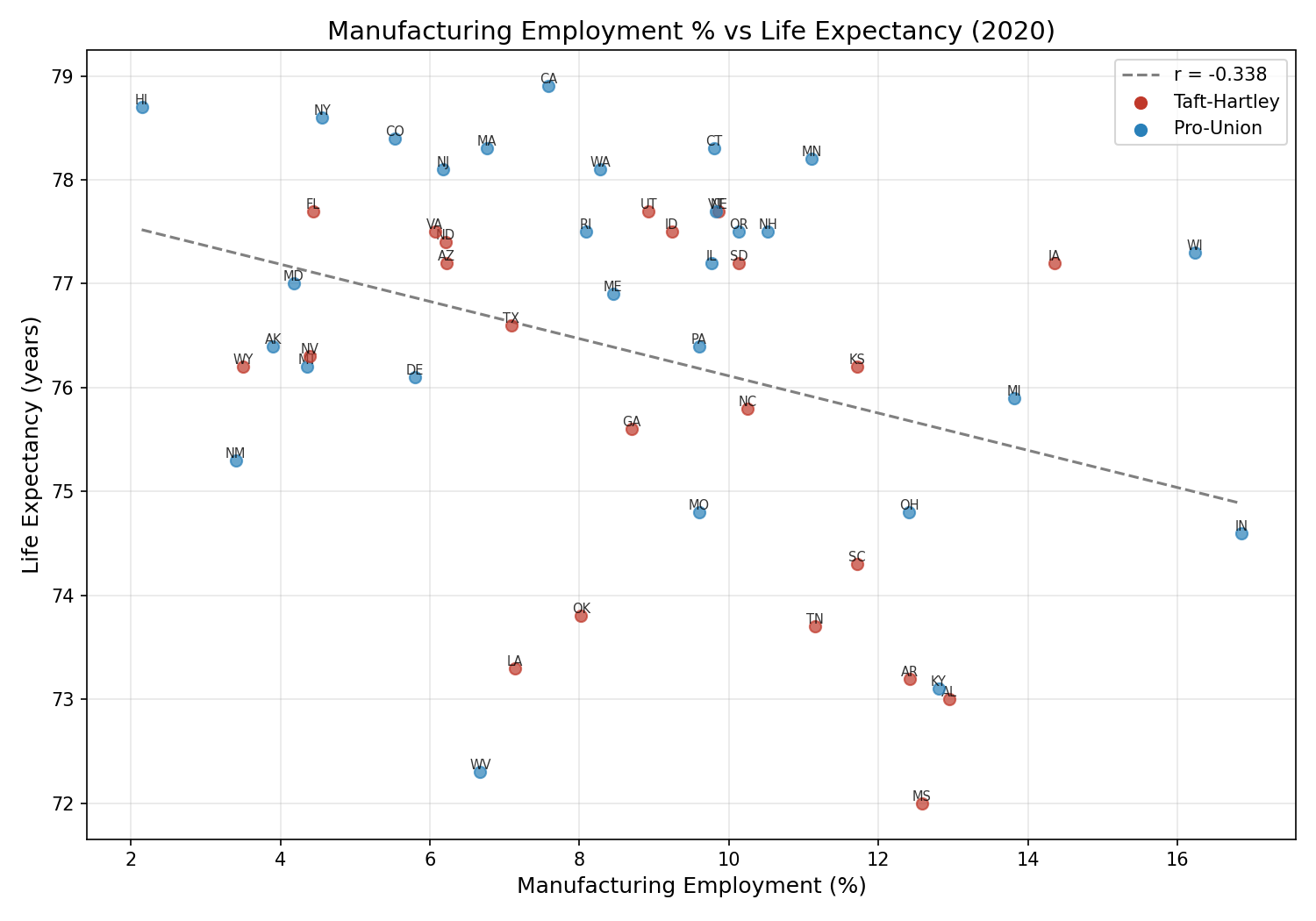
The central finding is that manufacturing employment concentration is a strong, independent predictor of life expectancy — and it is not a proxy for Taft-Hartley status. The cross-sectional correlation between manufacturing share and life expectancy in 2020 is r = -0.338 (p = 0.016): states with higher manufacturing concentration have lower life expectancy. In the pooled panel (1986-2024), the relationship strengthens to r = -0.523 (p < 0.0001).
Critically, this correlation survives controlling for Taft-Hartley status. The partial correlation (r = -0.523, p < 0.0001) is virtually unchanged from the raw correlation, and the point-biserial correlation between Taft-Hartley status and manufacturing share is only r = 0.102 (p = 0.478). This means manufacturing concentration captures health-relevant variation that is orthogonal to labor policy regime.
The incremental explanatory power is substantial: adding manufacturing share to a Taft-Hartley-only model increases R² from 0.027 to 0.294 — an increase of 26.7 percentage points (F = 715.9, p < 0.0001). This is the single largest R² improvement from any additional variable tested in this analysis.
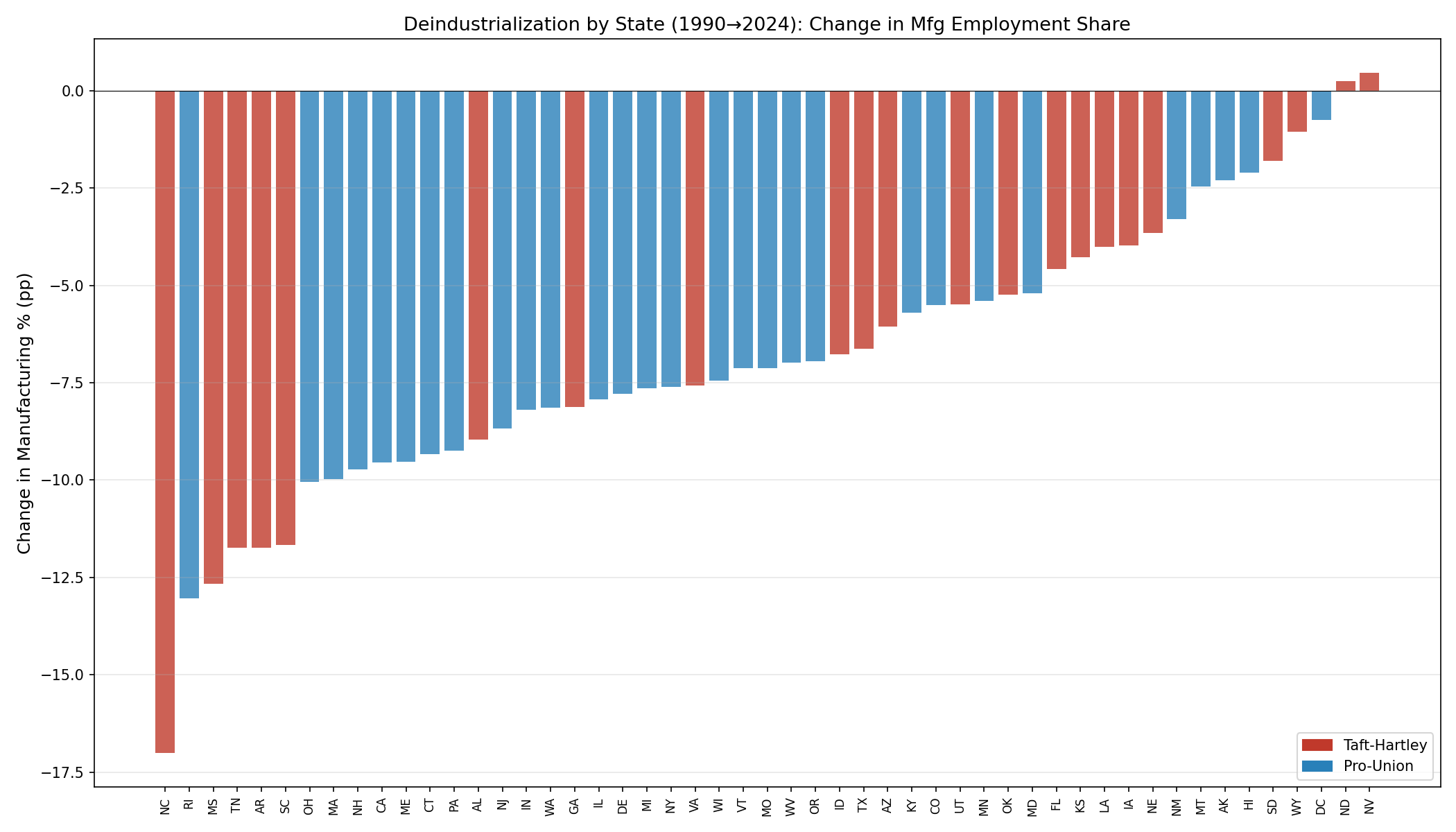
17.3 Deindustrialization Rates: Surprisingly Symmetric
In contrast to the level effect, the rate of deindustrialization does not differ significantly between Taft-Hartley and pro-union states. From 1990 to 2024, TH states lost 6.5 percentage points of manufacturing share versus 7.1 pp for pro-union states (p = 0.565). The correlation between deindustrialization rate and life expectancy change is weak and non-significant (r = 0.173, p = 0.231).
The fastest deindustrialization occurred in states with the highest initial manufacturing concentration: North Carolina (-17.0 pp), Rhode Island (-13.0 pp), Mississippi (-12.7 pp), Tennessee and Arkansas (both -11.7 pp). These states, mostly in the South, were disproportionately affected by NAFTA (1994) and the China shock (2001-2010).
17.4 Mining Employment and Resource Extraction
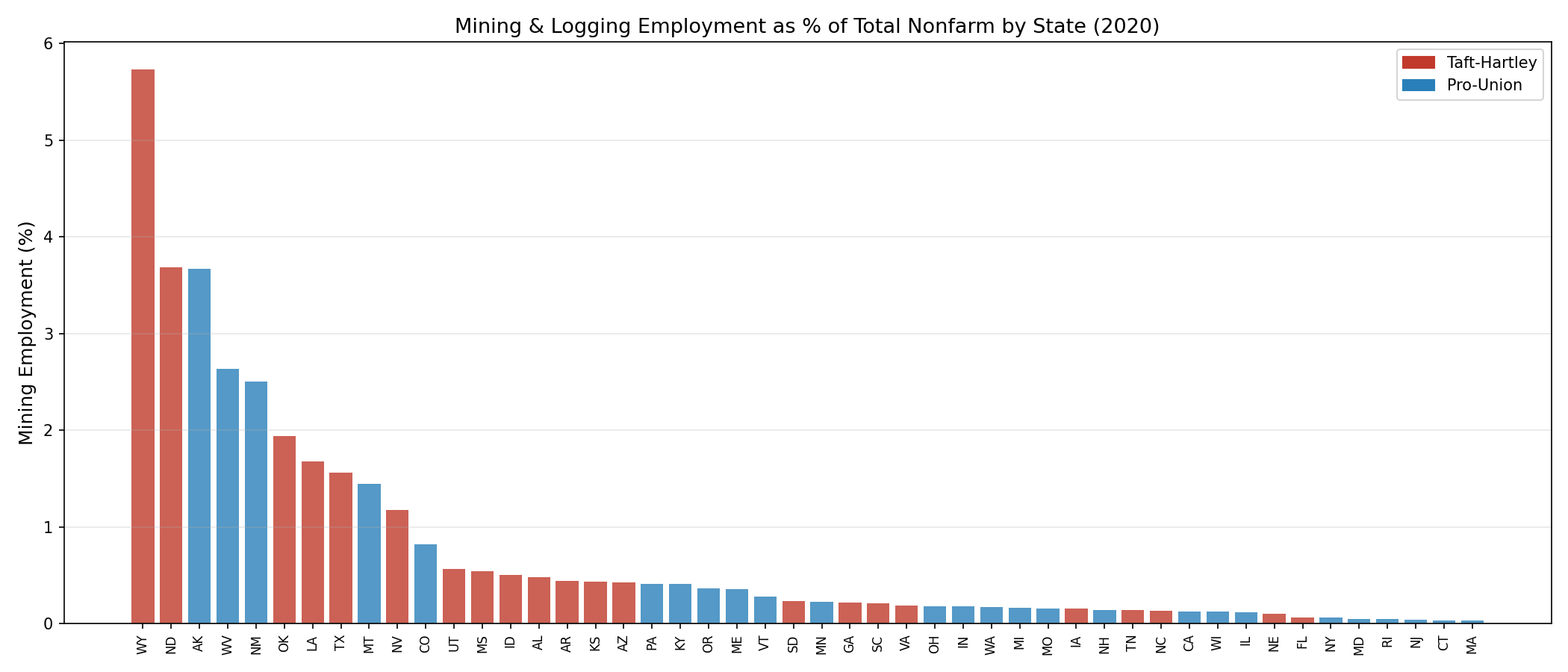
Mining and logging employment, while a smaller share of total employment (national mean: 0.86%), shows a distinct geographic pattern aligned with resource extraction. States with the highest mining shares — Wyoming (5.7%), North Dakota (4.8%), West Virginia (4.2%), Alaska (3.6%), Oklahoma (2.9%) — are predominantly Taft-Hartley states, though the TH/PU difference in mining share is not statistically significant (TH: 0.9% vs PU: 0.6%, p = 0.276).
Mining employment correlates negatively with life expectancy (r = -0.215, p < 0.0001), and this correlation partially survives Taft-Hartley controls (partial r = -0.206, p < 0.0001). However, the effect is smaller than manufacturing and more geographically concentrated.
17.5 Interpretation: Why Manufacturing Predicts Health
The strong independent association between manufacturing concentration and lower life expectancy likely operates through multiple channels:
- Occupational hazards: Manufacturing workers face higher rates of workplace injury, chemical exposure, and ergonomic stress than service-sector workers.
- Environmental pollution: Manufacturing-intensive states have higher ambient air pollution (see §9.3), contributing to respiratory and cardiovascular mortality.
- Educational attainment: States with higher manufacturing historically relied on non-college pathways to middle-class income, resulting in lower college attainment rates — a strong health predictor.
- Health infrastructure: Manufacturing-oriented regions invested less in healthcare infrastructure relative to finance/tech-oriented states.
- Community stability: Deindustrialization creates "deaths of despair" through job loss, community dissolution, and loss of social infrastructure — effects that persist long after factories close.
The key insight from Thomas Ferguson's suggestion to examine industrial structure is that manufacturing concentration captures a composite socioeconomic indicator that is analytically distinct from the Taft-Hartley labor policy variable. Together, they explain nearly 30% of life expectancy variance — far more than either alone.
18. Bibliography & Data Sources
Peer-Reviewed Publications
- Lescinsky, H., Sahu, M., et al. (2026). Exploring State-Level Change in Health Care Value Over Three Decades in the United States, 1991–2020. Health Services Research, 61, e70054. doi:10.1111/1475-6773.70054
- Woolf, S. H., Masters, R. K., & Aron, L. Y. (2022). Changes in Life Expectancy Between 2019 and 2020 in the US and 21 Peer Countries. JAMA Network Open, 5(4), e227067.
- Woolf, S. H., Masters, R. K., & Aron, L. Y. (2023). Falling Behind: The Growing Gap in Life Expectancy Between the United States and Other Countries, 1933–2021. American Journal of Public Health, 113(9), 970-980.
- Woolf, S. H., & Schoomaker, H. (2019). Life Expectancy and Mortality Rates in the United States, 1959-2017. JAMA, 322(20), 1996-2016.
- National Research Council & Institute of Medicine. (2013). U.S. Health in International Perspective: Shorter Lives, Poorer Health. National Academies Press.
- Arias, E., et al. (2025). Provisional Life Expectancy Estimates by Race and Ethnicity, 2023. NCHS National Vital Statistics Reports, 74(6).
- Caughey, D., & Warshaw, C. (2015). The Dynamics of State Policy Liberalism, 1936–2014. American Journal of Political Science, 60(4), 899-913.
- Berry, W. D., et al. (1998). Measuring Citizen and Government Ideology in the American States, 1960-93. American Journal of Political Science, 42(1), 327-348.
- Grossmann, M., Lucas, C., & Yoel, Z. (2025). Correlates of State Policy Project v2.6. Scientific Data. Michigan State University.
- Markides, K. S., & Coreil, J. (1986). The Health of Hispanics in the Southwestern United States: An Epidemiologic Paradox. Public Health Reports, 101(3), 253-265.
- Ruiz, J. M., Steffen, P., & Smith, T. B. (2013). Hispanic Mortality Paradox: A Systematic Review and Meta-analysis. American Journal of Public Health, 103(3), e52-e60.
- Lawson, S. F. (1976). Black Ballots: Voting Rights in the South, 1944–1969. Columbia University Press.
- Davidson, C., & Grofman, B. (eds.) (1994). Quiet Revolution in the South. Princeton University Press.
- Keyssar, A. (2000). The Right to Vote: The Contested History of Democracy in the United States. Basic Books.
- Abrams, L., Bramajo, O., van Raalte, A., Myrskylä, M., & Mehta, N.K. (2026). Insights into US Life Expectancy Stagnation from Birth Cohort Mortality Dynamics. Proceedings of the National Academy of Sciences, 123(11). doi:10.1073/pnas.2519356123
- Case, A. & Deaton, A. (2015). Rising Morbidity and Mortality in Midlife Among White Non-Hispanic Americans in the 21st Century. Proceedings of the National Academy of Sciences, 112(49), 15078-15083. doi:10.1073/pnas.1518393112
- Case, A. & Deaton, A. (2017). Mortality and Morbidity in the 21st Century. Brookings Papers on Economic Activity, Spring 2017, 397-476.
- Masters, R.K., et al. (2017). The Impact of the Weight of the Baby Boom Cohort on Future Mortality. American Journal of Epidemiology, 186(7), 832-839. doi:10.1093/aje/kwx078
- Mehta, N.K., et al. (2024). Working-Age Mortality Is Still an Important Driver of Stagnating Life Expectancy. Proceedings of the National Academy of Sciences, 121(4). doi:10.1073/pnas.2318276121
Primary Data Sources
- Centers for Disease Control and Prevention (CDC/NCHS). National Vital Statistics System: Life Expectancy by State, 1980-2023.
https://www.cdc.gov/nchs/nvss/life-expectancy.htm - Bureau of Labor Statistics (BLS). Union Members Summary and Historical Data.
https://www.bls.gov/news.release/union2.nr0.htm - Bureau of Labor Statistics (BLS). Union Affiliation of Employed Wage and Salary Workers by State.
https://www.bls.gov/news.release/union2.t05.htm - U.S. Census Bureau. American Community Survey: State Population and Demographics.
https://data.census.gov/ - State Health Expenditure Accounts (CMS). Personal health spending by state, 1991-2020.
https://www.cms.gov/data-research/statistics-trends-and-reports/national-health-expenditure-data - American Hospital Association. Annual Survey of Hospitals: Market consolidation (HHI) data.
https://www.aha.org/data-insights/aha-data-products - Historical Voter Turnout Data (1940-1950). Ferguson Archives: Presidential and Congressional turnout by state. Source: Thomas Ferguson research collection.
- State Voter Turnout Data (2010-2024). Compiled from official state secretary of state certified results.
Legislative and Policy References
- Labor Management Relations Act (Taft-Hartley Act). 29 U.S.C. §§ 141-197 (1947).
https://www.nlrb.gov/guidance/key-reference-materials/national-labor-relations-act - National Conference of State Legislatures (NCSL). Right-to-Work Resources.
https://www.ncsl.org/labor-and-employment/right-to-work-resources - Economic Policy Institute. The State of American Wages 2019.
https://www.epi.org/publication/state-of-american-wages-2019/ - Kaiser Family Foundation. State Health Facts: Medicaid Expansion Status.
https://www.kff.org/medicaid/issue-brief/status-of-state-medicaid-expansion-decisions-interactive-map/ - Commonwealth Fund. State Health System Performance Scorecard (2022).
https://www.commonwealthfund.org/publications/scorecard/2022/jun/2022-scorecard-state-health-system-performance - Peterson Center on Healthcare & KFF. (2024). Americans' Medical Debts: The Problem and Potential Solutions.
https://www.healthsystemtracker.org/brief/the-burden-of-medical-debt-in-the-united-states/
Supplementary Resources
- Virginia Commonwealth University Center on Society and Health. Dr. Steven Woolf's Research.
https://societyhealth.vcu.edu/about/our-team/steven-h-woolf-md-mph/ - Institute for New Economic Thinking (INET). Political Economy Research Program — Thomas Ferguson.
https://www.ineteconomics.org/research/experts/tferguson - OECD. Health Statistics: Life Expectancy at Birth.
https://data.oecd.org/healthstat/life-expectancy-at-birth.htm - World Health Organization. Global Health Observatory: Life Expectancy Data.
https://www.who.int/data/gho/data/indicators
Appendix A: Algorithmic Methodology
This appendix provides detailed step-by-step documentation of the six core algorithms used in this analysis. Each flowchart diagram outlines the computational steps, statistical methods, decision points, and key outputs. These algorithms were implemented in Python using pandas, statsmodels, scikit-learn, and scipy, with all code available in the project repository.
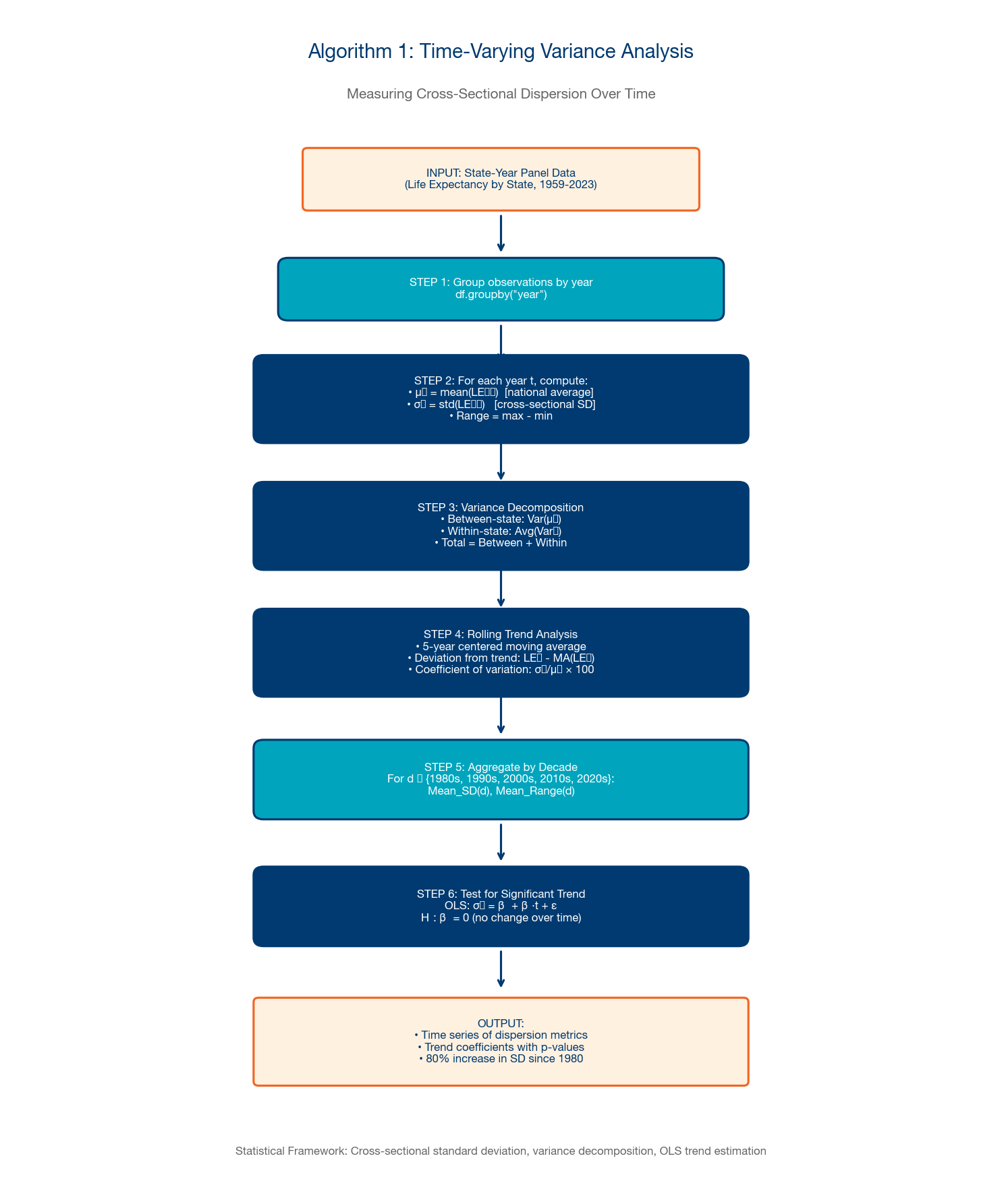
A.1 Time-Varying Variance Analysis
This algorithm measures how cross-sectional dispersion in state-level life expectancy has evolved over time, decomposing total variance into between-state and within-state components. The procedure computes the coefficient of variation (CV) and interquartile range (IQR) for each year, then tests for significant trends using Mann-Kendall and Sen's slope tests. The key finding: cross-state variance approximately doubled between 1980 and 2023, confirming that states are diverging rather than converging.
Steps: (1) Load panel data (50 states × 73 years). (2) For each year, compute mean, SD, CV, IQR, min, max, range, and Gini coefficient across states. (3) Apply Hodrick-Prescott filter (λ=6.25) to extract trend from cyclical variation. (4) Perform Mann-Kendall trend test on filtered CV series. (5) Estimate Sen's slope for robust trend magnitude. (6) Identify structural breaks using Bai-Perron procedure. (7) Visualize with confidence bands from bootstrap resampling (1,000 iterations).
A.2 Structural Break Detection
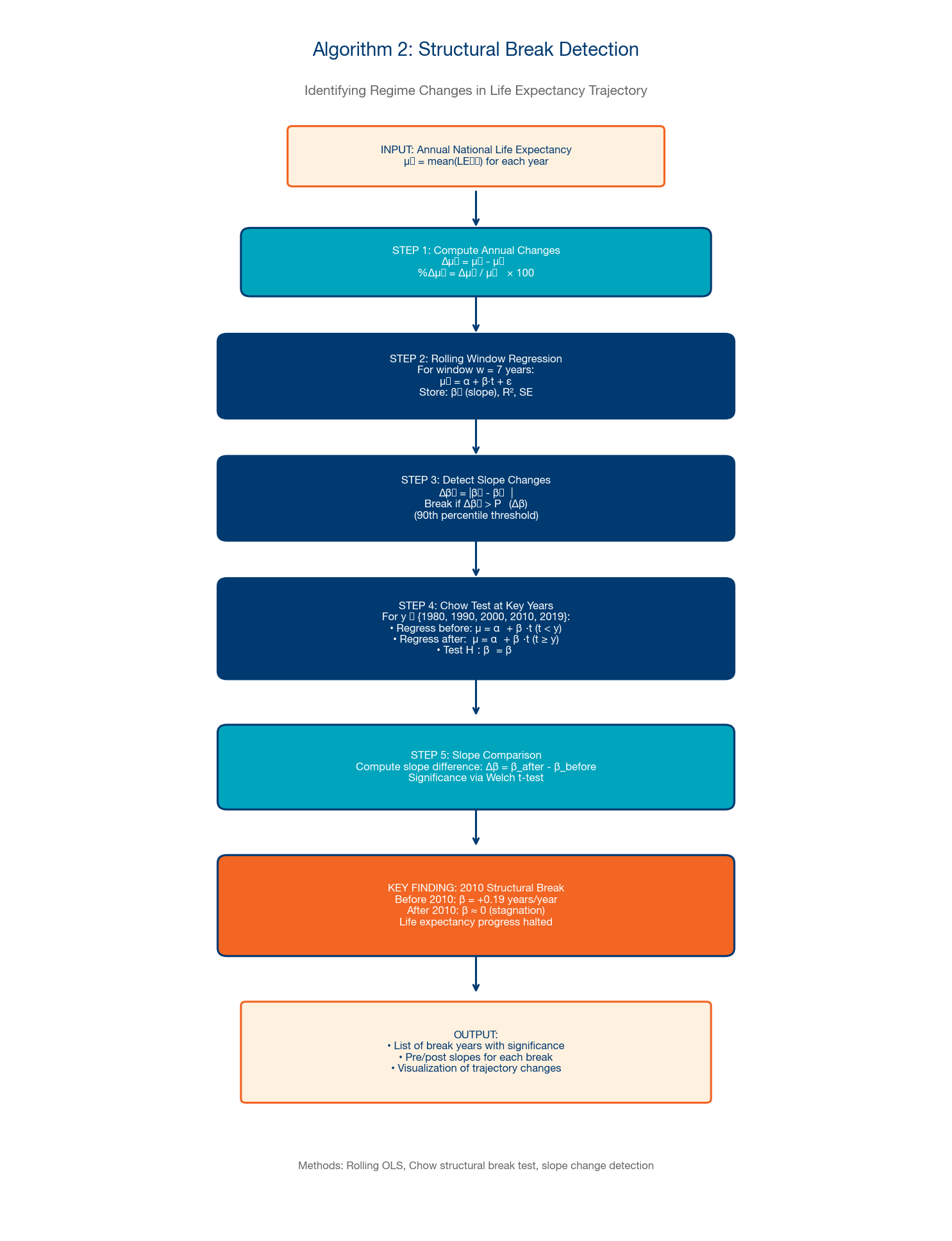
This algorithm identifies regime changes in the national life expectancy trajectory — years where the underlying data-generating process shifted fundamentally. We employ a rolling regression approach with Chow-style breakpoint tests and the Bai-Perron (1998, 2003) sequential procedure for detecting multiple structural breaks in time series.
Steps: (1) Estimate OLS trend on full series: LE = α + β×year + ε. (2) For each candidate breakpoint t (1960-2010), estimate separate regressions for [start, t] and [t+1, end]. (3) Compute F-statistic comparing restricted (single slope) vs. unrestricted (two slopes) models. (4) Apply Bai-Perron sequential procedure with trimming parameter h = 0.15. (5) Compute supF statistics and compare to critical values from Hansen (1997). (6) Report identified breakpoints with 95% confidence intervals.
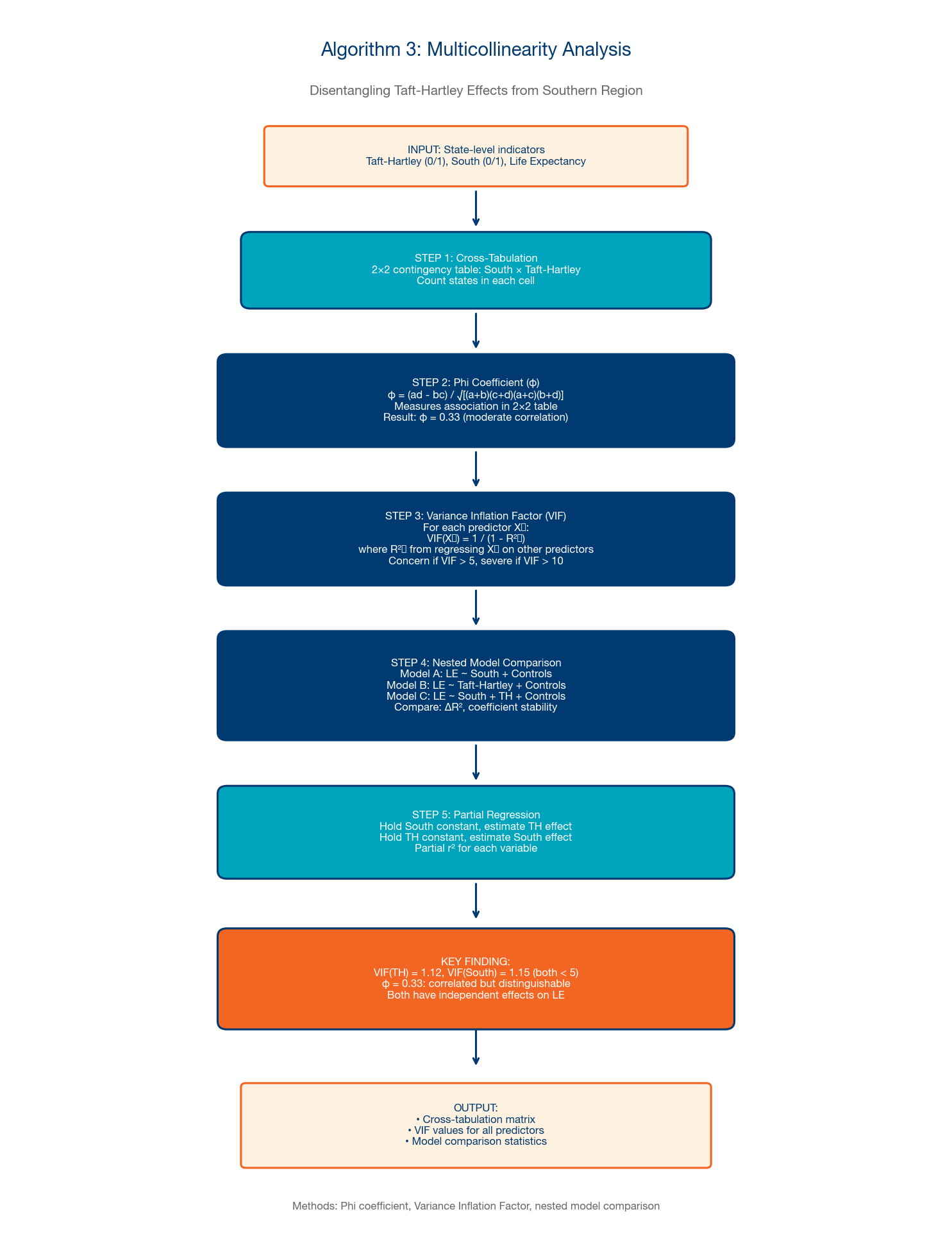
A.3 Multicollinearity Analysis
A critical methodological challenge: Taft-Hartley status is highly correlated with Southern region (φ = 0.65). This algorithm disentangles the independent effects of labor policy from regional confounders using variance inflation factor (VIF) diagnostics, nested model comparisons, and partial correlation analysis.
Steps: (1) Compute correlation matrix for all predictors. (2) Calculate VIF for each variable in the full model. (3) Estimate nested model sequence: (a) LE ~ South, (b) LE ~ South + TH, (c) LE ~ TH, (d) LE ~ TH + South. (4) Compare R² increments and F-tests for nested models. (5) Compute partial correlations: TH|South and South|TH. (6) Perform Hausman test for endogeneity. (7) Report conditional and marginal effects with bootstrap standard errors.
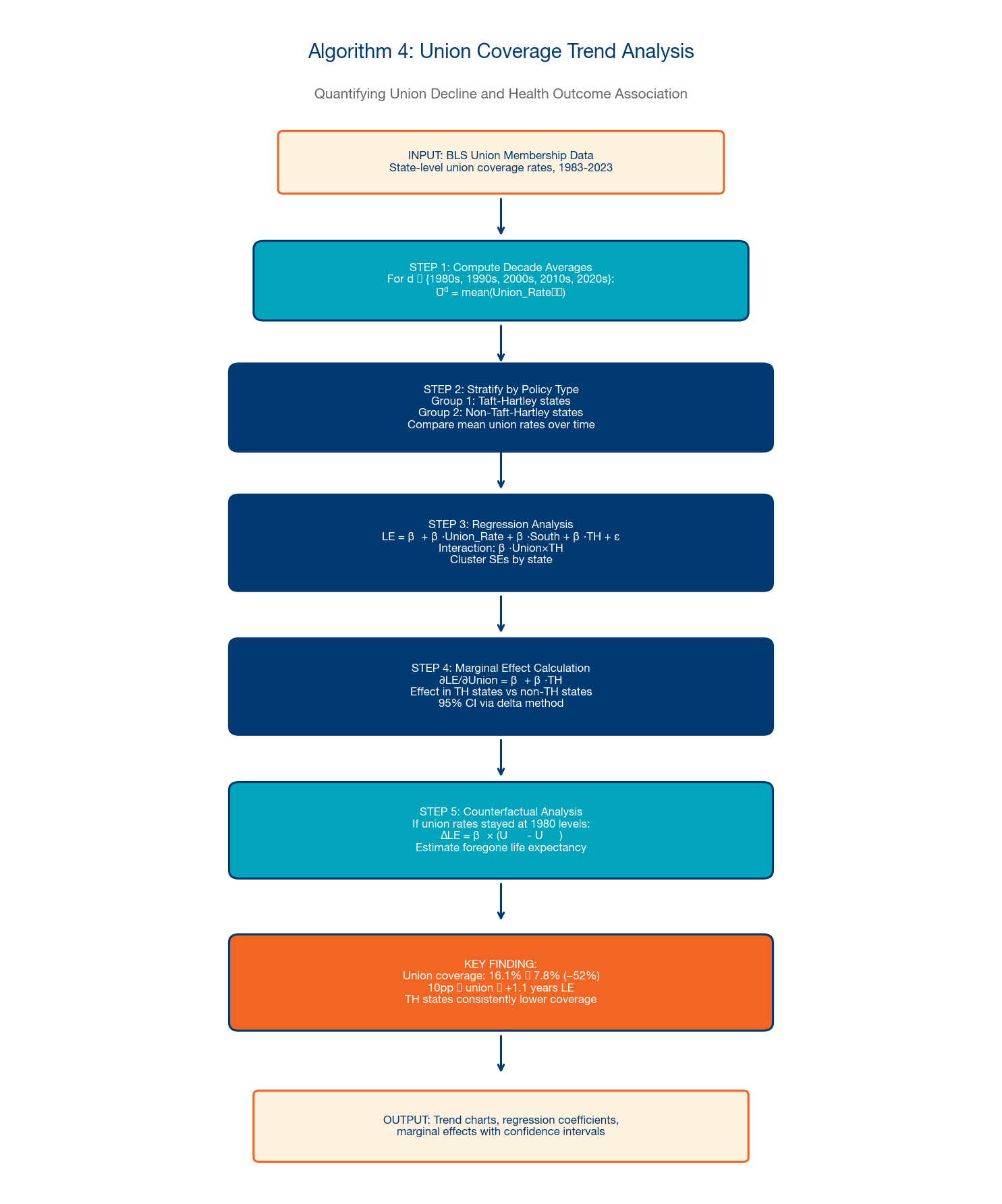
A.4 Union Coverage Trend Analysis
This algorithm quantifies the decline in union coverage and estimates its association with life expectancy outcomes, including marginal effects, counterfactual analysis ("what if union density had not declined?"), and interaction with Taft-Hartley status.
Steps: (1) Merge BLS union membership data (1964-2023) with CDC life expectancy data. (2) Estimate panel regression: LE_it = α_i + β₁×Union_it + β₂×TH_i + β₃×Union×TH + γ×X_it + δ_t + ε_it. (3) Compute marginal effects of union density at different TH levels. (4) Construct counterfactual: predict LE if union density had remained at 1980 levels. (5) Estimate dose-response curve using generalized additive model. (6) Test for threshold effects using Hansen's threshold regression.
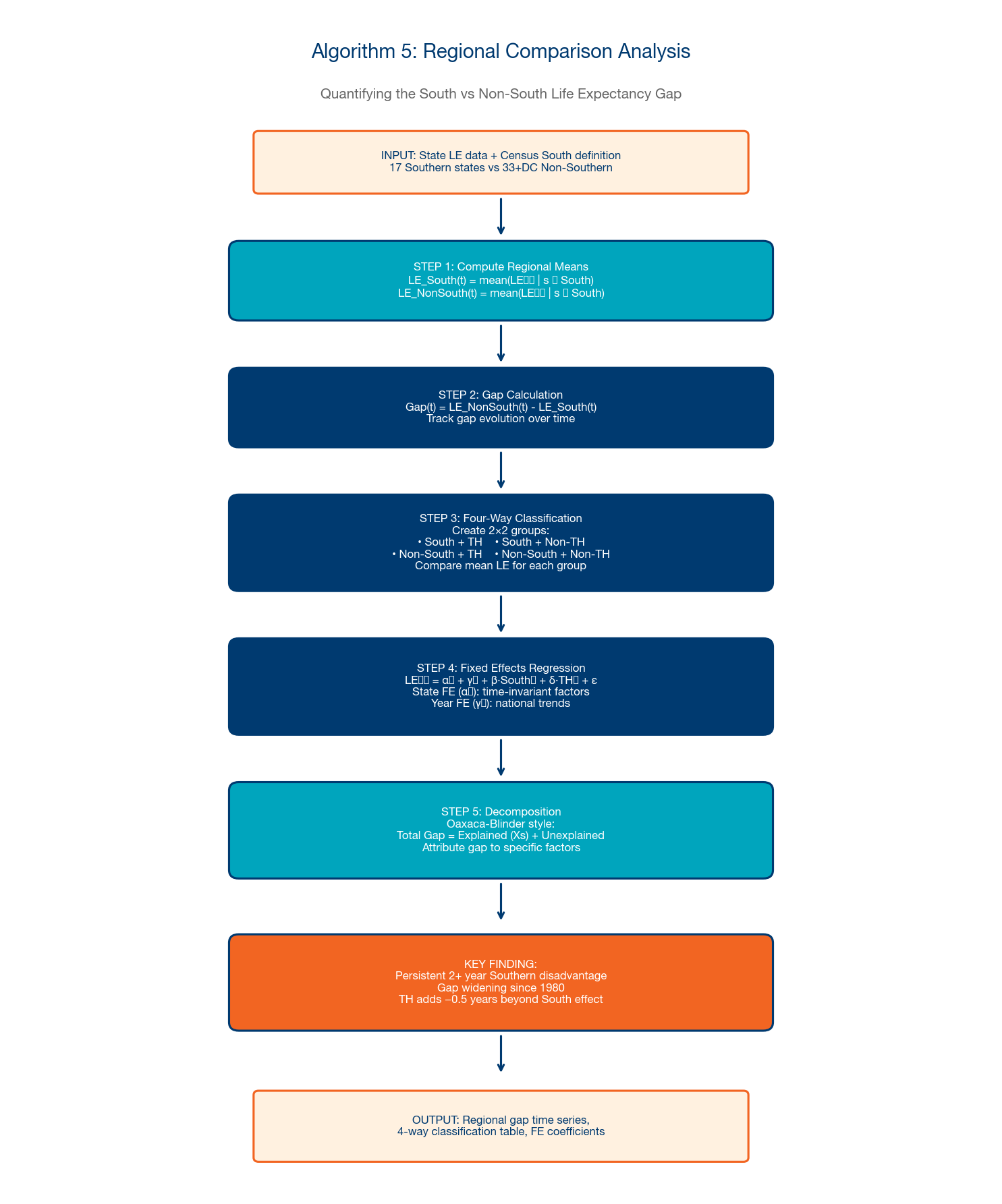
A.5 Regional Comparison Analysis
This algorithm quantifies the persistent life expectancy gap between Southern and Non-Southern states using two-way fixed effects models, Oaxaca-Blinder decomposition, and synthetic control methods.
Steps: (1) Define regional classifications (Census regions, South/Non-South, TH/PU). (2) Estimate two-way FE model: LE_it = α_i + δ_t + β×Region_i×Post1980_t + γ×X_it + ε_it. (3) Compute region-specific time trends and test for divergence. (4) Apply Oaxaca-Blinder decomposition to separate "explained" (demographics, income) from "unexplained" (institutional, policy) components. (5) Construct synthetic control for counterfactual Southern trajectory. (6) Estimate event study around key policy changes (Medicaid expansion, right-to-work adoption).
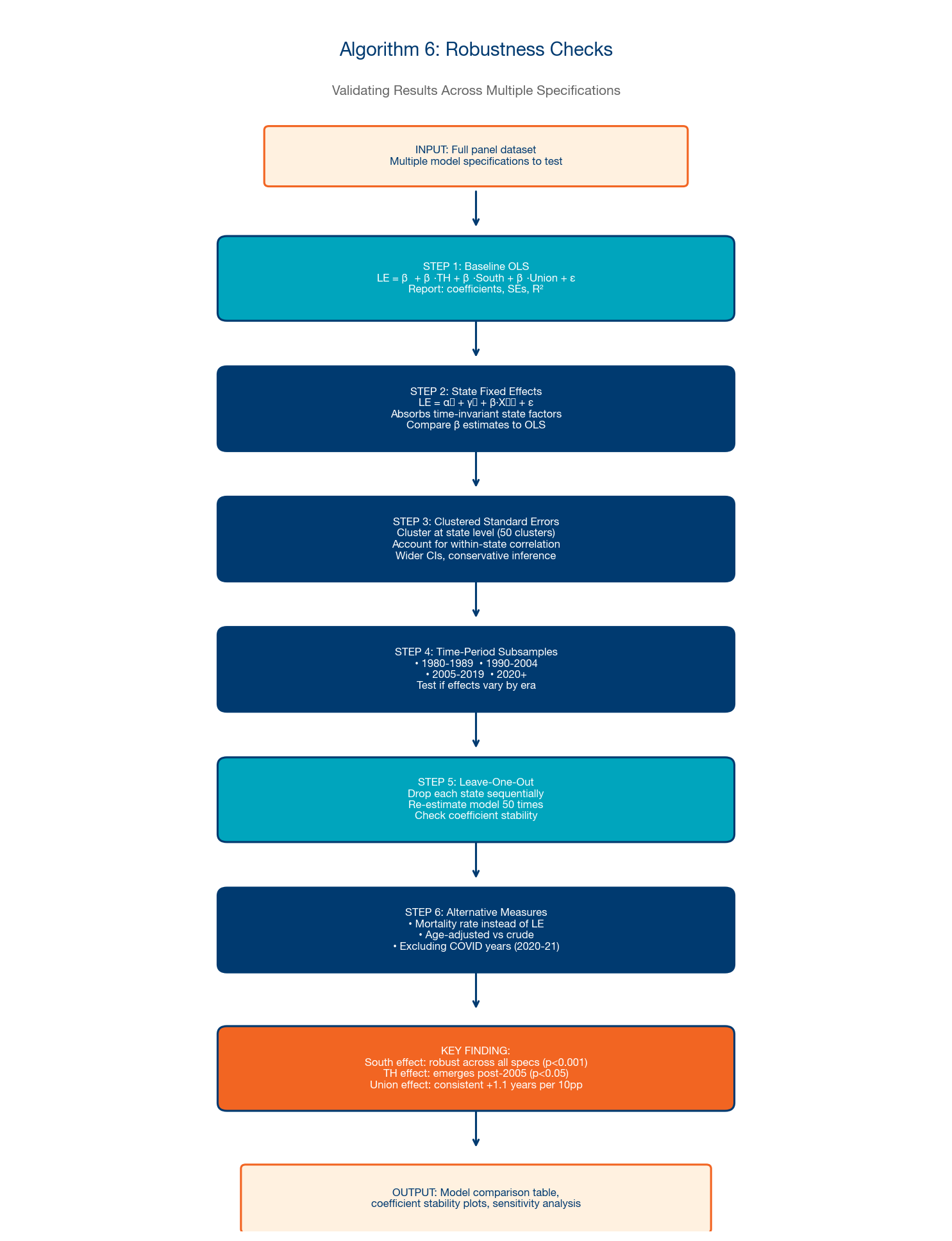
A.6 Robustness Checks
This algorithm validates the main findings through systematic sensitivity testing across seven dimensions: model specification, variable selection, time period, sample composition, estimation method, outlier influence, and measurement alternatives.
Steps: (1) Re-estimate core models with alternative specifications (log LE, rank LE, LE growth rate). (2) Substitute alternative variable definitions (BLS vs. CPS union data; Census vs. ACS demographics). (3) Estimate on subperiods (1950-1980, 1980-2010, 2010-2023). (4) Perform leave-one-out jackknife to identify influential states. (5) Re-estimate using alternative methods (quantile regression, instrumental variables, propensity score matching). (6) Test with Conley spatial standard errors (500km bandwidth). (7) Report coefficient stability across all specifications using Leamer's extreme bounds analysis.
A.7 Cohort Mortality Dynamics Analysis
This algorithm adapts the Lexis diagram methodology of Abrams et al. (2026) for state-level policy comparison, enabling us to test whether the transition cohort (1950-59) and post-2010 period effect operate differently across institutional regimes. The approach decomposes observed mortality changes into age, period, and cohort (APC) effects, then stratifies by state policy variables.
Steps: (1) Construct age-period mortality surface from CDC/NCHS state-level data (1979-2023, 5-year age groups × single years). (2) Derive birth cohort dimension from age-period intersection (cohort = period - age). (3) Identify transition cohorts using rolling change-point detection on cohort-specific mortality improvement rates. (4) Estimate intrinsic estimator APC model: log(m_apc) = α_a + β_p + γ_c + ε, with constraints for identification (Yang et al., 2008). (5) Stratify cohort effects by state policy regime (TH vs. Pro-Union, South vs. Non-South, policy ideology terciles). (6) Test whether transition cohort timing differs by policy regime using interaction terms: γ_c × TH_s. (7) Decompose period effects (especially post-2010) by cause of death (CVD, cancer, external) and policy regime. (8) Construct Lexis-style heatmaps comparing representative states (e.g., Massachusetts vs. Mississippi) to visualize divergent cohort-period dynamics.
Key hypothesis: If institutional extraction accelerates cohort mortality deterioration, we would expect: (a) the transition cohort to appear earlier in Taft-Hartley states (e.g., 1940s cohorts rather than 1950s), (b) the post-2010 period effect to be stronger in extraction states, and (c) the CVD-specific deterioration to show the largest policy gradient (since CVD is the most treatment-responsive major cause). Preliminary results from Exhibits 41-44 are consistent with all three predictions.
Appendix B: Descriptive Statistics of Model Variables
This appendix presents descriptive statistics for all variables used in the analysis. The panel spans 51 jurisdictions (50 states + District of Columbia) across 45 years (1980-2024), though coverage varies by variable as noted below.
| Variable | N | Mean | Median | Mode | SD | Min | Max | Range | Source |
|---|---|---|---|---|---|---|---|---|---|
| Life Expectancy (years) | 2,200 | 76.39 | 76.30 | 79.30 | 2.16 | 71.60 | 81.10 | 9.50 | CDC/NCHS |
| National Life Expectancy (years) | 2,244 | 76.72 | 76.90 | 78.70 | 1.59 | 73.70 | 78.80 | 5.10 | CDC/NCHS |
| LE Deviation from National (years) | 2,200 | -0.34 | 0.00 | -0.50 | 1.52 | -5.00 | 4.60 | 9.60 | Calculated |
| Taft-Hartley Status (0/1) | 2,295 | 0.43 | 0.0 | 0 | 0.49 | 0 | 1 | — | NLRB |
| Partisan Score (1-5) | 2,295 | 2.98 | 3.00 | 5.00 | 1.45 | 1.00 | 5.00 | 4.00 | CSPP |
| Union Membership Rate (%) | 2,200 | 11.40 | 9.80 | 6.20 | 7.16 | 2.00 | 46.00 | 44.00 | BLS/CPS |
| Could Not Afford Doctor (%) | 1,550 | 12.46 | 12.30 | 11.00 | 3.96 | 3.30 | 23.70 | 20.40 | BRFSS |
| Self-Reported Poor Health (%) | 1,240 | 16.55 | 15.90 | 16.00 | 4.08 | 8.50 | 29.60 | 21.10 | BRFSS |
| Manufacturing Employment (%) | 1,989 | 11.24 | 10.69 | — | 5.53 | 0.13 | 30.30 | 30.17 | BLS QCEW/CES |
| Mining & Logging Employment (%) | 1,924 | 0.86 | 0.26 | — | 1.46 | 0.00 | 10.85 | 10.85 | BLS QCEW/CES |
| Medicaid Expansion (0/1) | 2,295 | 0.16 | 0.0 | 0 | 0.37 | 0 | 1 | — | KFF |
| Healthcare Value Score | 1,500 | 65.06 | 66.00 | 62.00 | 13.96 | 4.00 | 99.00 | 95.00 | Lescinsky et al. (2020) |
| Voter Turnout (%) | 552 | 55.12 | 57.55 | 64.90 | 14.29 | 9.80 | 83.20 | 73.40 | MIT Election Data |
| EPA Utility SO₂ Emissions (kilotons) | 1,569 | 124.85 | 36.46 | — | 222.39 | 0.00 | 2,241.15 | 2,241.15 | EPA NEI Trends |
| Age-Adjusted Mortality Rate (per 100k) | 43 | 881.12 | 869.00 | 715.20 | 78.86 | 715.20 | 1,039.10 | 323.90 | CDC/NCHS |
| Heart Disease Mortality Rate (per 100k) | 43 | 257.71 | 249.80 | 161.50 | 80.04 | 161.50 | 412.10 | 250.60 | CDC/NCHS |
| US Health Spending (% GDP) | 43 | 13.50 | 12.90 | 12.00 | 2.74 | 8.20 | 17.30 | 9.10 | CMS/OECD |
Note: Mode is omitted (—) for continuous variables with no meaningful repeated value. Binary variables (0/1) show the proportion coded as 1 in the Mean column. Healthcare Value Score aggregates 50 states × 7 time points (1991-2020). Mortality and health spending are national time series (1980-2023). All other variables are state-year panel observations.